
&imwidth=800&imheight=600&format=webp&quality=medium "When deserts turn white: Saudi Arabia’s snowfall is a climate red flag and a warning that India can't ignore")
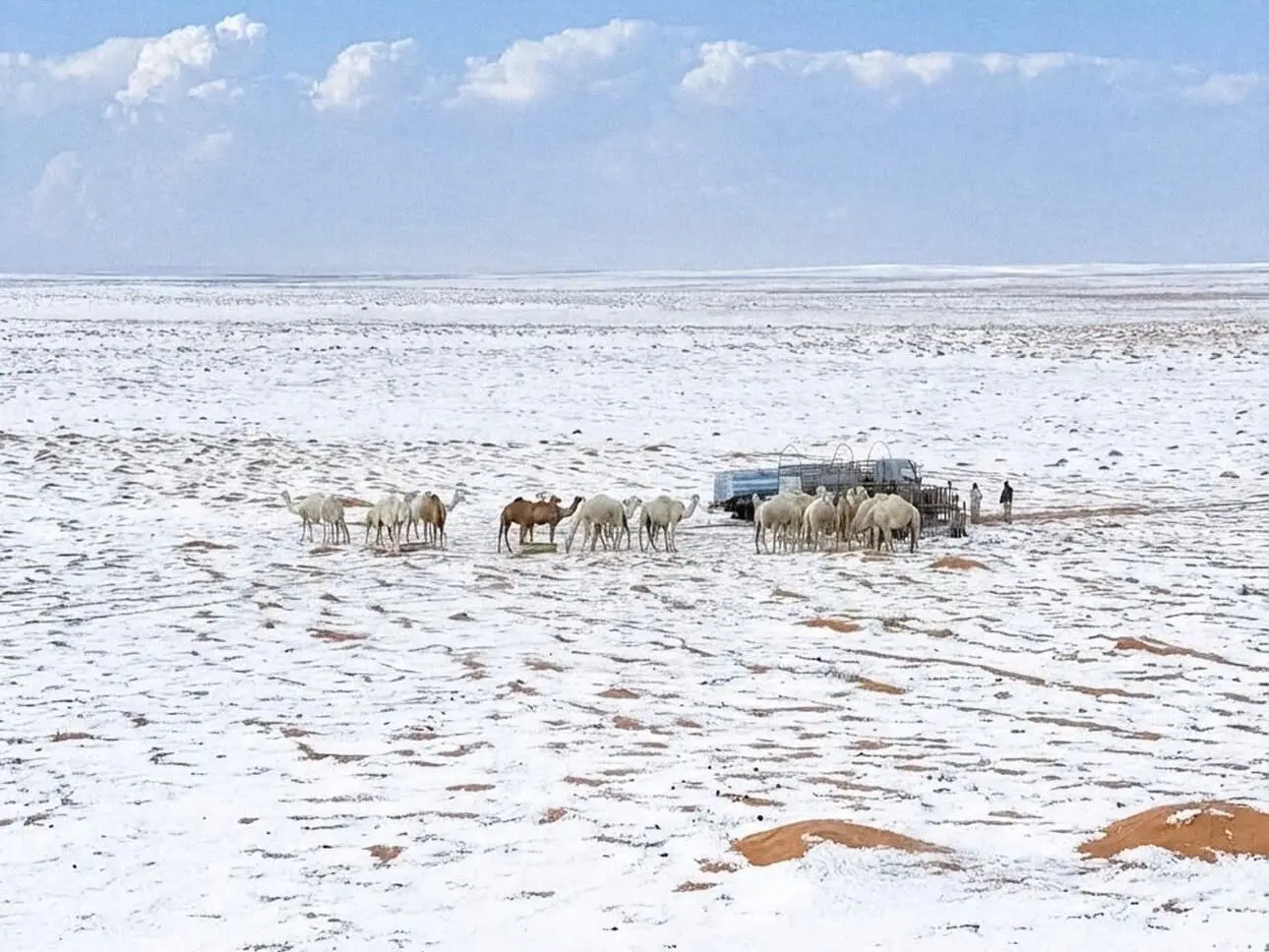
Snowfall in Saudi Arabia is almost unheard of. Yet this winter, parts of the country’s northern belt witnessed scenes more common to Europe than the Arabian desert. Temperatures dropped sharply in regions like Tabuk, and nearby highlands were blanketed in snow, and weather authorities were forced to issue cold-wave alerts. Videos of white-capped dunes and frozen landscapes spread rapidly online. While many marvelled at the spectacle, the images carried a deeper and more troubling message.
Snowfall in one of the world’s hottest regions is not just unusual, it is symptomatic of a planet whose climate balance is rapidly unravelling. The episode underlined a reality scientists have warned about for years: climate change is no longer theoretical. Its effects are unfolding now, often in forms that challenge historical records and regional expectations.

A world of weather extremes
A common misunderstanding is that global warming simply results in rising temperatures everywhere. Climate experts argue otherwise. A warmer planet traps more heat and moisture in the atmosphere, increasing instability and fuelling extreme and unpredictable weather events. This explains why heatwaves, intense rainfall, flash floods, and sudden cold spells are appearing simultaneously across different parts of the world, including regions where such phenomena were once rare.
India experienced this volatility first-hand over the past year. Large swathes of northern and central India endured prolonged and record-breaking heatwaves. Shortly after, cloudbursts and extreme rainfall triggered landslides and floods in Uttarakhand, Himachal Pradesh, and Sikkim. In several areas, the monsoon arrived late and erratically, while elsewhere it turned destructive. These contrasting events are not isolated accidents. Together, they point to a climate system under mounting pressure.
Trending Stories
)
Nigerian Navy discovers 99,000 litres of suspected stolen, illegally refined products as it intensifies anti-crude oil theft operations
)
Man pushes Russian humanoid robot. Watch what happens next
)
Coast Guard jet carrying DHS Secretary Markwayne Mullin makes emergency landing after engine failure
&im=FitAndFill=(700,400))
How the Su-30MKI flies up to 8,000 kilometres using mid-air refueling
)
Trump says he’s ‘happy’ Harry and Meghan left US , calls them disrespectful
)
Chaos in Ukraine's Kyiv: Zelensky calls shootout between spy services 'absolutely shameful'
)
Harry Potter and the Philosophers' Stone: New trailer reveals fresh look at Hogwarts, sorting ceremony and iconic moments to life
)
2,000 pairs of underwear buried in Switzerland revealed something startling
)
Pakistan faces growing hunger crisis amid rising food insecurity
)
Belgium, latest EU state cautioned by India over arms for Pakistan; gets assurances from Brussels
)
Houthis target Yemen with ballistic missiles, Yemeni army downs several drones
)
No selfies with God, no reels inside: Tamil Nadu CM bans smartphones in temples | Gravitas
)
Indian Air Force pilot Abhinandan Varthaman, who shot down Pak fighter jet retires, takes up private job
)
Report: Egypt eyes new Rafale F4 deal amid air force modernisation push
)
Rubio on Modi-Pezeshkian meeting: 'No country should help Iran evade sanctions'
)
WION Exclusive: Hasina says she reads father’s unfinished memoir while planning Dhaka return
&im=FitAndFill=(700,400))
Why the Su-30MKI uses a giant air brake on its back instead of its wings
)
‘This is real’: Hegseth’s post on Canadian military woman sparks controversy
)
Bangladesh batter Towhid Hridoy creates history with 350 not out in South Africa
)
Republican Senator Thom Tillis calls on Trump to fire Pete Hegseth over his 'inept management' of military
)
Beginning of the end? More glacial lake outbursts threaten millions in India, Nepal and China
)
Pentagon just launched its AI portal with ChatGPT, Grok and Gemini
)
Is Trump ending Iran war? 'Operation Fury' naming ends, Hegseth extends troop plan to 2027 as prez appears tired ahead of midterms
)
Trump suggests renaming Strait of Hormuz to ‘Trump Strait’
)
Pakistanis are eating less. What they are eating instead is even more alarming
)
Nepal floods: 1,204 dead, 4,216 missing as tearful relatives pray for the missing
)
EU and NATO step up pressure on Russia after Germany ‘escalation incidents’
)
Husband uses secret camera to record wife’s affair, wins divorce case, ends up in jail for spying
)
At least 2 killed in Minneapolis shooting, suspect also dead
)
Manipur violence: 25 houses torched in Manipur’s Kangpokpi a day after 10 homes were burnt along Imphal-Tamenglong road
)
US Mint releases $1 coins featuring Donald Trump, priced up to $154.50
&im=FitAndFill=(700,400))
Why the glass canopy on the Su-30MKI has a distinct golden tint
)
India to host inaugural 2027 Women's Champions Trophy across Mumbai and Vadodara
Why India cannot ignore this warning
For India, the lesson is not about unexpected snow in distant deserts but about growing vulnerability at home. Agriculture, water resources, cities, and power systems are all built around predictable seasonal cycles. When those cycles collapse, the consequences ripple across the economy and society. Crop losses, urban flooding, water shortages, and heat-related illnesses are already becoming more frequent. This makes climate adaptation no longer optional. India must accelerate efforts in heat-resistant city design, flood-resilient infrastructure, a robust early-warning system, and climate-smart farming practices.
While cutting emissions remains crucial, adapting to a changing climate is now unavoidable. Saudi Arabia’s snowfall should not be brushed aside as an internet oddity. It is another warning sign of a world where weather patterns are growing increasingly erratic and unforgiving. As global temperatures continue to rise, such anomalies are likely to become more common, not less.
A global south crisis
What happened in Saudi Arabia reflects a broader trend across the Global South. Southeast Asia has been battered by persistent floods that have displaced millions. African nations are swinging between prolonged droughts and sudden deluges, devastating agriculture. In South America, abnormal temperature spikes have disrupted ecosystems and strained power grids.
Developing countries are bearing the brunt of this upheaval. High population density, fragile infrastructure, and heavy reliance on climate-sensitive livelihoods mean even short-lived weather shocks can escalate into humanitarian and economic emergencies. These concerns dominated discussions at this year’s COP30 climate summit in Belém, Brazil, where leaders acknowledged that climate impacts are accelerating faster than many nations can adapt. The message, for India and the world, is unmistakable. The climate crisis is no longer approaching. It has already arrived, and it is reshaping life in real time.

