India-Bangladesh mark 54th anniversary of Vijay Diwas. Here's what happened on this day. Know all about it

&imwidth=600&imheight=450&format=webp&quality=medium "India-Bangladesh mark 54th anniversary of Vijay Diwas. Here's what happened on this day. Know all about it")
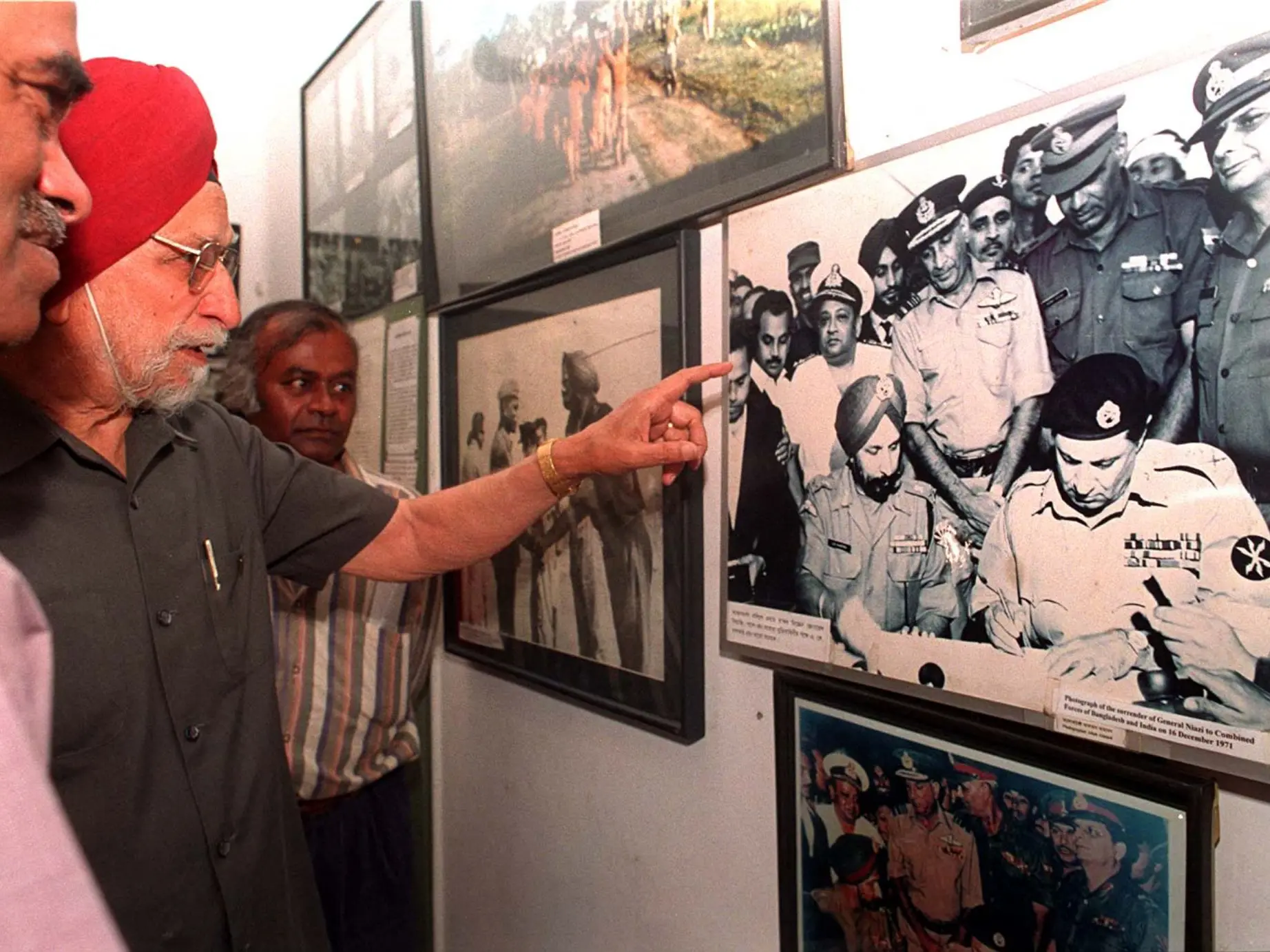
Jagjit Singh Aurora (with red turban), chief of Bangladesh-India Joint Command during Bangladesh's 1971 independence war against Pakistan, points to a photograph during a visit to Dhaka's private Liberation War Museum 21 March. The historic picture shows him sitting with defeated commander of Pakistani army general A. A. K. Niazi signing the surrender document on December 16, 1971. Photograph: (AFP (File Photo)
On December 16, 1971, the Indian armed forces scored a decisive victory over Pakistan, forcing 93,000 Pakistani troops to lay down their arms in Dhaka and leading to the creation of Bangladesh from East Pakistan.
December 16 marks the 54th anniversary of 'Vijay Diwas,' the Indian armed forces' decisive victory over Pakistan, forcing 93,000 of its troops to surrender weapons in Dhaka and splitting the country into two parts. On the east side of India, Bangladesh, carved out of East Pakistan. Bangladesh celebrate the day as Victory Day as the country was liberated from the Pakistani occupation forces on this day in 1971 after a nine-month-long bloodstained War of Liberation.
Indian Prime Minister Narendra Modi, who is on a three-nation visit, remembered the courageous armed forces who fought tooth and nail in the 1971 war that led to the liberation of Bangladesh. He paid tribute to the unmatched spirit of nationalism of the brave soldiers.
"On Vijay Diwas, we remember the brave soldiers whose courage and sacrifice ensured India had a historic victory in 1971. Their steadfast resolve and selfless service protected our nation and etched a moment of pride in our history. This day stands as a salute to their valour and a reminder of their unmatched spirit. Their heroism continues to inspire generations of Indians," he wrote on X.
Commemorating the heroes of the 1971, war, President Droupadi Murmu inaugurated Param Vir Dirgha at Rashtrapati Bhavan.
Banglesh's chief advisor Muhammad Yunus marked Victory Day, the day it gained liberation from West Pakistan, by observing a military parade in Dhaka's National Parade Ground along with the Army chief, chiefs of other wings of the military, senior leaders and government officials.
The president and the chief adviser have paid tributes to the martyrs of the Liberation War by placing wreaths at the Savar National Martyrs' Memorial on the outskirts of the capital at sunrise.
The events that led to the creation of Bangladesh and the Indian Army's decisive victory, prompting the biggest surrender since World War II.
The 1970 election verdict denied
Pakistan’s political crisis began with the December 1970 general election, the country’s first national poll based on adult franchise. The Awami League, led by Sheikh Mujibur Rahman, won a landslide, securing 167 of 169 seats in East Pakistan and an absolute majority in the National Assembly.
Trending Stories
&im=FitAndFill=(700,400)&imwidth=280&imheight=210&format=webp&quality=medium)
&imwidth=280&imheight=210&format=webp&quality=medium)
&imwidth=280&imheight=210&format=webp&quality=medium)
&imwidth=280&imheight=210&format=webp&quality=medium)
&imwidth=280&imheight=210&format=webp&quality=medium)
&imwidth=280&imheight=210&format=webp&quality=medium)
&imwidth=280&imheight=210&format=webp&quality=medium)
&imwidth=280&imheight=210&format=webp&quality=medium)
&imwidth=280&imheight=210&format=webp&quality=medium)
&imwidth=280&imheight=210&format=webp&quality=medium)
&imwidth=280&imheight=210&format=webp&quality=medium)
&imwidth=280&imheight=210&format=webp&quality=medium)
&imwidth=280&imheight=210&format=webp&quality=medium)
&imwidth=280&imheight=210&format=webp&quality=medium)
&imwidth=280&imheight=210&format=webp&quality=medium)
&imwidth=280&imheight=210&format=webp&quality=medium)
&imwidth=280&imheight=210&format=webp&quality=medium)
&imwidth=280&imheight=210&format=webp&quality=medium)
&imwidth=280&imheight=210&format=webp&quality=medium)
&imwidth=280&imheight=210&format=webp&quality=medium)
&imwidth=280&imheight=210&format=webp&quality=medium)
&imwidth=280&imheight=210&format=webp&quality=medium)
&imwidth=280&imheight=210&format=webp&quality=medium)
&imwidth=280&imheight=210&format=webp&quality=medium)
&imwidth=280&imheight=210&format=webp&quality=medium)
&imwidth=280&imheight=210&format=webp&quality=medium)
&imwidth=280&imheight=210&format=webp&quality=medium)
&imwidth=280&imheight=210&format=webp&quality=medium)
&im=FitAndFill=(700,400)&imwidth=280&imheight=210&format=webp&quality=medium)
&im=FitAndFill=(700,400)&imwidth=280&imheight=210&format=webp&quality=medium)
&imwidth=280&imheight=210&format=webp&quality=medium)
&imwidth=280&imheight=210&format=webp&quality=medium)
&imwidth=280&imheight=210&format=webp&quality=medium)
&imwidth=280&imheight=210&format=webp&quality=medium)
&im=FitAndFill=(700,400)&imwidth=280&imheight=210&format=webp&quality=medium)
&imwidth=280&imheight=210&format=webp&quality=medium)
Despite the clear mandate, the West Pakistani leadership, military dictator President General Yahya Khan and Pakistan Peoples Party chief Zulfikar Ali Bhutto refused to transfer power. The indefinite postponement of the National Assembly session triggered mass protests across East Pakistan.
Army crackdown and declaration of independence
On the night of March 25–26, 1971, the Pakistan Army launched Operation Searchlight, a brutal military crackdown aimed at crushing Bengali political resistance. Troops targeted students, intellectuals and Awami League supporters in Dhaka and other cities.
Sheikh Mujibur Rahman was arrested, but before that, Bangladesh’s independence was declared on March 26. A provisional government-in-exile was later formed, while the Mukti Bahini resistance force began guerrilla operations with Indian support.
India enters the war, surrender follows
As violence escalated, nearly 10 million refugees fled into India. After Pakistan launched air strikes on Indian airfields on December 3, 1971, India formally entered the war. Under Prime Minister Indira Gandhi and Army chief General Sam Manekshaw, Indian forces executed a swift eastern campaign.
On December 16, 1971, Lt Gen A.A.K. Niazi surrendered to Lt Gen Jagjit Singh Aurora in Dhaka, with around 93,000 Pakistani troops laying down arms, marking the largest military surrender since World War II and the birth of Bangladesh.