
&imwidth=800&imheight=600&format=webp&quality=medium "Climate change caused Nepal floods, but a 2015 earthquake may have contributed")
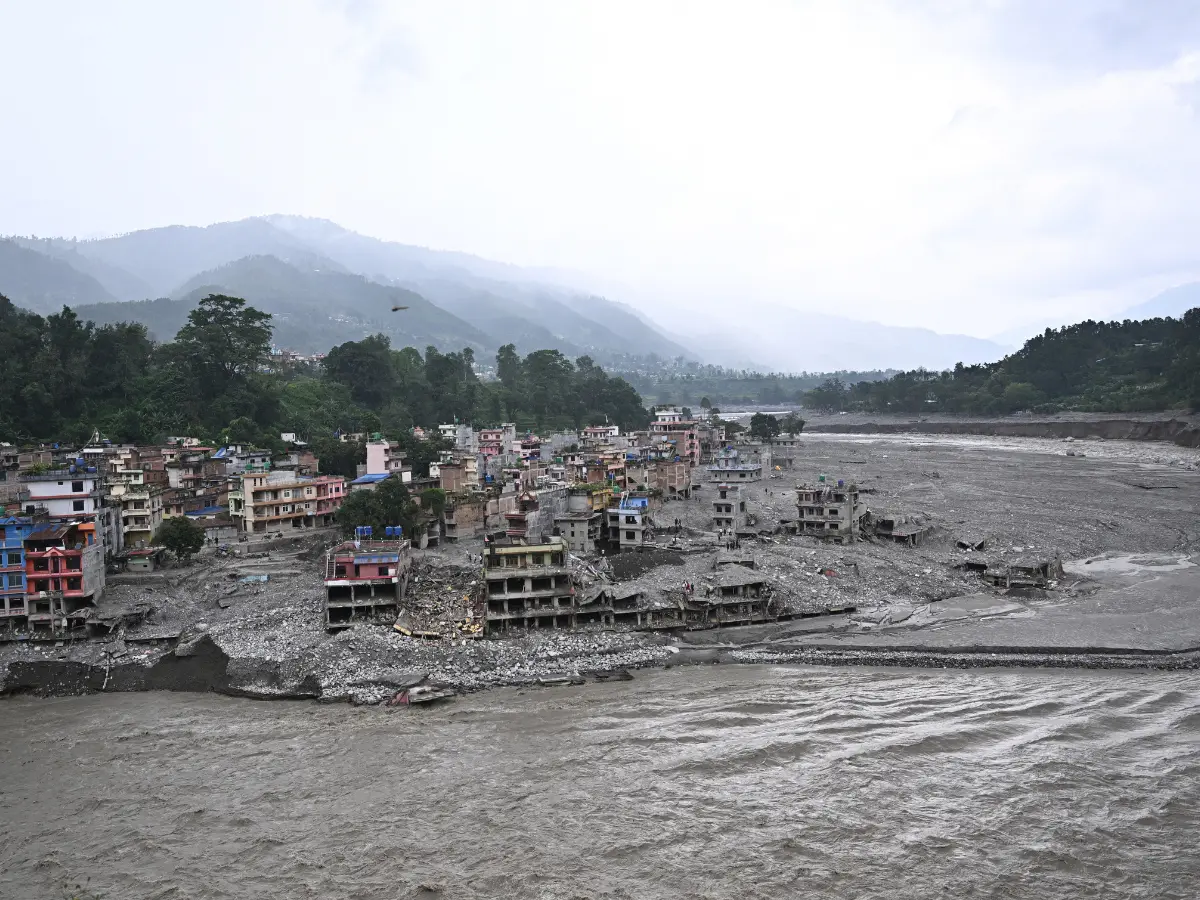
A new study has blamed human-induced global warming for the catastrophic Nepal floods, saying the rising temperatures had thawed permafrost and thinned glacier ice that had been holding the mountainside together for centuries. Led by the World Weather Attribution (WWA), the study states that decades of warming had weakened the slope that collapsed on August 26, setting the stage for a disaster that went beyond the capacity of the existing disaster adaptation systems.
They also found during their course of the study that the freezing line in the Himalayas has been moving up by 100 metres every decade. This is the point above which the ground remains permanently frozen. After the devastating floods killed over 1,300 people in Nepal and Tibet, scientists have been trying to understand what transpired on the day. Every study done so far has blamed climate change for it. Glaciers are melting in the Himalayas, which can cause similar floods in the future.
"Climate warming, as a result of humans burning fossil fuels, is melting ice and snow in the Himalayas, decreasing glacier coverage and thawing permafrost," which destabilises the mountainsides, Bethan Davies, professor of glaciology at Newcastle University, said.

Mechanism of Nepal floods similar to Chamoli disaster
They stated that even though the scale of the disaster was unlike anything seen before, the signs of an imminent threat were always there. Walter Immerzeel, a mountain hydrologist at Utrecht University, told reporters, “The mechanism of the disaster is comparable to what happened in India in Uttarakhand, which is called the Chamoli disaster.”
Comparing the two disasters, the team further said that in the Chamoli incident, the material that flowed down was only a fifth of what was seen in Nepal and the impact was much less, making the Nepal tragedy “unprecedented.”
Trending Stories
)
The Early Spring season 2 is happening, but fans have one request - 'don't change the actors'
)
Saudi vs Houthis: Riyadh claims to have shot Houthi drone targeting Mecca
)
Daayra movie review: Kareena Kapoor, Prithviraj Sukumaran shine in Meghna Gulzar’s cop-versus-cop crime thriller
)
US, China dominate global economy: Where does India rank among the world's biggest economies?
)
Veteran actor Anant Nag honoured with Indian cinema’s highest award
)
Trump calls Canada-EU associate membership plan ‘laughable’ and threatens 'very serious tariffs'
)
800 million years old - Scientists discover 'fingerprints' of supercontinent Gondwana in ancient rocks
)
Saudi Vs Houthis: Yemeni military rebels clash with Houthis
)
India breaks silence on US Russia sanctions bill, 100% tariff threat: ‘Committed to energy security’ for 1.4 billion
)
Bigg Boss 20: Mahhi Vij reveals she lost Yuva role to Kareena Kapoor; 'didn’t work out in my favour'
)
US trade tariff: 100% tariff targets Russian buyers amid trade tensions
)
All Indian goods to get duty-free access to New Zealand
)
Strapped to flight seat with duct tape: Passenger claims no memory of mid-air outburst
)
Katrina Kaif’s postpartum weight is not the problem; your gaze is
&im=FitAndFill=(700,400))
Suriya and Jyothika say ‘I do’ again after 20 years! See their dreamy wedding pics
)
Meghan Markle's phone number leaked from children's WhatsApp group, couple switches Archie and Lilibet's school
)
Trump praises India’s Opium crackdown, hails anti-drug efforts
)
Pakistan boycotts chess match against Israel at Olympiad
)
Pakistan naval vessel returns to harbour with 'severe damage' after collision with Indian warship in Arabian Sea
)
AUS vs SA: Steve Smith still gets 'little flashbacks' from sandpaper gate
)
Hockey: Pakistan urges AHF to move Asian Champions Trophy out of India over security concerns
)
Trump's Iran war faces fresh House rebuke; 7 Republicans join Democrats in push to end conflict ahead of midterms
)
Europe wants a common playbook for security threats, seeks security beyond NATO
)
Shahzad Bhatti Network declared terrorist organisation under UAPA: Govt order
)
Taiwan seeks deeper India ties as direct flights restart soon and chip projects advance
)
Trump gets new power to hit India, China with up to 100% tariffs as US Senate clears Russia sanctions bill
)
Lionel Messi for 2026 Ballon d’Or over Mbappe and Yamal, says Diego Simeone
)
BRICS success stuns White House, Trump targets India with 100% tariff | Gravitas
)
Pakistan: Imran Khan's sons Kasim & Sulaiman claim their father is 'tortured' in jail
)
Alex Saab, ally of Venezuela's Maduro, pleads guilty in US corruption case
)
No Pandya as Auqib Nabi earns maiden ODI call-up; Mayank returns for WI T20Is| check full squads
)
Sydney Sweeney defends provocative ad choice, the internet is still not impressed
)
Fed raises rates for first time in 3 years, Kevin Warsh defies Trump as inflation mounts
)
US Treasury rallies global financial institutions for Op Economic Outcast to isolate Iran
)
Abhishek Sharma rises to No. 2 in T20Is; ENG’s Robinson 3rd after record Pakistan Tests
&im=FitAndFill=(700,400))
New OTT releases this week (September 14-20, 2026): Lust Stories 3, Waiting Hai, Irumudi- 5 new titles coming on Netflix, Prime Video and more
)
Protests erupt over migrant housing plan in Piddington
2015 earthquake could have been a reason as well
They also presented another possibility. In 2015, a magnitude-7.8 earthquake struck the Langtang Lirung mountain on Nepal's northern border, where the glacier collapse occurred this year. This may have weakened the slope that gave way in August. The intense shaking of the ground probably damaged the bedrock and increased the number of fractures. However, there is no proof that this happened, Immerzeel said.
He added that these two factors combined may have had an impact, although they are sure that the changing climate was definitely responsible for the Nepal disaster.
Hotter monsoon months before Nepal tragedy
The researchers further stated that climate change had increased the temperatures in the months of July and August, which were the highest ever recorded in the region. During the monsoon, it was 1.5 degrees Celsius warmer, and the annual temperature had spiked by nearly 2 degrees Celsius.
Professor Friederike Otto of Imperial College London said that even though they did not run a specific attribution model on the Langtang Lirung glacier's thinning, glacier thinning is the only cause of the tragedy that unfolded on August 26.

