Hockey India president Dilip Tirkey breaks silence on team's jersey colour change from blue to saffron

&imwidth=600&imheight=450&format=webp&quality=medium "Hockey India president Dilip Tirkey breaks silence on team's jersey colour change from blue to saffron")
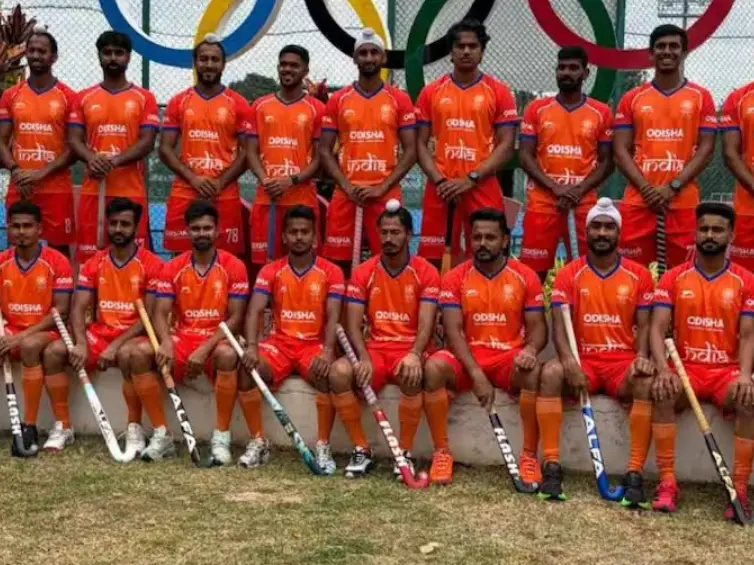
Indian hockey team players Photograph: (Hockey India)
Hockey India President Dilip Tirkey said the switch from blue to orange jerseys was made on the recommendation of players and coaches due to visibility issues on blue turf.
Hockey India President Dilip Kumar Tirkey on Thursday (Jul 30) defended the decision to change the Indian men's and women's hockey teams' primary blue jerseys to orange, saying the move was based on feedback from players, coaches and support staff over visibility issues on blue turf, which made it harder for players to see each other during matches.
The new jersey has sparked debate, with former India captain and Olympian Viren Rasquinha questioning the decision, while Congress MP Priyanka Gandhi Vadra also criticised the change.
Speaking to ANI, Tirkey said that the new jerseys were unveiled ahead of the FIH Men’s and Women’s Hockey World Cups, which begin on Aug 14 and 15 in the Netherlands and Belgium.
“So this time, the orange colour has been chosen. And yes, I accept that for many years, there was a legacy where Team India used to wear blue. We have played many tournaments, many important tournaments wearing blue… even I played wearing blue. But the change that has been made this time–and this is not the first time; in 2014 as well, I think the team wore yellow, and in 2018 too, light blue was used–a suggestion came directly from our coaches, supporting staff, players, and team captains,” Tirkey told ANI.
Explaining the reason behind the change, Tirkey said players and coaches felt the blue jersey reduced visibility because it matched the colour of the turf.
Trending Stories
)
&im=FitAndFill=(700,400))
&im=FitAndFill=(700,400))
)
)
&im=FitAndFill=(700,400))
)
&im=FitAndFill=(700,400))
)
)
)
)
)
)
)
)
&im=FitAndFill=(700,400))
)
)
)
)
)
)
)
)
)
)
)
)
)
)
&im=FitAndFill=(700,400))
)
)
“Their suggestion was that on the field, the hockey turf is blue, and the players’ playing kit was also blue. So technical visibility during play was affected because of that overlap. Somewhere, they were feeling that issue,” he said.
He added that the team suggested two colours , yellow and orange, and orange was chosen because it is one of the colours in the Indian national flag.
“They suggested two colour options: yellow and orange. It was noted that orange is also one of our national colours from the Indian flag. So orange was chosen and designed accordingly. If after the tournament or in the future the players feel otherwise, we can work again on improving the kit colour,” he said.
Tirkey said Hockey India would be open to changing the jersey again if players were not comfortable with the orange kit in the future.
“If after or during the World Cup, the team or players do not feel comfortable with the orange colour–which was introduced based on their own request–we can definitely change it in the future to a colour that the team prefers,” he said.
He further stressed that the decision was driven by technical reasons and player feedback.
“There was a specific request from players and coaches. On blue hockey turf, wearing blue jerseys created visual overlap during fast gameplay, reducing contrast and clarity. Secondly, Orange is represented in our national flag. Out of the two options requested by the squad (orange and yellow), orange was selected,” he said.
“For this World Cup, the orange kit is designated as the primary jersey, with white as the secondary kit. If required later, adjustments can always be made,” Tirkey added.
With inputs from agencies