School management is making huge profit, making tuition fees unaffordable for Indian children

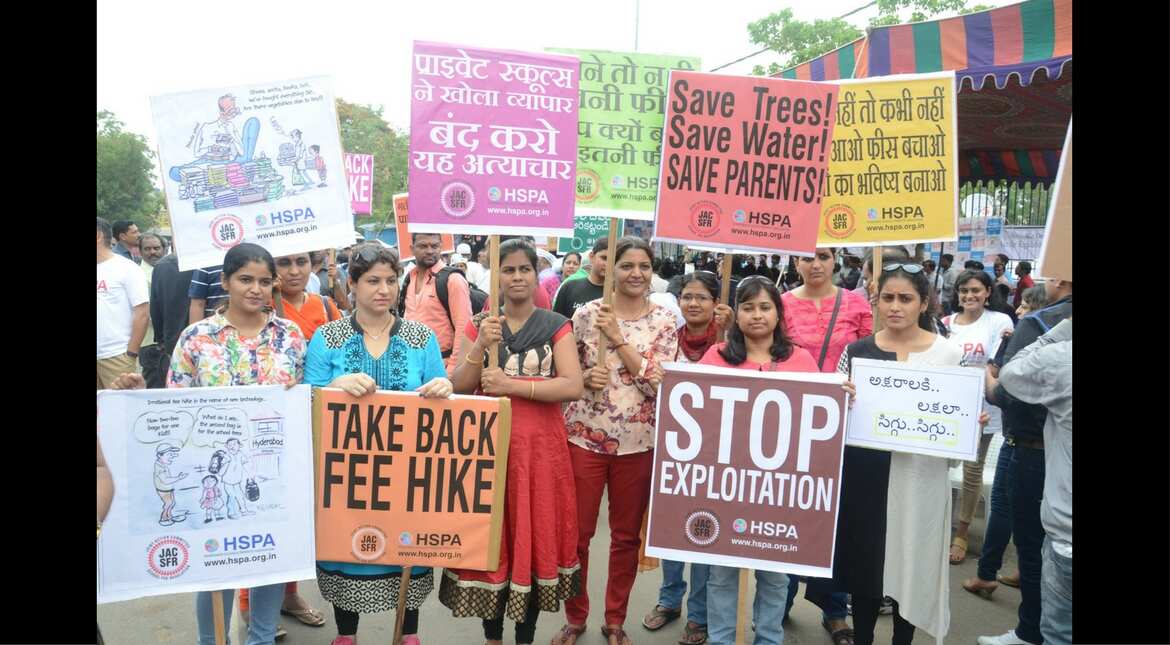
HSPA, the parents? organization in Hyderabad
As investment from dubious foreign sources pour into Indian schools, the tuition fee spikes up to 500%.
Do you know what the latest and most effective means of birth control in India is? Do not be shocked – it is the increasing cost of school education! This is not fake news from a WhatsApp forward but the finding of a survey by ASSOCHAM (Associated Chamber for Commerce & Industry). And you would yourself know the truth of the matterif you have school going children or have interacted with parents of school going children. I have met several couples who'veopted to have just one child instead of two because of “school fees.” I have also met quite a few youngsters who are now afraid of even getting married looking at the astronomical levels to which the school fees is rising.
The essence of it all is that – the increasing cost of school education is a real and grave danger not only to the present but also to the future generations of our nation.
Parents opting for a single child instead of two is just one of the fallout of the steep fee hike. People unwilling to get married is another. However, the worst part of the fee hike is that thegirl child suffers the most. Several parents in the lower income segment who chooseto educate a single child, which more often than not turns out to be the male child at the cost of the girl child.

With school fees having already increased between 150 per centto 500 per centin the last 10 years, we have reached such a stage, where providing good quality education to a single child will soonbecomeunaffordable.
&im=FitAndFill=(700,400)&imwidth=180&imheight=135&format=webp&quality=medium)
‘0-100km/h in 1 second Tesla Roadster’: Why tyre grip becomes a problem when cars accelerate this fast
&imwidth=180&imheight=135&format=webp&quality=medium)
Up to 1 million satellites in orbit? the space race raising questions about who controls space
&imwidth=180&imheight=135&format=webp&quality=medium)
US sanctions Cuban state-owned bank BICSA over alleged financial links to Iran
&imwidth=180&imheight=135&format=webp&quality=medium)
Majid Majidi's new film Midday Meal takes top prize at Asia's biggest film festival
&imwidth=180&imheight=135&format=webp&quality=medium)
Broke Your iPhone Duo? Here’s how much screen repair could cost
&imwidth=180&imheight=135&format=webp&quality=medium)
Russian woman and Bihar boy's love story goes viral after she reaches India to marry him
&imwidth=180&imheight=135&format=webp&quality=medium)
Arijit Singh 9-city India stadium tour to start from January: Check venue and ticket prices
&imwidth=180&imheight=135&format=webp&quality=medium)
Ramayana International trailer out: First glimpse of Kunal Kapoor as Indra Dev in Ranbir Kapoor and Yash starrer
&imwidth=180&imheight=135&format=webp&quality=medium)
Billy Joel's health update: Why the singer can't drive or perform right now?
&imwidth=180&imheight=135&format=webp&quality=medium)
Turkey Floods: Heavy rains flood homes and submerge vehicles in Istanbul
&imwidth=180&imheight=135&format=webp&quality=medium)
Katie Zacharia, White House Press Secretary admits she never passed bar exam amid credentials controversy
&imwidth=180&imheight=135&format=webp&quality=medium)
Ukraine blinded: Musk deflects blame on Trump, Putin sharpens attack | Gravitas
&imwidth=180&imheight=135&format=webp&quality=medium)
Oregon school shooting: 16-year-old identified as suspect after at least four killed, including three children
&imwidth=180&imheight=135&format=webp&quality=medium)
Who is Abu Dhabi royal Mahrah Al Nahyan, found unconscious on London street with toddler after cocaine use
&imwidth=180&imheight=135&format=webp&quality=medium)
US-Iran War: Trump eyes mother of all bombs; Iran in crosshairs

Not Khan but Pal: Why did Imran Khan choose his mother's surname over his father's? Family tree explained
&imwidth=180&imheight=135&format=webp&quality=medium)
Russia-Ukraine War: Putin vows retaliation against Ukraine
&imwidth=180&imheight=135&format=webp&quality=medium)
'Turns out the future does have flying cars': Musk's Tesla unveils 'flying' sports car with SpaceX technology | Watch
&imwidth=180&imheight=135&format=webp&quality=medium)
Australian woman charged for adding snail poison to lover's curry at work
&imwidth=180&imheight=135&format=webp&quality=medium)
Central Park in Delhi shut on October 16, 17 amid CJP's protest call
&im=FitAndFill=(700,400)&imwidth=180&imheight=135&format=webp&quality=medium)
Inside the Peshawar school tragedy: 34 dead, building's condition under scrutiny and owner arrested. Here's what all happened
&im=FitAndFill=(700,400)&imwidth=180&imheight=135&format=webp&quality=medium)
‘No traffic jams for Tesla owners’: How Elon Musk’s new flying car is different from regular cars?
&imwidth=180&imheight=135&format=webp&quality=medium)
‘My president, I mean my husband’: Trump's new press secretary Katie Zacharia's first briefing goes off the rails in 14 minutes
&im=FitAndFill=(700,400)&imwidth=180&imheight=135&format=webp&quality=medium)
World's 7 most innovative countries in 2026 REVEALED: Did India make the list? | In Pics
&imwidth=180&imheight=135&format=webp&quality=medium)
Trump says Zelensky 'not a good guy' amid fresh Russia-Ukraine tensions | Watch video
&imwidth=180&imheight=135&format=webp&quality=medium)
Earthquake measuring 7 magnitude strikes Russia’s Kamchatka Peninsula
&imwidth=180&imheight=135&format=webp&quality=medium)
Was Trump in danger at Alaska rally? Viral video shows Secret Service agents reacting
&imwidth=180&imheight=135&format=webp&quality=medium)
'Will stand with Pakistan in case of war with US': Rajasthan BJP chief's remark sparks row
&imwidth=180&imheight=135&format=webp&quality=medium)
US midterms 2026: FBI investigates suspicious mailings containing 'unknown substance' sent to election offices
&imwidth=180&imheight=135&format=webp&quality=medium)
Abhishek Sharma sets all-time record for most T20I sixes in a year
&im=FitAndFill=(700,400)&imwidth=180&imheight=135&format=webp&quality=medium)
Inside Tesla's Roadster: 10 features of Elon Musk's 'flying car' that push the limits of electric vehicles | In Pics
&imwidth=180&imheight=135&format=webp&quality=medium)
India’s naval priorities: Ex-Navy Chief calls for third aircraft carrier, more warships and submarines
&imwidth=180&imheight=135&format=webp&quality=medium)
Netanyahu defies Trump, blocks Gaza military base for Board of Peace | Gravitas
&imwidth=180&imheight=135&format=webp&quality=medium)
Saudi Arabia executes Two Bangladesh nationals over immoral act
&imwidth=180&imheight=135&format=webp&quality=medium)
Nine former FBI employees fired over investigation into Trump's classified records sue Kash Patel, DOJ over alleged unlawful dismissal
&im=FitAndFill=(700,400)&imwidth=180&imheight=135&format=webp&quality=medium)
Tesla Roadster's thrusters vs rocket engines: What's the difference?
&imwidth=180&imheight=135&format=webp&quality=medium)
Mumbai: CJP brings Tricolour protest to Azad Maidan after weeks of demonstrations
&imwidth=180&imheight=135&format=webp&quality=medium)
'Ukraine must get all it needs to protect civilians and infrastructure': Macron
&imwidth=180&imheight=135&format=webp&quality=medium)
Portland stabbing: Multiple people reportedly stabbed hours after deadly Bend school shooting
Will farmer suicides become passé and parent suicides gain currency? Quite possible - given that such instances have already been reported from some places. At least two suicides in Telangana have been attributed to unaffordable school fees. This should come as no surprise to anyone as Telangana seems to be the worst afflicted state with Hyderabad, the capital of Telangana, being declared the costliest city for school education in India. In fact, Hyderabad is the costliest for school education despite being amongst the most affordable cities to live in.
Parents across India are aggrieved and have started organising themselves into associations. There are agitations, protests, and court cases being filed in almost all cities andstates of India. Some of the national media houses too have started focusing on the issue. However, most of the debates turn out to be the parents’ words vs the schools’ words. While the parents keep on saying that the schools are ‘illegally’ profiteering and are in fact indulging in massive #SchoolFeeLoot, the schools maintain that they are hardly making any money!
What is the truth?
It is important for the truth to be uncovered and for the issue to be resolved. Truth can be easily uncovered if the government were to so decide and order a free and fair probe into l’affaire school fees. However, only one of the 29 states and 7 union territories of India haveordered a probe into the matter. And even in this one case of Telangana, it has been two years since a probe was ordered but nothing has come out till date despite massive protests by the parents there.
Thankfully, the answer seems to have been found even without the government and despite the government by a bunch of ordinary citizens determined to expose the school mafia. HSPA, the parents’ organization in Hyderabad has managed to do what no government or even a court appointed committee could do, i.e. answer these two critical questions on the subject:
1. Are the schools really profiteering? If yes, then to what extent? and
2. How do they manage to by-pass the law which states in unambiguous terms that ‘schools cannot be run as for profit institutions’?
These questions have been answered with full data & proof in form of balance sheets of several schools. Read the ‘interesting’ details in the next part of the article.
How Schools hoodwink the government and by-pass no profiteering law
As written in introduction piece on the subject, the intent of this 3 part article is to basically answer these two critical questions with respect to the issue of school fees:
1. Are the schools really profiteering? If yes, then to what extent? and
2. How do they manage to by-pass the law in India which states in unambiguous terms that ‘schools cannot be run as for profit institutions’?
In the interest of a more logical flow of the article we’ll first answer the second of the questions listed above.
Only Registered Not for Profit Societies get a license to operate a school
It may first be noted that by law, no “For-Profit” Company or firm can get a license to operate a school in India. This is listed out in the EducationAct passed by each state and reinforced by a multitude of judgements passed by various High Courts and also the Supreme Court of India.
Yet, we all know for a fact that profiteering is rampant. We will establish this also with full data andproofs in the concludingpart of this series. For now, first – the modus operandi adopted by schools to hide these profits.
Move money from one pocket (of the education society) to another pocket (subsidiaries / shell companies)
The modus operandi is actually very simple and known to the government but not to the public at large (till now). It is a ‘clever’ form of corporate structuring wherein the license, on paper, remains with the ‘not for profit’ society but the entire management is run or shown as run through a Shell Company / Subsidiary / Subsidiaries opened by the society members themselves. Look at a sample structure given in a research report by Anand Rathi & Company:
-20170628074257.jpg) Research diagram by Anand Rathi & Company (Others)
Research diagram by Anand Rathi & Company (Others)
The diagram depicts -
- A School Trust / Society outsourcing the management to two subsidiaries - one a Management Company and another an Infra Company.
- These two subsidiaries are controlled vide a Holding Company - the owners of which are same as the owners of the Education Society / Trust.
Thus, the money and profits that actually belong to the pocket of school trustare transferred out to the pocket of one or more subsidiaries for private benefit of the society members or the school Trustees.Thus, through compliance with the non-profit requirement, as no profit or a loss is shown in the accounts of the Society, most if not the entire profit is parked in one or more subsidiaries.
There is no end to the number of such subsidiaries that a school can float. There could be:
- One for Land & Building rent
- Second for Facilities & infrastructure management
- Third for Transport management
- Fourth for Food or canteen management
- Fifth for School Teacher management
- Sixth for Books, Stationery, uniform
And so on…
Evidence of such structuring
Above form of structuring is not confined to the paper but can be found in schools across India. HSPA, in its press conference held in June, presented a list of 8 schools structured in this manner.
There are several interesting and shocking aspects that are revealed by a study of schools so structured. Some of the highlights are given below:
1. Complex web of 11 Companies to manage 5 Schools
- Oakridge brand of Schools operating in Hyderabad, Vizag, Bangalore and Mohali seem to have a complex web of 11 companies with one Holding Company and one ultimate holding company to manage the operations of its schools.
2. Investments by Books & Stationery manufacturers in Schools
- School fees is not the only culprit in fleecing parents, the cost of books, stationery & uniform is also a big factor.
- The magnitude of money to be made from books andstationery can be gauged from the fact that Navneet Learning LLP (a reputed manufacturer of books, workbooks, text books and stationery based out of Mumbai) has an investment of Rs. 60 Crores in Gowtham Model Schools in Hyderabad.
3. Foreign Investment by George Soros in Schools.
- George Soros, for those who do not know, is a famed player in the forex markets of the world and is largely credited for triggering the South East Asian currency crisis in the mid 1990’s. He along with Pierre Omdiyar (renowned investor from Silicon Valley) and Google (through a jointly owned company called SONG Investment Advisors) has invested around Rs. 70 Crores in K-12 Techno Services Pvt. Ltd that manages a chain of budget schools by name of Gowtham Model Schools in Hyderabad.
4. Investments in schools from Tax Havens like British Virgin Islands
As if investments form George Soros was not enough, you can find money coming into schools from companies based out of British Virgin Islands that are famous for being a Tax Haven of the world with its opaque banking system.
- The GIIS – Global Indian International Schools having schools across India is managed again through a web of subsidiaries with their holding company Global Indian Holdings PvtLtd. Based in Singapore and the ultimate holding Company Global Indian School Holdings Ltd. based in British Virgin Islands.
- Indian Cricketer Chandu Borde is closely associated with this chain of schools and is director in many of the subsidiaries.
Thus, we can see clearly the sly manner of structuring school operations that renders useless any regulatory requirement of ‘non-profit’ operations that the government or the courts of India may want to enforce on the schools.
It is ironical that a sector that is supposed to be run purely on a ‘not-for-profit’ basis has foreign money invested in it that too from dubious sources such as British Virgin Islands and currency speculators like George Soros. Obviously, Soros and other private equity or venture capitalists are not investing in schools for charity or for ‘service to society’. They are doing so to make money – make lots of money! How much money exactly - we shall see in the concluding part of the article with balance sheets of schools presented as proof.