ISRO 2023 Rewind - 8 Rockets and a Spaceplane deliver streak of successes

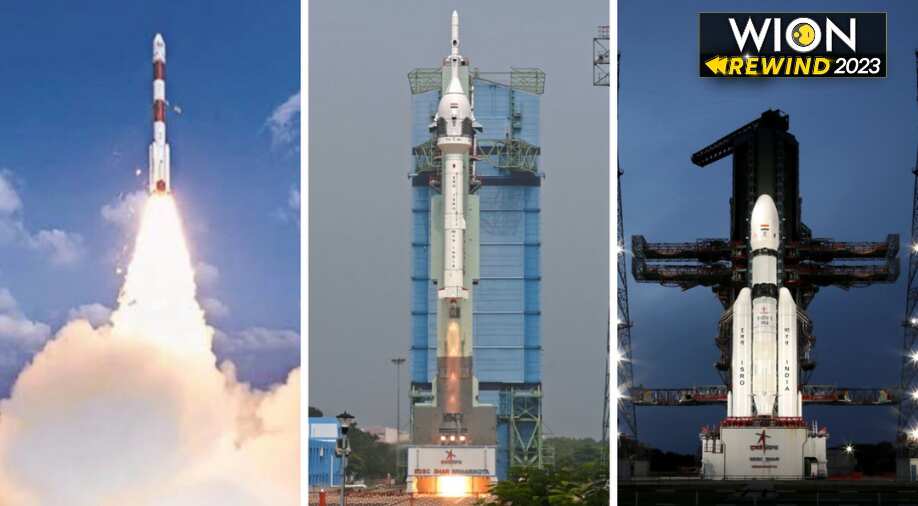
ISRO rockets
Not many space agencies or private firms operate a diverse fleet of four rocket variants, where each one of them belongs to a different era and uses technologies of varying complexity. The year 2023 saw all of ISRO's four launch vehicles (SSLV, PSLV, GSLV, and LVM3) and the lone Spaceplane (RLV-TD) perform their respective tasks with utmost perfection.
This is a laudable feat that showcases ISRO's ability to spring back from failures, undertake course corrections, and deliver on the job, given how two of these rockets(SSLV and GSLV) had not delivered successes in the previous year or two. Here's a look at some of the significant feats of ISRO in 2023:
SSLV-D2/EOS-07 Mission

In August 2022, the maiden mission of India's smallest and newest rocket SSLV had failed, shortly after the vehicle reached space and could not inject its satellites in the desired orbits. Owing to sensor and software issues, the satellites were injected into unsustainable orbits closer to the Earth, thereby leading to a situation where none of the satellites were usable. While the major stages of the rocket performed as expected, the error at the fag end of the mission proved too costly.
Learning from the wealth of flight data gathered during the maiden flight, ISRO performed the second launch of SSLV in February, delivering a successful mission that injected its three passenger satellites (EOS-07, Janus-1, and AzaadiSAT-2) into the desired orbits.
With this launch, ISRO established the capability of the newest vehicle in its fleet, one that the Indian space agency pins a lot of hope on. Given its simple architecture, easy-to-assemble nature, and industry-friendly manufacturing processes, the SSLV is a rocket that is purpose-built for quick deployment for national and commercial purposes.
)
'Lot of things to learn from experienced players': Jayasuriya backs Rohit, Virat for 2027 ODI World Cup
&im=FitAndFill=(700,400))
Kareena Kapoor birthday special: Inside her net worth, best movies, luxurious lifestyle and love story with Saif Ali Khan
)
Trump says he'll build an 'AI Force' and appoint a czar, for 'high IQ' people only
)
Punjab man consumes poison outside DC office; Congress, BJP target AAP government
)
SNL UK takes aim at Ed Sheeran with AI Princess Diana sketch
)
Iran sets 7 conditions to end war with US: What are Tehran’s demands?
)
AI actress Tilly Norwood glitches mid-interview, switches from English to Chinese | Watch
)
Mahabharat actor Saurav Gurjar arrested in Hyderabad, sent to 14-day judicial custody in sexual exploitation case
)
Chancellor Friedrich Merz vows to stay on as exit polls signal major poll setback
)
J&K Assembly Session begins amid chaos: BJP, ruling alliance clash as statehood demand dominates
)
Taylor Swift has a 'proud wife' moment as Travis Kelce scores first touchdown of season: 'That’s my husband!'
)
'Were you here to sell chickpeas?': Wasim Akram criticises Babar Azam's captaincy
&im=FitAndFill=(700,400))
New OTT releases this week (September 21-27, 2026): Shaque: Trust No One, Hunkkaar, Don’t Be Shy- 5 new titles coming to Netflix, Prime Video and more
)
Noel Tata challenges Chandrasekaran’s reappointment as Tata Sons chairman. What happened at the board meeting
)
Italy moves to ban face veils in schools as Meloni pushes new integration measures
)
TIFF 2026: Theja Rio’s Angh wins Platform Prize, puts Nagaland story on global stage
)
Delhi: Flagged voters remain on the draft roll but face hearings
)
Saudi Arabia exits China-led mBridge digital currency platform amid Saudi-Houthi conflict
)
40-foot waves crash into cruise ship in dangerous stretch near Antarctica. Watch
)
Jailer 2: Vidya Balan joins Rajinikanth's upcoming film as Kantha | Watch
)
‘0% chance’: Nvidia CEO Jensen Huang dismisses AI extinction fears by 2030
)
Samsung raises Galaxy S26 prices by Rs 20,000: Here’s what each model now costs
)
Bessent meets China’s He Lifeng to prepare for Trump-Xi summit
)
CDU suffers historic defeat in eastern Germany as AfD surges, Merz vows to stay on
)
China now makes advanced memory chips without the machines it was banned from buying
)
Arvind Kejriwal, family members, Delhi CM Rekha Gupta get SIR notices
)
Trump-Xi summit: US Treasury Secretary holds meeting with Chinese Vice Premier
)
Fleming's aspirations as England Test coach include WTC, top ranking and Ashes
)
Saudi vs Houthis: Houthis claim missiles & drones used in attack on key Saudi sites
)
Delhi Air pollution: Strict crackdown on waste burning
)
Apple reportedly building AI server with M8 Ultra chips, may use Nvidia technology
&im=FitAndFill=(700,400))
What TSMC's 2nm technology means for Apple
)
Glitch in the matrix caught on camera: Woman vanishes after talking to reporter
)
Several petrol pumps, other businesses to refuse UPI payments above Rs 2,000 from Oct 16: Is it legal?
)
AI kill switch explained: Why shutting down a dangerous AI may not be as simple as pressing a button
)
Microsoft executive called AI training the ‘largest theft of labour in human history’
)
Pilot recreates Mona Lisa in sky over Oklahoma and Arkansas in four-hour flight: VIDEO
)
US ships in Indian Ocean ‘will be attacked’ if war resumes, warns Iran
)
Samay Raina-Mukesh Chhabra controversy explained: What happened over girlfriend joke on India's Got Latent?
)
Putin's United Russia party wins 355 seats in Duma election; 4 other parties cross threshold to enter parliament
)
S Jaishankar, former Army chief among high-profile names issued Delhi SIR notices
LVM3 M3/ OneWeb India-2 Mission
By carrying out its second commercial mission, the LVM3 rocket enhanced its track record by delivering its sixth success in a row. Performed in March, this was a repeat mission of the October 23rd launch, where it orbited 36 satellites of the UK-based firm OneWeb (now Eutelsat OneWeb).
Notably, these are the only missions that LVM3 has undertaken to Low earth orbit(roughly 400-2000kms above the earth).
Until these missions, LVM3 hadundertaken only single-satellite ferrying missions to Geosynchronous Transfer orbits (roughly 170x36000kms).
Also Read |ISRO 2023 Rewind - To the Moon and back, in preparation for Chandrayaan-4
Delivering 36 satellites is a sophisticated feat that requires re-orientation to ensure that each of the satellites is delivered into their specific slots and is done at precise time intervals to avoid the risk of collisions.
This feat by the Cryogenic Upper stage of the rocket proves its mettle to undertake a wide range of missions. By accomplishing twin commercial missions using the LVM3, ISRO's commercial arm is estimated to have earned $125mn or Rs.1000 crores.
RLV-TD Spaceplane
Only the US and China are known to operate spaceplanes, a reusable aerospace vehicle that can glide and land on an airstrip, while within the earth's atmosphere and manoeuvre like a spacecraft, when in space.
These spaceplanes are launched into space by being mounted atop rockets. In the coming years, India could be the third nation with a fully operational spaceplane, thanks to ISRO's Reusable Launch Vehicle (RLV).
Also Read |ISRO's 60th PSLV rocket to lift off with XPoSat on January 1
Spaceplanes are strategic assets with significant military applications and potential space warfare capabilities. Much of the activities of operational spaceplanes remain shrouded in secrecy and are broadly referred to as some form of research activity.
In April, the RLV-TD (a smaller prototype of the spaceplane) completed an autonomous landing on an airstrip, after being dropped from an altitude of 5kms, by an Indian Air Force heavy-lift chopper.
The precise autonomous landing on the runway centreline is a milestone feat, given how the spaceplane makes the landing approach at speeds much higher than fighter aircraft. After a few more years of trials, India can hope to have a full-sized spaceplane that can be used to ferry cargo or satellites to space and carry out very sophisticated strategic missions.
GSLV-F12/NVS-01 Mission
In August 2021, minutes before placing a crucial strategic-use satellite(GISAT-1) in orbit, the GSLV rocket suffered a malfunction in its final stage (cryogenic engine), thereby leading to the loss of an expensive satellite, that was expected to provide unprecedented capabilities in monitoring India's frontiers.
Throughout 2022, ISRO did not fly the GSLV rocket. Meanwhile, ISRO carried out multiple technical tweaks and tests to ensure the rocket's ideal performance.
In May 2023, the GSLV precisely orbited the next-generation Navigation satellite NVS-01 and put the apprehensions to rest, thereby validating the extensive work that ISRO had carried out on perfecting this rocket and its performance. Notably, it is this GSLV rocket that ISRO has spent most time and effort in amending to perfection. Of all the rockets in ISRO's fleet, the GSLV has earned the "naughty boy" reputation for having been so hard to tame.
While there have been mentions of GSLV's retirement, it certainly won't fly into the sunset without accomplishing several more missions, including the NASA-ISRO Synthetic Aperture Radar (NISAR) launch and multiple launches of the Indian spaceplane.
LVM3 M4 - Chandrayaan-3
In a perfect launch on a sweltering afternoon in mid-July, the LVM3 soared to the skies carrying the Lunar soft-landing hopes of 1.4 billion Indians.
These are hopes that were dashed at the time of the failed landing attempt in September 2019. In almost 17 minutes, the LVM3 had performed its task and injected Chandrayaan-3 in a perfect orbit, thereby offering what was a great start to the circuitous, 40-day journey to the Lunar touchdown.
Just as the autonomous Lunar landing sequence of the moon lander is described widely as "minutes of terror", the launch mission is also quite a tense experience.
Once the rocket lifts off, the entire sequence is autonomous and the only human intervention (if at all it arises) would be to hit a kill switch and self-destruct the rocket, if things aren't going well. With the launch of Chandrayaan-3, LVM3 bolstered its success rate, thereby making it seven successive successful missions for the vehicle, which is also being re-purposed (human-rated) for the Indian astronaut mission Gaganyaan.
PSLV (TeLEOS-2, DS-SAR, Aditya-L1)
Of the three missions carried out by the PSLV in 2023, two were commercial missions that ferried Singaporean satellites as primary customers. As has become routine, the 30-year-old PSLV aced the missions and raked in the revenue for NSIL, ISRO's commercial arm. Continuing with its legacy of having successfully launched India's maiden Moon and Mars missions, the PSLV also launched India's maiden sun-study mission Aditya-L1. With only two failures in a total of 59 missions, PSLV has set a standard for ISRO and this track record explains why it remains a vehicle of choice for a wide range of missions.
TV-D1
Based on the legacy liquid-fuelled rocket Vikasthat powers key stages of the PSLV, GSLV, and LVM3 rocket, ISRO built a smaller vehicle known as Test Vehicle. This Test Vehicle (TV) is a purpose-built mini rocket that ISRO has designed for carrying out and demonstrating various scenarios and technologies that are a pre-requisite for its future missions.
In October, during its maiden flight, the test vehicle was meant to test the in-flight abort system of the Gaganyaan crew module that is eventually meant to ferry Indian astronauts to space and return them safely. The TV-D1 flight was pre-programmed to shut down at a predetermined altitude and speed, thereby triggering the ejection system(crew escape system) that would separate the empty crew capsule from the rocket that it is seated atop.
By shutting down the TV-D1 rocket in time (pre-planned rocket failure) and successfully demonstrating the Crew Escape System, ISRO ended the year on a high.
