It will be 'hell': Earth might turn into Venus some day, greenhouse effect simulation shows

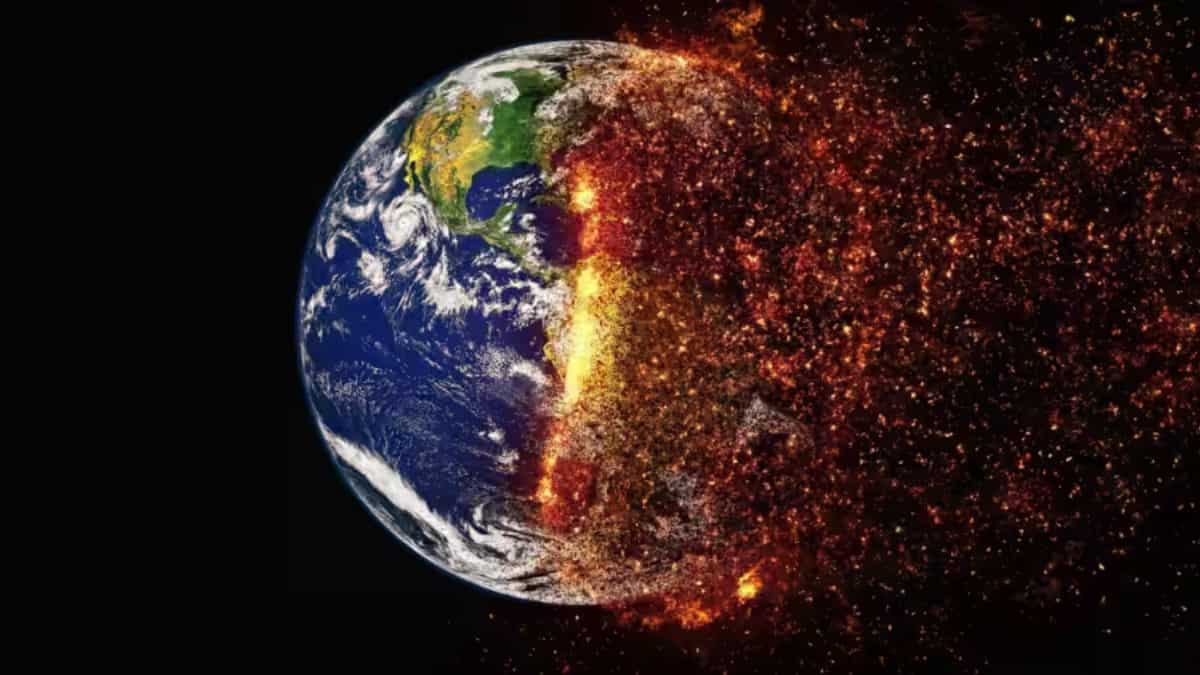
Global warming (Representative image)
Researchers for the first time have simulated all stages of a runaway greenhouse effect and found that our green and blue planet will turn into an uninhabitable “hell” in the coming centuries.
A team of astronomers on Monday (Dec 18)said that it would take only a couple of degrees of rise in Earth’s temperature or a slight increase in the Sun’s luminosityto initiate an “irreversible” runaway warming, making it as inhospitable as Venus whose average surface temperature is around 464 degrees Celsius.
What was the research about?

A team of astronomers from the University of Geneva (UNIGE), with support from France’s CNRS laboratories in Paris and Bordeaux, said that they were the first ones to simulate all stages of a runaway greenhouse effect, the results of which were published in the Astronomy and Astrophysics review.
ALSO READ |COP28 summit kicks off with breakthrough climate disaster fund agreement
The greenhouse effect is the process through which certain gases including water vapour in Earth’s atmosphere trap the Sun’s heat. While some of these gases occur naturally, others are generated by human activity like burning of fossil fuels such as coal, oil and gas.
&imwidth=180&imheight=135&format=webp&quality=medium)
IND-W vs ZIM-W, 2nd ODI: Harmanpreet Kaur, Vaishnavi Sharma star in India's 121-run win
&im=FitAndFill=(700,400)&imwidth=180&imheight=135&format=webp&quality=medium)
What is the real meaning behind Pete Hegseth's tattoos?
&imwidth=180&imheight=135&format=webp&quality=medium)
Telangana unveils AI avatar of IT minister D Sridhar Babu at Hyderabad DevFest 2026
&imwidth=180&imheight=135&format=webp&quality=medium)
'This is humiliation': Vijay Deverakonda under fire over controversial marriage proposal remark on Koffee With Karan 9
&imwidth=180&imheight=135&format=webp&quality=medium)
Pahalgam, Gulmarg record season’s first sub-zero temperatures as winter chill intensifies in Kashmir
&imwidth=180&imheight=135&format=webp&quality=medium)
Govinda breaks silence on divorce rumours with Sunita Ahuja, calls her his first love
&imwidth=180&imheight=135&format=webp&quality=medium)
Indian embassy warns nationals in Saudi Arabia against filming missile strikes
&imwidth=180&imheight=135&format=webp&quality=medium)
Can Putin cheat death? All about his daughter’s billion-dollar quest for immortality
&imwidth=180&imheight=135&format=webp&quality=medium)
Saudi says debris fell in Mecca, Medina after missile interceptions; Houthis deny targeting holy cities
&imwidth=180&imheight=135&format=webp&quality=medium)
Netanyahu warns Israelis of ‘existential threat’ from Iran, posts AI image of nuclear strike
&imwidth=180&imheight=135&format=webp&quality=medium)
Trump revives ‘shithouse countries’ slur, targets Abdul El-Sayed and Ilhan Omar at Georgia rally
&imwidth=180&imheight=135&format=webp&quality=medium)
Pakistan airline PIA unveils new crew uniforms, faces online criticism
&imwidth=180&imheight=135&format=webp&quality=medium)
Kerala judge's 17-year-old son allegedly driving Mercedes kills scooter rider
&imwidth=180&imheight=135&format=webp&quality=medium)
'Already tired of his 9-to-5': Baby born with a moustache becomes internet sensation, video goes viral | Watch
&imwidth=180&imheight=135&format=webp&quality=medium)
Bigg Boss 20: Rohit Shetty indirectly reacts to firing at his Mumbai home
&imwidth=180&imheight=135&format=webp&quality=medium)
Tiger Shroff’s team calls report on actor’s reaction to Mumbai attack ‘completely untrue’
&imwidth=180&imheight=135&format=webp&quality=medium)
Russia-Ukraine drone attacks kill 6, injure 31 across both countries
&imwidth=180&imheight=135&format=webp&quality=medium)
'I promised Gautam & Kotak Sir that...': Tilak Varma opens up on match-winning mindset against NZ
&imwidth=180&imheight=135&format=webp&quality=medium)
‘Saddam Hussein opened a cheesecake factory’: Obama mocks Trump’s White House renovations; defends Abdul El-Sayed
&imwidth=180&imheight=135&format=webp&quality=medium)
Anthropic's leaked AI bill would act only at 50 deaths or $1bn in harm
&imwidth=180&imheight=135&format=webp&quality=medium)
China's dancing robot turns violent bodyguard, lifts cars and fights intruders - Watch
&im=FitAndFill=(700,400)&imwidth=180&imheight=135&format=webp&quality=medium)
Why do some fighter jets have two engines while others use one?
&imwidth=180&imheight=135&format=webp&quality=medium)
Byeon Woo Seok makes first public appearance as Sung Jin Woo for Solo Leveling at Netflix Korea’s 10th anniversary event
&im=FitAndFill=(700,400)&imwidth=180&imheight=135&format=webp&quality=medium)
New Friday OTT releases (October 23, 2026): Gajab Raat, Dorothy, Chaar Yaar- Watch these 6 new movies and TV shows on Netflix, Prime Video and more
&imwidth=180&imheight=135&format=webp&quality=medium)
'Clear overkill': Putin rejects claims Russia is behind mass protests in Europe
&imwidth=180&imheight=135&format=webp&quality=medium)
'If it was up to me, it wouldn't have ended like this': James Anderson opens up on Lancashire exit
&imwidth=180&imheight=135&format=webp&quality=medium)
‘Do I make a deal or finish them off’: What Trump said on resuming Iran strikes
&imwidth=180&imheight=135&format=webp&quality=medium)
Javed Akhtar backs Rashmika Mandanna after Koffee With Karan 9 accent trolling, calls out ‘linguistic superiority’
&imwidth=180&imheight=135&format=webp&quality=medium)
WATCH | Langur walks into Odisha repair shop, hugs shopkeeper; internet reacts to heartwarming video
&imwidth=180&imheight=135&format=webp&quality=medium)
Nagpur man fails to pay rent, allegedly prints fake Rs 500 notes worth Rs 37 lakh
&imwidth=180&imheight=135&format=webp&quality=medium)
Venezuelan opposition leader María Machado returns home after over 10 months in exile
&imwidth=180&imheight=135&format=webp&quality=medium)
‘Modi ka baap bhi jayega,’ Kharge loses cool at party event in Patna; BJP slams him
&imwidth=180&imheight=135&format=webp&quality=medium)
Why Europe’s protests are about more than austerity and rising costs
&imwidth=180&imheight=135&format=webp&quality=medium)
Kim Kardashian, Kris Jenner turn heads with Bold looks at All’s Fair season 2 premiere in Rome
The runaway greenhouse effect is when solar irradiation increases to a point that it sets off a dramatic, snowballing rise in a planet’s temperature.
The idea of a runaway of the greenhouse effect is not new and climate change is not the same as a runaway greenhouse process, but researchers warned that Earth was not far from the “apocalyptical scenario”.
The runaway greenhouse effect envisions a planet evolving from a temperate state like the one currently on Earth to one with surface temperatures of above 1,000 degrees Celsius.
For this study, scientists “demonstrated that from initial stages of the process, the atmospheric structure and cloud coverage undergo significant changes, leading to an almost-unstoppable and very complicated to reverse runaway greenhouse effect".
What would cause the Earth to turn into ‘hell’?
While the research, in part, was designed to provide a tool for studying the climate on other planets, particularly those outside our solar system or exoplanets in order to determine their potential for hosting life, it also provides an insight into what Earth may look like in the centuries to come.
ALSO READ |Global warming has upped Greenland glacier melting five-folds in 20 years
The researchers noted that a small amount of greenhouse effect is necessary to keep the Earth’s average temperature below the freezing point of water, without which it would turn into an ice-covered ball hostile to life.
However, too much of it increases the rate of evaporation of oceans which also raises the amount of water vapour in the atmosphere and traps heat like a rescue blanket.
“There is a critical threshold for this amount of water vapor, beyond which the planet cannot cool down anymore,” said Guillaume Chaverot, former postdoctoral scholar at UNIGE and main author of the study, in a statement.
“From there, everything gets carried away until the oceans end up getting fully evaporated and the temperature reaches several hundred degrees,” Chaverot added.
One of the most important and rather surprising aspects of the study was the observation of an odd cloud pattern.“From the start of the transition, we can observe some very dense clouds developing in the high atmosphere,” said Chaverot.
This dense cloud pattern appearing in the high atmosphere increases the runaway effect and makes the process irreversible.
The study comes as countries across the world are attempting to cap Earth’s warming to 1.5 degrees Celsius by 2050.
(With inputs from agencies)