Extreme orbit of a star moving at 25,000 kmps drags into spacetime near Sagittarius A*

&imwidth=600&imheight=450&format=webp&quality=medium "Extreme orbit of a star moving at 25,000 kmps drags into spacetime near Sagittarius A*")
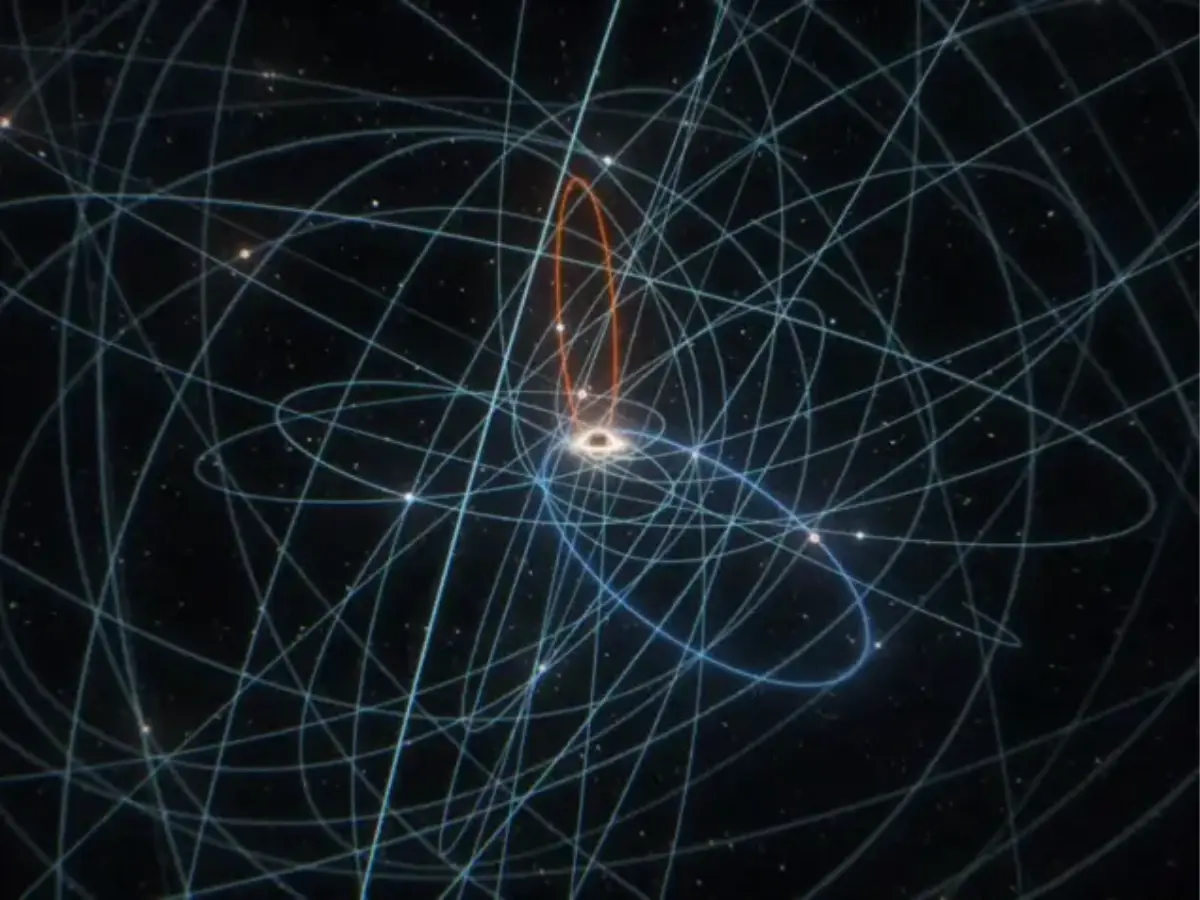
Sagittarius A* at the centre, orbit of S301 in red, and the orbits of all known stars around the supermassive black hole. Photograph: (Max Planck Institute for Extraterrestrial Physics)
A star moving at more than 25,000 km per second around Sagittarius A*, our supermassive black hole, is turning into a special probe to study the galactic centre. S301 was once a binary, but the black hole likely threw away its companion.
Astronomers have detected a fast-moving star near the Milky Way's supermassive black hole, which is moving at a whopping 25,000 kilometres per second, which is 8.5 per cent of the speed of light. The discovery by the Max Planck Institute for Extraterrestrial Physics has been described in a paper published in Nature. S301 completes one orbit around Sagittarius A* in 8.7 years. It touches the top velocity when it moves closer to the black hole. At its closest point, the distance between Sagittarius A* and this star is the same as the distance between the Sun and Saturn.
The study further states that S301's trajectory suggests it was possibly part of a binary system at some point, but the black hole tore them apart, capturing one in a tight orbit and sending the other hurtling into deep space. Finding this lost star could strengthen the theory.
Star becomes a probe to study the black hole
For now, the GRAVITY+ collaboration is using this star as a probe to study the supermassive black hole. They think that using it can help answer some questions about it, such as its spin. It is also an opportunity to test the theory that black holes have no "hair".
Black holes emit no light, which makes it extremely hard to study them. Stars and other bodies that approach the galactic centre are the only means to shed some light on the nature of this cosmic dark element. Astrophysicist Felix Mang of the Max Planck Institute for Extraterrestrial Physics in Germany, who was part of the team that studied the star, told ScienceAlert that the star is a probe "with which we can gauge the spinning spacetime curvature around this massive black hole is just really cool."
Trending Stories
&imwidth=280&imheight=210&format=webp&quality=medium)
&imwidth=280&imheight=210&format=webp&quality=medium)
&imwidth=280&imheight=210&format=webp&quality=medium)
&im=FitAndFill=(700,400)&imwidth=280&imheight=210&format=webp&quality=medium)
&imwidth=280&imheight=210&format=webp&quality=medium)
&imwidth=280&imheight=210&format=webp&quality=medium)
&imwidth=280&imheight=210&format=webp&quality=medium)
&imwidth=280&imheight=210&format=webp&quality=medium)
&imwidth=280&imheight=210&format=webp&quality=medium)
&imwidth=280&imheight=210&format=webp&quality=medium)
&imwidth=280&imheight=210&format=webp&quality=medium)
&imwidth=280&imheight=210&format=webp&quality=medium)
&imwidth=280&imheight=210&format=webp&quality=medium)
&imwidth=280&imheight=210&format=webp&quality=medium)
&imwidth=280&imheight=210&format=webp&quality=medium)
&im=FitAndFill=(700,400)&imwidth=280&imheight=210&format=webp&quality=medium)
&imwidth=280&imheight=210&format=webp&quality=medium)
&imwidth=280&imheight=210&format=webp&quality=medium)
&imwidth=280&imheight=210&format=webp&quality=medium)
&imwidth=280&imheight=210&format=webp&quality=medium)
&imwidth=280&imheight=210&format=webp&quality=medium)
&imwidth=280&imheight=210&format=webp&quality=medium)
&imwidth=280&imheight=210&format=webp&quality=medium)
&imwidth=280&imheight=210&format=webp&quality=medium)
&imwidth=280&imheight=210&format=webp&quality=medium)
&imwidth=280&imheight=210&format=webp&quality=medium)
&imwidth=280&imheight=210&format=webp&quality=medium)
&imwidth=280&imheight=210&format=webp&quality=medium)
&imwidth=280&imheight=210&format=webp&quality=medium)
&imwidth=280&imheight=210&format=webp&quality=medium)
&imwidth=280&imheight=210&format=webp&quality=medium)
&imwidth=280&imheight=210&format=webp&quality=medium)
&imwidth=280&imheight=210&format=webp&quality=medium)
&imwidth=280&imheight=210&format=webp&quality=medium)
&imwidth=280&imheight=210&format=webp&quality=medium)
S301 has an elongated orbit which sends it into extreme depths of the black hole's gravity well. As it does this, it accelerates wildly, reaching speeds of more than 25,000 kilometres per second. As black holes spin, spacetime gets dragged towards their centre. S301, in its journey, dips so near the black hole that it enters this very fabric of spacetime. This creates frame-dragging, or the Lense-Thirring effect. This can help scientists learn about the spin of Sagittarius A*.
Falling into the dragging spacetime around black hole
As S301 approaches the closest point, falling into the stretching spacetime slightly changes its orbit. Comparing the altered orbit with its original orbit can help calculate how our supermassive black hole spins. This brings us closer to understanding the no-hair theorem, according to which, if we know the mass and spin of an uncharged black hole, it can predict every other detail about its gravitational field.
The wait to see the star reach pericentre, its closest point to the black hole, isn't long. This is set to happen towards the end of 2031. At this point, the effect of spin on its orbit will be strongest. Scientists are hoping to confirm the black hole's spin within the next decade. They are also hoping to find more stars like S301 for quicker results.

