
&imwidth=800&imheight=600&format=webp&quality=medium "Can Earth survive the death of Sun? Researcher proposes wild plan to live for 9 quadrillion years")
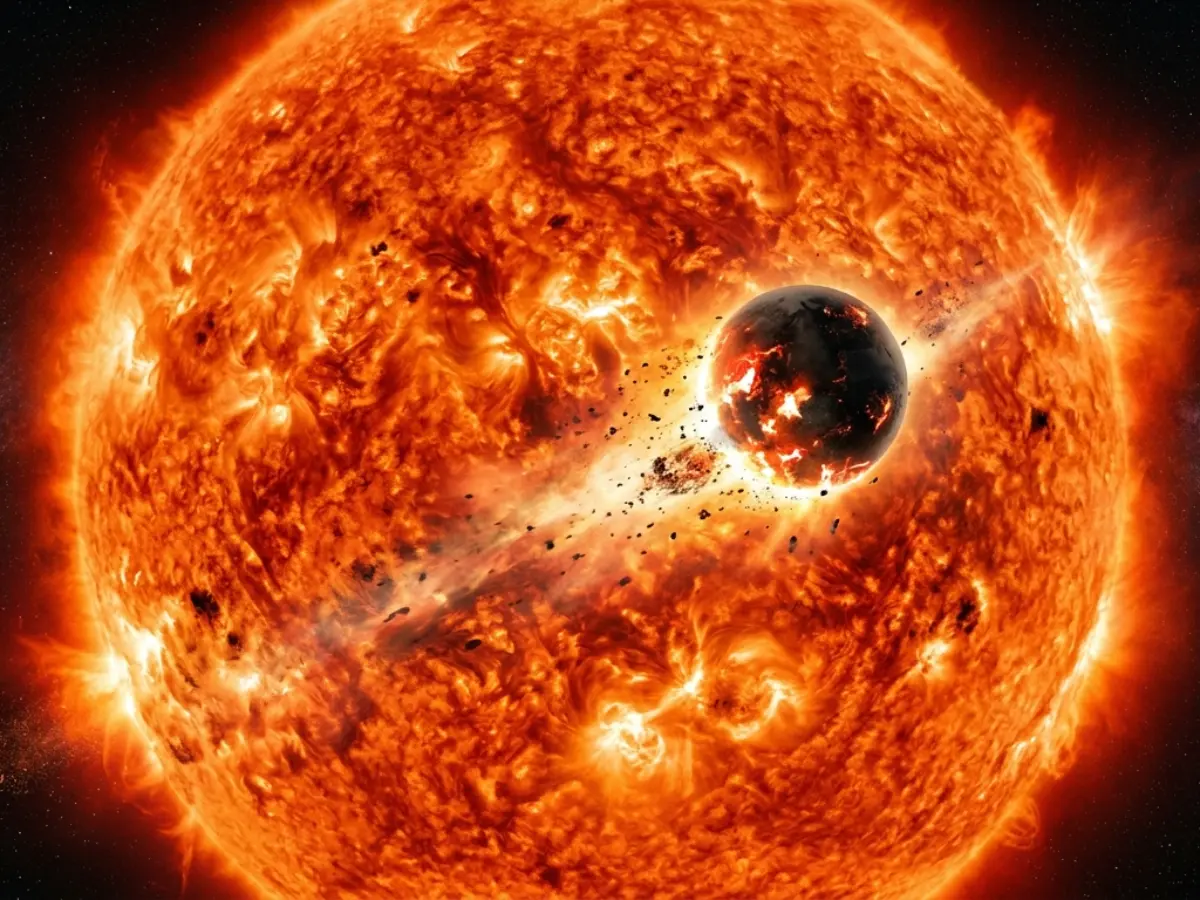
Scientists have long projected that billions of years from now, our Sun will start expanding as it reaches the end stages of its life. It will become a Red Giant, swallow Mercury and Venus, and likely Earth and Mars as well, while affecting the environments and orbits of Jupiter and the later gas giants. But one researcher thinks that we can save ourselves from this fate. A soon-to-be-published study argues that it is possible to dodge the bullet when the Sun is no longer alive.
Independent researcher Gabriel Harry provides a solution to living for up to 9 quadrillion years even when the Sun runs out of fuel in about a billion years, and finally shrivels into a glowing ring of gas in 5 billion years. The study, set to appear in the Journal of the British Interplanetary Society, states megaengineering can protect Earth from not only the Sun, but also tectonics and water loss, changes in the planet’s tilt and spin, collision, and any other dangers from beyond our solar system.
A sunshield in Moon's orbit

In its current state, Earth will become uninhabitable in about one billion years, Harry states. "Implementing and maintaining the set of safeguards would allow the Earth to remain habitable for 9.1 million billion years," he adds. As the Sun starts expanding, Earth will need some kind of shield to protect itself from solar radiation. He proposes that a 700,000-kilometre-wide sunshade placed just outside the Moon’s orbit can save Earth.
To keep it in position, a carbon cable can be used, which is attached to a weight placed at Lagrange Point 1 (L1). It will be made of aluminium that can be mined from the Moon, and will cover a 70-degree area of the sky. The 2-million-km carbon tether could be made by mining 40 per cent of the dwarf planet Ceres. The shield will be 0.1 millimetres thick, putting its total mass at around 100 quadrillion kilograms.
Trending Stories
)
Trump says Russia has ‘lost control’ of its diesel industry, calls for end to ‘ridiculous, never-ending’ war
)
Asian Games: Indian women's hockey team thrash Indonesia 17-1, blasts 36 goals in 2 matches
)
Putin's United Russia party wins 355 seats in Duma election; 4 other parties cross threshold to enter parliament
)
Delhi Air pollution: Strict crackdown on waste burning
)
'I never imagined…': Bihar-born Japan cricketer Abhishek Anand on historic India clash
)
‘0% chance’: Nvidia CEO Jensen Huang dismisses AI extinction fears by 2030
)
Samay Raina-Mukesh Chhabra controversy explained: What happened over girlfriend joke on India's Got Latent?
)
Four decades after leaving Kolkata, the Birlas may be coming back for more
)
BTS' fans question iHeartRadio’s treatment of group after brief festival set
)
Glitch in the matrix caught on camera: Woman vanishes after talking to reporter
)
Samsung raises Galaxy S26 prices by Rs 20,000: Here’s what each model now costs
)
IIT Bombay tensions ease after three-hour open house; director’s assurances pacify students
)
J&K Assembly Session begins amid chaos: BJP, ruling alliance clash as statehood demand dominates
)
8,000 bees worth over $20,000 stolen from hives in Queensland
)
Four Hands, Two Sonatas ep (5-8) review: Song Kang Lee, Jun Young elevate the emotional stakes after a tragic turn
)
The Verdict | The Mecca Agreement is under scrutiny as Houthis attack Saudis
)
Who was Sheikh Ahmed bin Rashid Al Maktoum? From Dubai Royal family to police, sports and racing
)
Saudi Arabia exits China-led mBridge digital currency platform amid Saudi-Houthi conflict
)
Maharashtra TET paper leak: Chargesheet reveals papers smuggled in shoe insoles for Rs 8,000
)
'Lot of things to learn from experienced players': Jayasuriya backs Rohit, Virat for 2027 ODI World Cup
)
Taylor Swift has a 'proud wife' moment as Travis Kelce scores first touchdown of season: 'That’s my husband!'
)
North Korea's nuclear tests triggered 1,399 earthquakes: Earth is still shaking | Gravitas
)
Mahabharat actor Saurav Gurjar arrested in Hyderabad, sent to 14-day judicial custody in sexual exploitation case
&im=FitAndFill=(700,400))
New OTT releases this week (September 21-27, 2026): Shaque: Trust No One, Hunkkaar, Don’t Be Shy- 5 new titles coming to Netflix, Prime Video and more
)
WATCH | Mysterious lights over Tehran caught on video. Drone, aircraft or something else?
)
What is Yom Kippur and why is it celebrated? All you need to know about the Jewish Day of Atonement
)
White House TV pool halts Trump coverage after CNN barred from UNGA events
)
Iranian airlines to shut worldwide on Sept 23, Bessent warns of US banking ban
)
Pilot recreates Mona Lisa in sky over Oklahoma and Arkansas in four-hour flight: VIDEO
)
Fitna Al-Khawarij: Decoding biggest security threat to Pakistan | Gravitas
)
Jailer 2: Vidya Balan joins Rajinikanth's upcoming film as Kantha | Watch
)
Microsoft executive called AI training the ‘largest theft of labour in human history’
)
40-foot waves crash into cruise ship in dangerous stretch near Antarctica. Watch
)
Mystery explosions rock Aleppo, residents told to stay indoors
)
BTS fans mock iHeartRadio’s day 2 turnout after short set controversy
)
The Scandal, why so scandalous? Ji Chang Wook leaves you gasping for air
How to heat up Earth if the Sun is blocked out
However, blocking out the Sun would cool Earth considerably. To solve this problem, he suggests making an artificial sun. The fuel could be sourced from Jupiter for fusion reactors that could orbit the gas giant 6,500 km deep in its atmosphere. The energy produced can be beamed up to Jupiter’s L1, then shone onto Earth’s surface, heating up the atmosphere.
How to avoid being swallowed by the Sun?
The problem of being engulfed by the Sun would still remain. For this, we would need to move away from it. Harry suggests extending Earth’s orbit from 1 astronomical unit to 1.2 astronomical units. For this shift, oxygen mined from Jupiter could be used to fire a particle beam past Earth. With a mass roughly equal to half of the Amazon River’s outflow, it will slowly move our planet away from the Sun.
All of these methods sound like straight from a sci-fi thriller, and it is hard to believe that they could ever become real. Mining Jupiter for energy and a 2-million-km carbon tether sound purely absurd. However, since the Sun is still many, many years away from dying, an advanced civilisation might be able to pull it off. Let's save his recommendations in a black box that future humans can dig up.

