
&imwidth=800&imheight=600&format=webp&quality=medium "Sun may spare Earth and Mars, as study reverses course on death of our planet")
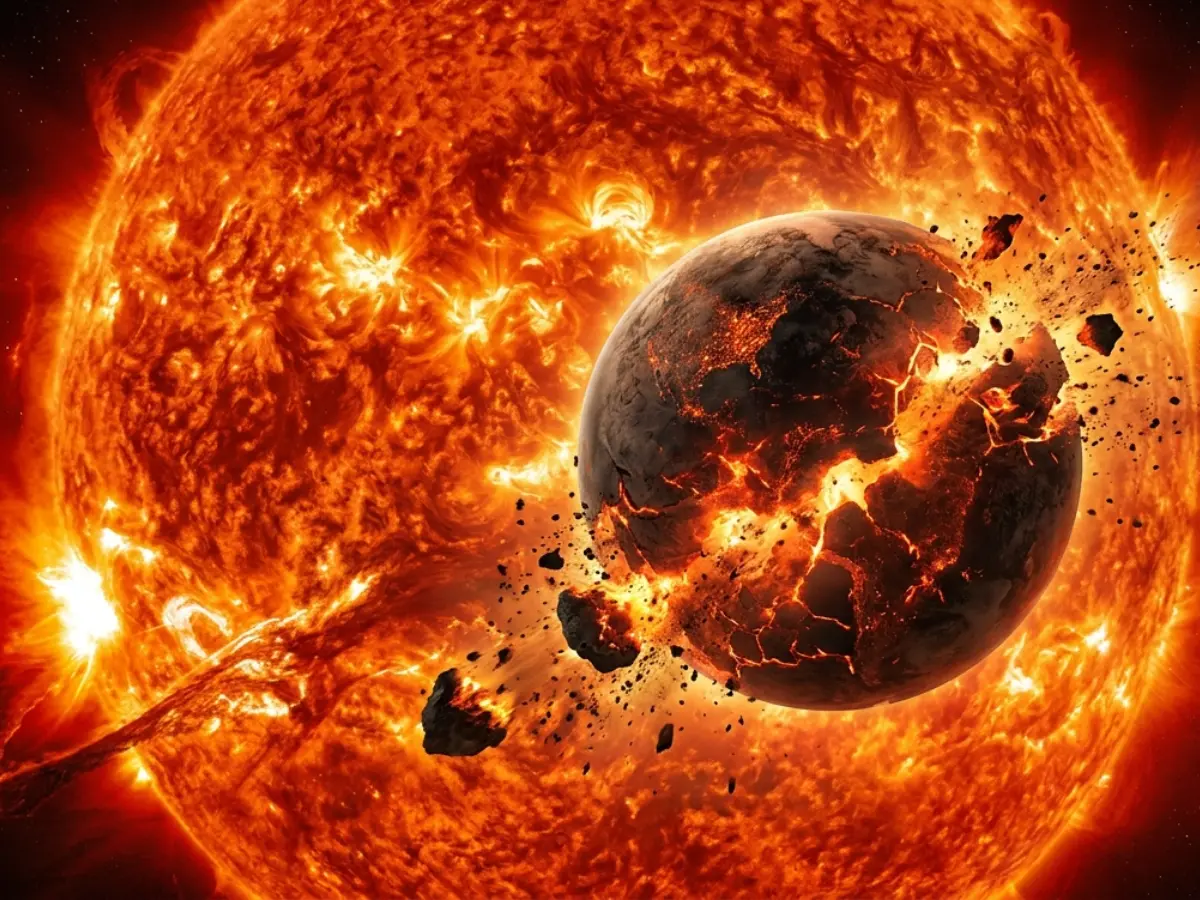
A new study has changed a major belief about Earth's demise in the cosmos. For a long time, it has been hypothesised that the Sun will swallow Earth towards the end of its life when it turns into a Red Giant. However, a new study has proposed that this may or may not happen, and it depends on two things. When the sun burns through all of the hydrogen in its core, it will go through a violent death in which it will expand, in turn increasing its gravitational forces, which will pull Earth towards it. As it nears Earth, intense tidal waves will stir within the star. When they end, Earth will end up inside the sun, dead for eternity. But there is another scenario that can unfold.
According to the study published in the journal Astronomy & Astrophysics on Friday, stellar winds will cause the Sun to lose a lot of mass, pushing away our planet. "Earth's fate depends on a delicate balance between these two effects," astrophysicist Mats Esseldeurs, the lead author, explained. The ultimate fate of our planet will depend on which of the two forces dominates at the time. "If tidal interactions predominate, Earth is engulfed by the sun. If the sun's mass loss predominates, Earth escapes into an orbit larger than the radius of its star," the scientist from Belgium's University of Leuven said in a statement. Also Read: Lease for life on Earth extended as study finds end of times are at least 1.84 billion years away
The study is based on tidal dissipation within giant stars. To understand how much mass the sun could lose, the researchers focused on L2 Puppis, a star they call the sun's "old cousin." Stephane Mathis, an astrophysicist and co-author of the study, said that "in the current state of knowledge, Earth could move away from the sun, contrary to what was predicted before." Not only would Earth escape the Sun's wrath, but even Mars would survive. However, Mercury and Venus would not be so lucky and would be swallowed by the Sun. Also Read: New theory suggests billions of 'mini universes' could be scattered in our own cosmos

Earth's future - Imminent death
But humans on Earth have nothing to worry about as of now, since the Sun at least has another 5 billion years of life left. By that time, we would have long gone. Earth is currently in the middle of its 10-billion-year cosmic life cycle. As the Sun starts to burn hotter and brighter in about 1-2 billion years, our planet will witness a super-greenhouse effect, with surface temperatures climbing to over 100°C. The oceans will evaporate, and life will cease to exist.

