
&imwidth=800&imheight=600&format=webp&quality=medium "US-Indian tariff wrangling show limits of Trump’s art of the deal")
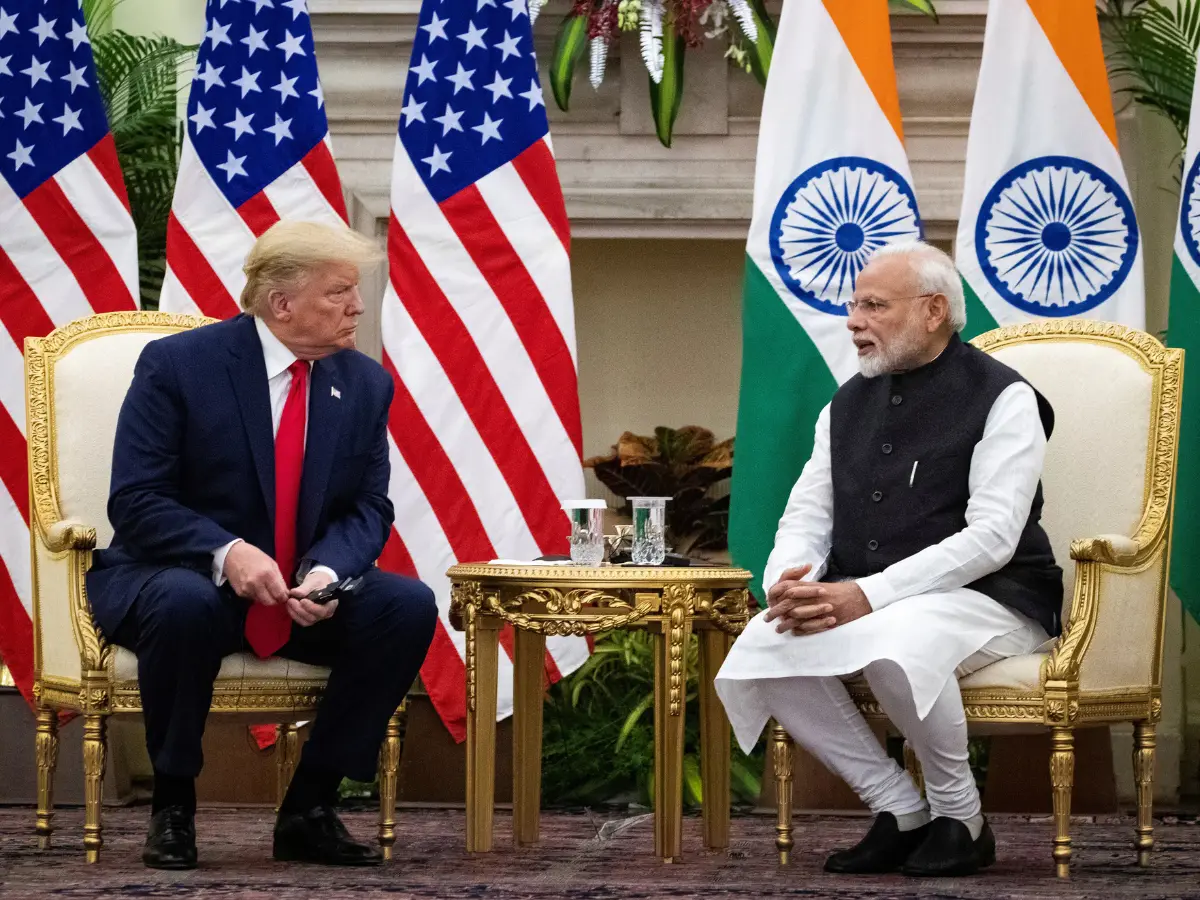
It took just six months from US President Donald Trump showering praise on his Indian counterpart, Narendra Modi, to berating him as the leader of a ‘dead economy” aligned with Russia.
In February, Trump greeted Modi with a hug at the White House and described him as a “great friend” and “great leader” who “is doing a really great job in India. Everybody talks about him. He’s doing a fantastic job.”
Trump’s shower of praise did not end there. “He is a much tougher negotiator than me, and he is a much better negotiator than me. There is not even a contest.”

Praise for the “tough negotiator” soon faded when efforts to forge a bilateral trade deal between the world’s biggest economy and the world’s most populous country ran into difficulties over a number of U.S. demands on which India refused to budge. They included opening agricultural markets and India halting imports of Russian oil.
Doing so, Trump argued, would prop up the Russian economy and thus prolong the war of aggression President Vladimir Putin unleashed on Ukraine in February 2022.
India’s continued purchases of discounted Russian oil prompted an angry Trump social media posting warning of a penalty on top of the 25 per cent tariff due to take effect this week, along with levies of different sizes on most countries.
Trending Stories
)
Indus treaty can no longer function in its current form, says India; plans 5,500 mw of new J&K hydro projects
&im=FitAndFill=(700,400))
Meet top 5 batters with most runs in India vs Zimbabwe T20Is
)
Sonam Wangchuk's connection with George Soros and Ford Foundation explained!
)
'George Soros playbook': Understanding the foreign funding network around Sonam Wangchuk
)
'There is no need for...': PM Modi takes a veiled dig at Rahul Gandhi, sends big message amid Parliament March
)
'Now come to us': CJP resumes protest after Parliament march violence, calls meeting with Nadda 'waste of time'
&im=FitAndFill=(700,400))
2026 FIFA World Cup awards: Full list of Golden Boot, Golden Ball, Golden Glove and every major winner
)
'What is wrong...': Anna Hazare breaks silence on Sonam Wangchuk's protest, makes an appeal to Centre
)
Xi Jinping's new AI bloc: China launches 'World AI Body' with Pakistan and Russia in, India out
)
'We acted immediately...': Indian PM Modi breaks silence on paper leaks as NEET protest, calls for Education Minister's resignation grows
)
UP BTech gold medalist dies by suicide after failing in nearly 50 govt job attempts, leaves note for father
)
'Guru is the...': Indian Education Minister Dharmendra Pradhan shares message on education amid calls for his resignation
)
Jail over Khamenei post: J&K youth returns home after 3 months in Saudi custody
)
Japan is selling a refrigerator to cool the human body for Rs 9 lakh. It is already a hit in Tokyo
)
Truck loaded with stones, metro stations closed: What's happening at Jantar Mantar now
)
Student union leaders call off hunger strike at Jantar Mantar after civil society appeal, but protest continues
)
Salman Khan breaks silence on health concerns after viral Mumbai appearance
&im=FitAndFill=(700,400))
Why US fighter jets use seamless bubble canopies compared to Russian jets
)
Iran strikes Amazon data infrastructure in Bahrain, power, water desalination plants in Kuwait
)
3.5-million-year-old mystery creature found in Japan is a 'giant' never seen before
&im=FitAndFill=(700,400))
Why the F-22’s cockpit glass is thicker than a standard fighter jet
&im=FitAndFill=(700,400))
FIFA World Cup 2026 team of the tournament: The best XI that ruled football’s biggest stage
&im=FitAndFill=(700,400))
New OTT releases this week (July 20-26, 2026): Musafir Cafe, Adarsh Baal Vidyalaya, 72 Hours- 5 new titles coming on Netflix, Prime Video and more
)
FACT CHECK: Was Abhijit Dipke detained during CJP's Parliament march? Here's what police say
“I don’t care what India does with Russia,” he said in a posting on his Truth Social site on July 29, a day before the official start of his global trade war. “They can take their dead economies together, for all I care.”
Exaggeration is the hallmark of the American president. India does not have a “dead economy”. On the contrary: The latest report by the International Monetary Fund (IMF) singles India out as the world’s fastest-growing major economy, with GDP projected to grow 6.4 per cent both for the rest of 2025 and 2026.
Some economists predict that India is on track to overtake Japan as the world’s fourth-largest economy.
Trump has said that the US and India will continue negotiating a trade deal even after the August 1 deadline set for global tariffs.
India has reacted calmly to Trump’s obvious anger, with a spokesman saying it had taken note of his statement and remained committed to concluding a fair, balanced and mutually beneficial trade agreement. Another round of talks is scheduled for later this month.
While American and Indian negotiators wrestled over points of contention, the Trump administration moved closer to Pakistan, concluding a deal to help develop what Trump called Pakistan’s “massive oil reserves” (experts scoff at the label “massive”).
The US company that will lead the project is yet to be named, he said, adding mockingly, “maybe they’ll be selling oil to India some day.” The oil deal had an immediate effect on Pakistan: its tariffs, initially pegged at 29 percent, came down to 19 per cent.
The oil agreement was preceded by a protocol-breaking visit to the White House in June by the Pakistani Army Chief, Field Marshal Syed Asim Munir. It was a gesture clearly designed to irritate India -- and the first time a sitting US president had hosted the head of Pakistan’s army, which has long dominated the Pakistani political landscape.
In theory, there is a set formula for the percentage of tariffs the United States applies to its trade partners around the globe. It is tied to America’s bilateral trade deficit – how much more the US imports from a country than exports to it. That gap is then divided in half to arrive at what the government calls “discounted reciprocal tariff.”
In practice, Trump has been using tariffs in some cases as a tool of geopolitics. The most striking example is his decision to saddle Brazil with a 50 per cent rate despite the fact that the country has a trade surplus with the US The US leader explained the reason in an extraordinary letter to Brazilian President Luis Inacio Lula de Silva.
His predecessor, Jair Bolsonaro, a close friend of Trump, is on trial, charged with leading an attempted coup to overturn the elections he lost. Trump called the trial a “witch hunt” and an international disgrace that should end immediately. The Supreme Court judge who handles the case reacted by ordering Bolsonaro to wear an ankle monitor and banning him from contact with foreign governments.
The line between tariffs set by a formula and deals pleasing to Washington is also blurred by the ten per cent reduction granted to Pakistan after the announcement of the oil deal.
India appears unfazed by the threat of a penalty for buying Russian oil. On Saturday, officials in Delhi told the Reuters news agency that India would keep purchasing Russian oil because it could not violate long-term contracts.
The main buyers of Russian oil have been China and India, and their supply has propped up an economy weakened by the huge cost of the war against Ukraine.
Trump originally set a 50-day deadline for Russia to reach a deal to end the war, but shortened it to 12 days – which would be next week. Failure to comply would result in so-called secondary sanctions – that could mean slapping 100 per cent tariffs on buyers of Russian oil. Experts say that would disrupt global oil supplies.
China and the US are still wrangling over tariffs during a 90-day truce that expires on August 12. Washington rhetoric on China, its biggest trade partner, has been noticeably more restrained in recent days than criticism of India.
The latest broadside against India came on Sunday from Steve Miller, one of Trump’s closest aides, who said in a television interview that “it is not acceptable for India to continue financing this war by purchasing oil from Russia.” He however, did not mention that China is buying more oil from Russia than India.
