
&imwidth=800&imheight=600&format=webp&quality=medium "From Bihar’s turnaround to Gujarat’s 190 GW renewables---Can THESE 5 states decide India’s energy future?")
The ongoing Middle East crisis triggered by the USA-Israel vs Iran conflict has severely disrupted the global economy and geopolitics. Rising energy prices, broken supply chains, and economic uncertainty are now affecting households and industries worldwide. In contrast, India is turning this challenge into an opportunity. With a strong economic base and a proven ability to bounce back from adversity, the country is accelerating its journey towards a sustainable and self-reliant energy sector.
The recently concluded four-day Bharat Electricity Summit 2026 showcased India’s strong resolve and capability in handling energy challenges through renewable energy and clean technology. The clear message from the summit was that India’s energy transition is no longer just a national goal — it has become a powerful state-driven movement backed by innovation, policy reforms, and strong on-ground execution.
At the summit, five key states — Bihar, Gujarat, Andhra Pradesh, Maharashtra, and Delhi — presented ambitious and transformative roadmaps that strongly support Prime Minister Modi’s vision of Viksit Bharat. These states demonstrated how focused local strategies are helping achieve national targets of reliable power, clean energy adoption, and inclusive economic growth.

Bihar: Powering growth with reliability, reform
Leading the narrative was Bihar, which has made remarkable strides in strengthening its power infrastructure and ensuring reliable electricity access across urban and rural areas. Once considered a power-deficit state, Bihar today stands as a model of turnaround through focused investments in transmission, distribution, and smart technologies.
At the summit, Bihar underlined its forward-looking approach toward grid modernization and energy storage systems, backed by structured investment pipelines. The state’s commitment to improving reliability and reducing losses has significantly enhanced consumer confidence and industrial growth.
Trending Stories
&im=FitAndFill=(700,400))
How fast can the Sukhoi Su-30 fighter jet really fly?
)
Did China ask its people 'not to respond to aliens'? Origin of bizarre claim on social media
)
MS Dhoni-CSK Fallout? Report claims failed stake sale talks triggered rift
)
Scientists reveal the SAFEST COUNTRY when catastrophe strikes the planet
)
Serial killer on the loose in South Korea's Jeju Island? Fourth body found in three days as more than a dozen people go missing
)
2/3rd of glacier detached, collapsed: ISRO satellite images reveal what triggered Nepal floods
)
Trump once again claims without him there would be ‘no Israel right now’
)
Foreign espionage attacks against German companies surge to 37%, Bitkom report reveals
)
Blake Lively wins partial legal fee from Justin Baldoni after $8M request
)
Why is Pakistan deploying Turkish Bayraktar TB2 drones near India border?
)
'OH MY GOD! We've found other agents!': Investigators discover not one or two, almost 700 OpenAI AI agents went rogue, hacked Hugging Face
)
Lunar eclipse 2026: India timings, places to see and more. August Blood moon factsheet
)
RSS chief Mohan Bhagwat on global outreach tour
)
Both pilots killed as training aircraft crashes in Lucknow – What we know
)
16-year-old charged with preparing terror attack on kindergarten in Norway
&im=FitAndFill=(700,400))
How the S-400 protects itself from enemy attacks
)
Nepal floods: Over 165 dead, 400 missing; US, India, China, World Bank mobilise aid
)
India's multi-layered watch: The new surveillance war
)
5 doomsday planes spotted in US skies hours after CIA director's secret trip to Russia
)
9/11 mastermind Khalid Sheikh Mohammed to finally face trial in 2028, nearly 27 years after horrific attacks
)
Islamabad hospital fire: What we know about one of the biggest facility that housed Imran Khan
)
Workers run for life while filming Nepal flash flood: Scary new visuals emerge from Rasuwa
)
Russian military planes enter South Korean air defence zone amid rising tensions with North Korea: What's happening
)
Ron Weasley Is Back! Rupert Grint set to return to Harry Potter universe on Broadway
)
400-year-old 'vampire' grave in Poland reveals non-existent genetic lineage
)
Dolly Parton, global icon and queen of country music, dies at 80
)
Nepal flash floods: Kailash Mansarovar yatra affected, close to 400 pilgrims out of contact
)
'If he is dead, they're putting on a pretty good show': Trump casts fresh doubt over Mojtaba Khamenei's fate
)
Man arrested near US Capitol with guillotine in pickup truck: What happened?
&im=FitAndFill=(700,400))
Why the Su-30MKI cockpit is painted bright turquoise green
The power distribution sector in Bihar has achieved a significant national breakthrough, earning recognition from the Ministry of Power for its remarkable improvement in operational efficiency.
Bihar’s Energy Minister, Bijendra Prasad, said the government is focused on strengthening service delivery, increasing transparency, and using technology to enhance the overall consumer experience across the state.
Energy Secretary Manoj Kumar Singh, who is also Chairman and Managing Director of Bihar State Power Holding Company Limited, highlighted that the improved national rankings reflect a deep structural transformation in Bihar’s power distribution sector. The state’s Energy Secretary added, “We are building a resilient and future-ready grid, with investments in storage, smart metering, and digital monitoring systems to meet rising demand efficiently.”
Bihar’s push toward smart meters and digitization has improved billing efficiency, reduced AT&C losses, and empowered consumers—key elements in driving both economic and social development.
Gujarat: Leading India’s renewable revolution
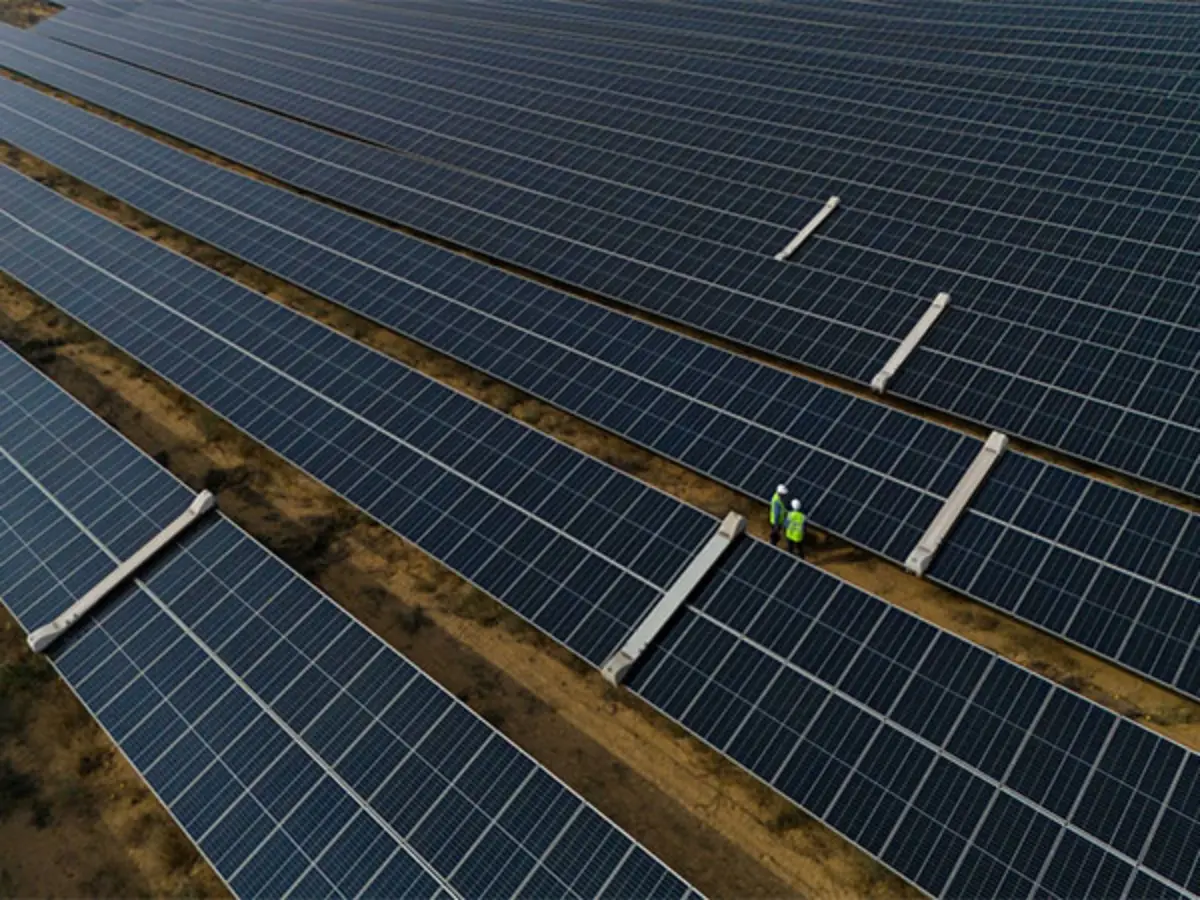
Gujarat reaffirmed its position as a renewable energy powerhouse with an ambitious target of achieving 190 GW of renewable capacity by 2047. The state’s proactive policies, investor-friendly ecosystem, and strong industrial base have made it a leader in solar and wind energy deployment.
Its integrated approach—combining renewable expansion with grid stability and storage solutions—sets a benchmark for other states. Gujarat’s progress reflects how clean energy can drive industrial competitiveness while supporting sustainability goals.
Andhra Pradesh: Building a clean energy hub
Andhra Pradesh presented one of the most ambitious visions at the Bharat Electricity Summit, aiming to develop an integrated clean energy hub with investments exceeding Rs 6 lakh crore. The state is focusing on large-scale renewable projects, green hydrogen, and port-led industrial ecosystems powered by clean energy. NTPC Limited is developing one of the world’s largest Green Hydrogen Hubs at Pudimadaka near Visakhapatnam.
The massive project, worth Rs1.85 lakh crore, was launched by Prime Minister Narendra Modi in January 2025. Spread over 1,600 acres, the hub aims to produce 1,500 tons per day of green hydrogen and its derivatives — including green ammonia, methanol, and Sustainable Aviation Fuel (SAF) — by 2032.
This approach not only positions Andhra Pradesh as a global energy hub but also creates significant employment opportunities, boosting regional economic development. The state’s emphasis on infrastructure and innovation highlights the critical role of energy in shaping future economies.
Maharashtra: Scaling capacity for future demand
Maharashtra, one of India’s largest power-consuming states, showcased its roadmap to meet a projected demand of 280 TWh by 2030. With rapid urbanization and industrialization, the state under the leadership of Devendra Fadnavis is investing heavily in capacity expansion, renewable integration, and grid modernization. Its strategy balances conventional and renewable sources while focusing on reliability and efficiency. Maharashtra’s stand underscores the importance of planning ahead to sustain economic growth without compromising on energy security.
The state has now become a power surplus state and is well prepared to meet the growing demand from industries and data centres. Mahavitaran (Maharashtra State Electricity Distribution Company) has emerged as one of Asia’s largest power distribution utilities, with its annual revenue crossing ₹1 lakh crore.
Delhi: Urban energy transition at scale
Delhi’s model represents the future of urban energy systems. The national capital is transitioning toward a high-renewable, storage-integrated power system, supported by advanced distribution reforms and near-universal smart meter adoption. Delhi is demonstrating how cities can lead the clean energy transition while ensuring uninterrupted power supply. Its success also highlights the role of policy innovation and governance in driving change.
The Delhi government, under Chief Minister Rekha Gupta, is strongly promoting clean energy with a Rs 3,942 crore allocation for the power sector in the 2026–27 budget. The focus is on restoring Delhi’s status as "Green Delhi" with the expansion of rooftop solar, electric vehicle (EV) infrastructure, and waste-to-energy projects. Key initiatives include the PM Surya Ghar: Muft Bijli Yojana, incentives for rooftop solar installations, and the creation of a dedicated Delhi Energy Conservation Fund to help Delhi move towards greater energy self-reliance.
Viksit Bharat through state leadership
The collective efforts of these five states illustrate a powerful narrative—India’s journey toward a developed nation is being shaped at the state level. Reliable electricity supply, smart metering, renewable energy adoption, and robust infrastructure are not just technical achievements; they are enablers of economic growth, social equity, and improved quality of life. Insights from government sources, including policy perspectives focused with national priorities, indicate that such state-led initiatives are critical to achieving energy security and sustainability goals. The emphasis on digitalization, storage, and green energy reflects a holistic approach to sectoral transformation.
As the Bharat Electricity Summit concluded, it left behind a strong sense of optimism and direction. The participation of Bihar, Gujarat, Andhra Pradesh, Maharashtra, and Delhi showcased how diverse regions, with unique challenges and opportunities, are collectively contributing to India’s energy transition. Their leadership not only strengthens the power sector but also accelerates the broader vision of Viksit Bharat—a future where reliable, sustainable, and inclusive energy powers every home, industry, and aspiration.