Miscalculating migration and maths: Why Rishi Sunak's views don't add up

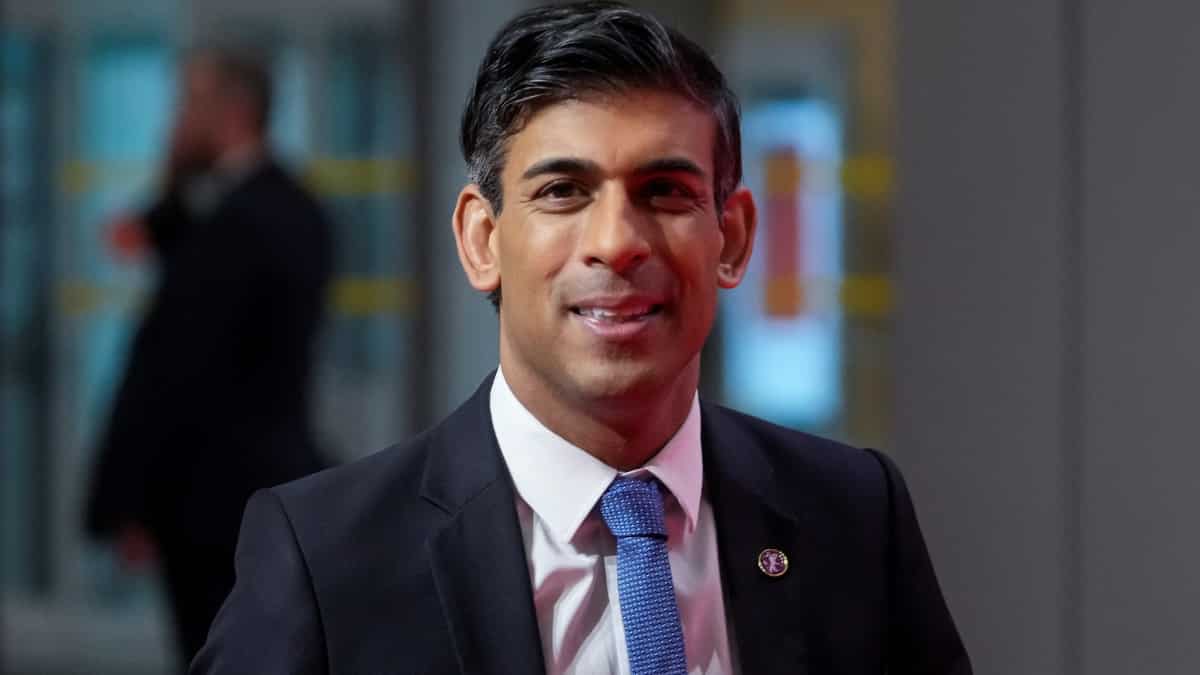
Rishi Sunak
There is a Tamil proverb that fits the situation perfectly after British prime minister Rishi Sunak talked somewhat cryptically about the importance of boosting numeracy among pupils in the United Kingdom, although its alliterative magic may be lost in translation. The saying goes: "Don't say ten times ten is hundred when the stomach is on fire".
Given the deep crisis in the UK economy, the vague statement, though well-intentioned to create jobs in the age of data science, fell short of any government commitment to put its money where its mouth is. Whatever the detail, long-term statements made when there's a short-term emergency of sorts with public services in a state of disarray do not ring true. That may well be the problem with the thinking design of Sunak's Conservative party.
"Let them learn maths" may well be Britain's questionable parallel to the "Let them eat cake" saying attributed dubiously to French queen Marie Antoinette.

But there's more irony to this than a matter of bad timing and lack of detail. A quick Google search will reveal Britain has produced an awe-inspiring range of famous mathematicians. Among them are physicist Isaac Newton, philosopher Bertrand Russell and computer science pioneers Alan Turing and Charles Babbage. G.H Hardy, who mentored Indian number science genius Srinivasan Ramanujan and a host of others bring up a list that should make Britain a mathematical superpower.
Also Read |Rishi Sunak to unveil plan for mandatory teaching of maths to students till the age of 18
Where did things go wrong? You can't oversimplify the issue but I like to think the gains of the Industrial Revolution, colonialism, and globalisation were not fairly shared with the common British people. The country's class system may not be as visible or talked about as India's caste system but the Brexit vote under which the UK exited the European Union showed that elite Britons in London's financial districts prospered while those in the countryside lagged, leading to insecurities that led to Brexit, which has drained the UK more than its proponents would care to admit.
)
The Early Spring is proof not everyone can talk about their real feelings, and it is perfectly OK
)
UN votes to ‘correct the map’ as India backs fairer world view
)
Nigerian Navy discovers 99,000 litres of suspected stolen, illegally refined products as it intensifies anti-crude oil theft operations
)
Who is Aditi Paudel? 17-year-old becomes Japan's first literacy ambassador
)
Bengaluru: Officials find 40 kg expired chilli at chairman's club
)
Jaishankar rejects trade link to ending Ukraine war
)
Israeli strikes on Lebanon kill three, injure 23 despite truce
)
Alpine glacier was covered with sheep wool sheets to prevent melting. It worked
)
South Korea mulls deploying military assets to Strait of Hormuz
)
World's fifth-largest economy, British army can't afford to train
)
Breaking | Vance takes the podium: First White House briefing since Leavitt's exit
)
Taiwan raises 'concerns' over China's missile test
)
BRICS 2026: $1 trillion sovereign capital set to converge in Delhi for first iBRICS Summit
)
What is Iran's Pickaxe Mountain that Trump has again threatened to bomb?
)
UN votes to correct world map that visually shrank Africa for 450 years
)
Former NewJeans member Danielle launches YouTube channel, hints at new solo journey
)
Bangladesh batter Towhid Hridoy creates history with 350 not out in South Africa
)
Brendan Fraser’s transformation fuels The Mummy 4 excitement as fans welcome back Rick O’Connell
&im=FitAndFill=(700,400))
Krishna Janmashtami 2026: From Dhaniya Panjiri to Makhana Kheer- 5 best sweet dishes perfect for celebrating Lord Krishna’s birth
)
Donald Trump plans to travel to Ireland on Qatari-donated jet amid security concerns
)
Nazi-looted art to return to Jewish heirs
)
Eight killed in Kerala’s Thrissur after car rams into lorry parked on highway
&im=FitAndFill=(700,400))
Why Russian fighter jets use bulky, low-pressure tyres compared to US jets
)
FBI-wanted fraud accused arrested in Jalandhar over $600,000 scam
&im=FitAndFill=(700,400))
Why US tanks weigh over 20 tons more than Russian tanks
&im=FitAndFill=(700,400))
New Friday OTT releases (September 4, 2026): GDN, Dhamaal 4, Jagamae Sangeetham- Watch 6 new movies and TV shows on Netflix, Prime Video and more
)
Killing the Himalayas slowly: Human urine is melting a glacier on Mount Everest
There's mourning in some circles about Britain losing its global clout, only underlining the hard reality that you cannot succeed globally while failing locally.
The psyche of Tories and colonial-era hubris may have done more damage to the British economy than the ruling party may be willing to acknowledge. In the popular narrative set by them, immigrants are freeloaders from poor countries threatening Britain's security, economy, and way of life. Contrast that with America. Though its right-wing campaigns are hard against illegal immigrants, especially from Latin America, the US has a strong business lobby that supports positive immigration of educated Asians and entrepreneurs.
Google and Facebook owe their origin to Jewish immigrants, Apple to Syrian-immigrant-fathered Steve Jobs and a number of hot startups and tech giants to Indian-born venture capitalist Vinod Khosla.
By stereotyping immigrants and not having a long-term vision on the issue, British politicians like Indian-origin home secretary Suella Braverman (possibly more loyal to Britain than the King) only discourage positive immigration.
UK can potentially model itself after Scandinavian or Northern Europe countries where public-funded higher education seems to be on stronger footing. Or it can fuel high growth by attracting the right immigrants and sharing the gains of growth with locals. As of now, the Sunak-led Tories have missed both the points.
What seems to have happened, thanks in no small measure to Tory insensitivity, is a case of what an American writer described as a 'secession of the successful'.
There's no doubt that indulgent/profligate Labour Party policies may not be exactly what the doctor ordered for the UK but more true, the rich cannot preach to the less fortunate the glory of mathematics when what is needed is a realistic balance between growth and social equity.
Though education up to the age of 18 is free in Britain, there appear to be big gaps in its education system. A report in The Guardian two years ago said quoting the Institute of Fiscal Studies that state schools in England have suffered their worst decline since the 1980s especially after Conservatives took power in 2010. Secondary schools and deprived areas were most hit by austerity measures.
The British PM may have at least cited his father-in-law and Infosys founder N.R Narayana Murthy as an example to call on UK's fat cats to do some mathematically inclined philanthropy or scholarships while offering a be-like-me sermon for young Britons to learn maths.
Without mixing metaphors, one may say Rishi Sunak's call to boost numeracy in Britain was not a well-calculated one in the land where Sir Isaac Newton invented calculus as a mathematical discipline.
If only Sunak realises the Newtonian gravity of the situation...
(Disclaimer: The views of the writer do not represent the views of WION or ZMCL. Nor does WION or ZMCL endorse the views of the writer.)
WATCH WION LIVE HERE
You can now write for wionews.com and be a part of the community. Share your stories and opinions with us here.
