China’s new era dawns in Manchester

Manchester attack
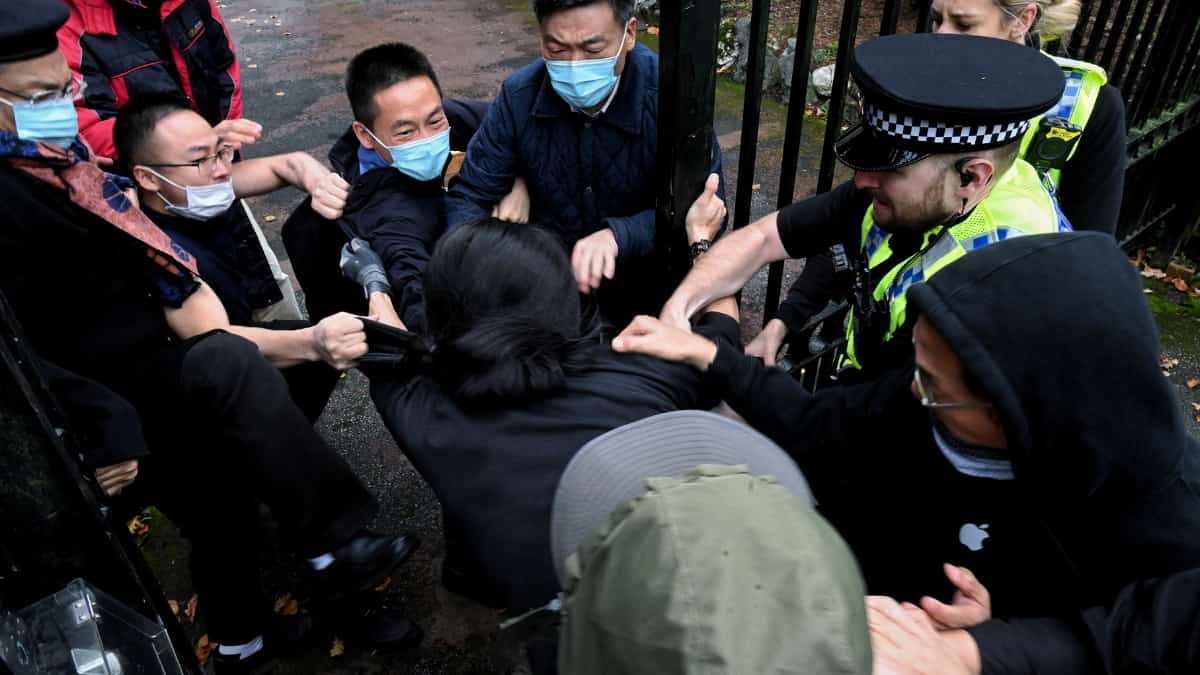
Manchester police are investigating a brawl that happened outside the Chinese consulate after some Hong Kong protesters and a group of diplomats clashed during a demonstration.
The whole thing lasted about a minute and the two sides were quickly separated by the UK police. But the diplomatic row that it ignited will probably continue for a few weeks, especially as the Consul General Zheng Xiyuan in an interview on Thursday defended pulling the hair of a protester, saying it was his duty.
The protester "was abusing my country, my leader, I think it's my duty," Zheng told Sky News.

The protester who was dragged into the consulate premises in turn told the media that he now fears for his and his family's safety. That could sound like an exaggerated claim, but to those who have witnessed Beijing's increased role in Hong Kong, it will ring true.
The first pangs of fear the city felt about Beijing's overreach into the city came in 2016 when a book publisher named Lee Bo disappeared from the city and later surfaced on the mainland. It was soon evident that Chinese security bureau had ferreted him away secretly though under the Hong Kong rules, the Chinese security officials had to gain official permission before operating in the city.
Soon after, his co-publisher Gui Minhai vanished from his holiday home in Thailand's Pattaya and weeks later he too appeared in China, apparently to apologise for his involvement in a traffic incident that happened years ago. It then became apparent that the real reason for their illegal arrest and kidnapping was the books they produced, which were salacious and focused on top Chinese leaders, including Xi Jinping. Gui has not been allowed to leave China till now, though he carries a Swedish passport.
&imwidth=180&imheight=135&format=webp&quality=medium)
Blasts heard in Sanaa as Saudi-led coalition warns civilians to evacuate; Houthis vow retaliation
&imwidth=180&imheight=135&format=webp&quality=medium)
China's counter-surveillance industry booms amid heightened espionage fears | Gravitas
&imwidth=180&imheight=135&format=webp&quality=medium)
Saudi Arabia strikes Yemen oil sites as Houthi missiles target Riyadh; 'limited fire' breaks out at Aramco
&im=FitAndFill=(700,400)&imwidth=180&imheight=135&format=webp&quality=medium)
Navratri 2026: 9 days, 9 forms of Goddess Durga and 9 colours- Check the complete list
&imwidth=180&imheight=135&format=webp&quality=medium)
Trump accuses Houthis of driving up oil prices before US midterms, warns of consequences
&imwidth=180&imheight=135&format=webp&quality=medium)
New Delhi rejects Beijing’s claims and remarks on Ladakh location naming exercise
&imwidth=180&imheight=135&format=webp&quality=medium)
Russian woman and Bihar boy's love story goes viral after she reaches India to marry him
&imwidth=180&imheight=135&format=webp&quality=medium)
US Midterms 2026: In Alaska, cost-of-living anxiety meets strangest ballot in high-stakes Senate race
&imwidth=180&imheight=135&format=webp&quality=medium)
CMs Vijay-Naidu meet in Vijayawada, discuss water sharing, river-linking
&imwidth=180&imheight=135&format=webp&quality=medium)
'Don't ever mess with nature!': Trump’s tiger attack post triggers social media backlash as victim's family issues heartbreaking tribute
&imwidth=180&imheight=135&format=webp&quality=medium)
OpenAI employee arrested by FBI after allegedly hiding recording device in office
&imwidth=180&imheight=135&format=webp&quality=medium)
Air India Flight from Frankfurt diverted to Jaipur after hijack alert, probe on
&imwidth=180&imheight=135&format=webp&quality=medium)
1,500 drones illuminate Mumbai sky as Cordelia Cruises unveils second ship, Cordelia Sky
&imwidth=180&imheight=135&format=webp&quality=medium)
Delhi Police arrest Cockroach Janta Party's Saurav Das, Ashutosh Ranka, Ajinkya Shinde in Jantar Mantar case, to be produced before court
&imwidth=180&imheight=135&format=webp&quality=medium)
Pope Leo XIV diagnosed with lung cancer after surgery, Vatican says 'successful surgery and recovering'
&imwidth=180&imheight=135&format=webp&quality=medium)
Pakistan to chair UN-backed global Borrowers’ Platform as its own debt burden mounts, triggers sarcastic reactions on social media
&imwidth=180&imheight=135&format=webp&quality=medium)
Robot gropes girl, makes thrusting movements in bizarre crime in Germany
&imwidth=180&imheight=135&format=webp&quality=medium)
France accuses Musk of ‘online harassment’ of European leaders, warns of poll interference
&imwidth=180&imheight=135&format=webp&quality=medium)
'Turn approver, resign, we'll forgive you': Rahul Gandhi claims receiving messages from CEC Gyanesh Kumar
&imwidth=180&imheight=135&format=webp&quality=medium)
MI5 chief warns Russia is UK’s ‘aggressor number one’ as Iran and AI threats grow
&imwidth=180&imheight=135&format=webp&quality=medium)
Trump reconsidering calling off Nidal Hasan's execution livestream. Here's why
&imwidth=180&imheight=135&format=webp&quality=medium)
‘My president, I mean my husband’: Trump's new press secretary Katie Zacharia's first briefing goes off the rails in 14 minutes
&imwidth=180&imheight=135&format=webp&quality=medium)
‘How many people did she illegally bring from Somalia?’ Trump targets Ilhan Omar, questions her net worth
&imwidth=180&imheight=135&format=webp&quality=medium)
Marco Rubio to visit India next week, focus on energy cooperation and strategic ties
&imwidth=180&imheight=135&format=webp&quality=medium)
'Ouch!!! That must hurt': Kangana Ranaut hails Kamal Haasan's sharp reply to Elon Musk over Starlink row
&imwidth=180&imheight=135&format=webp&quality=medium)
Girl 'dead' for 8 hours wakes up at her own funeral, dad insists she wasn't breathing
&imwidth=180&imheight=135&format=webp&quality=medium)
Sidhu Moose Wala’s younger brother wins hearts by recreating late singer’s signature move at Toronto Hologram Show
&imwidth=180&imheight=135&format=webp&quality=medium)
UK school ditches technology, shifts from screen to pen and paper for learning
&im=FitAndFill=(700,400)&imwidth=180&imheight=135&format=webp&quality=medium)
New OTT releases this week (October 12-18, 2026): Sacrifice, Koffee with Karan S9, Roadies Rebirth- 6 titles coming on Netflix, JioHotstar and more
&imwidth=180&imheight=135&format=webp&quality=medium)
New Cold War: Why is China buying more gold? Explained
&imwidth=180&imheight=135&format=webp&quality=medium)
Anupam Kher joins Ranbir Kapoor's Ramayana as Jatayu, new poster unveiled
&imwidth=180&imheight=135&format=webp&quality=medium)
Netanyahu wants to join Saudi's war on Houthis, but Crown Prince denies: Report
&imwidth=180&imheight=135&format=webp&quality=medium)
Measles kills again: 6 dead in Pennsylvania as America faces its worst outbreak in decades | Gravitas
&imwidth=180&imheight=135&format=webp&quality=medium)
Ken Paxton's Dubai night out with two US fugitives sparks political storm as Texas Senate race tightens
&imwidth=180&imheight=135&format=webp&quality=medium)
Cornell University suspends fraternity parties over 2024 gang rape allegations
The new security law which Beijing passed in 2020 gave the Chinese security forces the legal sanction to operate in Hong Kong under their own rules and removed most of the legal protection that residents were guaranteed till then, prompting many to flee the city and head to places like Britain, Australia and Canada.
Also Read |UK ministers urged to act against Chinese top diplomat over Manchester violence
Many of them organise rallies and protests in those places to highlight the goings on in Hong Kong, but there have been complaints that Chinese officials are keeping tabs on such people and intimidating them even in those places.
A report issued by international human rights group Safeguard Defenders said that China had set up informal police stations with links to security officials
in China in several countries. Beijing says the intention is to help Chinese citizens who are living overseas and such units have been established in the United States, Britain, Australia and Japan. But rights activists say this is to target dissidents abroad and prevent Chinese citizens from joining protests against the Communist Party rule.
There also have been reports of China using its wealthy status to forge connections with political leaders and universities in foreign countries to tell stories about the “real China”, against what Beijing says are the biased versions spread by Western media. Basically that boils down to keeping away topics that are anathema to the communist party.
China has been on this trajectory even before Xi became the all-powerful leader. As his clout in the party grew along with a personality cult around him, groups within the party now seem to be overeager to show their loyalty. One reflection of that is the Manchester consul general’s anger at the display of a caricature of Xi, a perfectly normal thing in Britain where lampooning of political figures go back centuries.
Such aggressive Wolf Warrior diplomacy has seen diplomats often getting into tangles with the media and governments in various countries. An example of that was when the Chinese embassy in New Delhi warned the Indian media in 2020, not to describe Taiwan as a country and Tsai Ing-wen as president, provoking a backlash.
The embassy on another occasion warned the Indian media against advocating the use of “Tibet card”, saying it will be seen as interference in China’s internal affairs. "China firmly opposes any country, organisation or individual supporting the anti-China separatist activities of the ‘Tibetan independence’ forces in any form and under any pretext,” it had said then. Never mind the fact that there is no law in India against such acts.
Also Read |I was dragged into Chinese consulate, says protester who was assaulted in Manchester
In 1959, the-then prime minister Jawaharlal Nehru had no second thoughts about giving refuge to Dalai Lama when he escaped to India and allowed him to establish a base in Dharamshala to continue his work. But when an event was held to mark the 60th anniversary of Dalai Lama’s arrival there, top Indian officials stayed away from the function, so as not to anger Beijing.
Chinese Communist Party has muted the world reaction as the country gained economic strength and flexed its muscle, using trade to fight its political battles. And most countries obliged as they had seen the wrath that Norway faced after dissident Liu Xiaobo was awarded Nobel Peace Prize in 2010.
Such aggression escalated as time went by and under Xi, China became sensitive to even tweets by non-political actors, as American manager of the basketball team Houston Rockets found out in 2019, though Twitter is banned in the country.
With Xi becoming the core of the Chinese Communist Party and the party positioned as the all-controlling entity, Chinese officials are now bound to get less tolerant of bad press about Xi. Even the hoax news that Indian news channels bandied about Xi getting arrested and overthrown could have ruffled the feathers of their patriotic troll army and a cyber backlash is plausible after the current political events get over in Beijing.
In the work report presented to the Congress, Xi hailed the beginning of a new era and said “China’s international influence, appeal and power to shape the world has significantly increased.” Maybe what we saw in Manchester is the dawn of the new Chinese era that Xi envisions.
(Disclaimer: The views of the writer do not represent the views of WION or ZMCL. Nor does WION or ZMCL endorse the views of the writer.)