


The way money moves across borders is gradually changing as businesses explore alternatives to conventional international banking channels. Digital currencies, blockchain-based payment systems and stablecoins are creating new possibilities for settling transactions, raising questions about how international trade payments could work in the coming years.
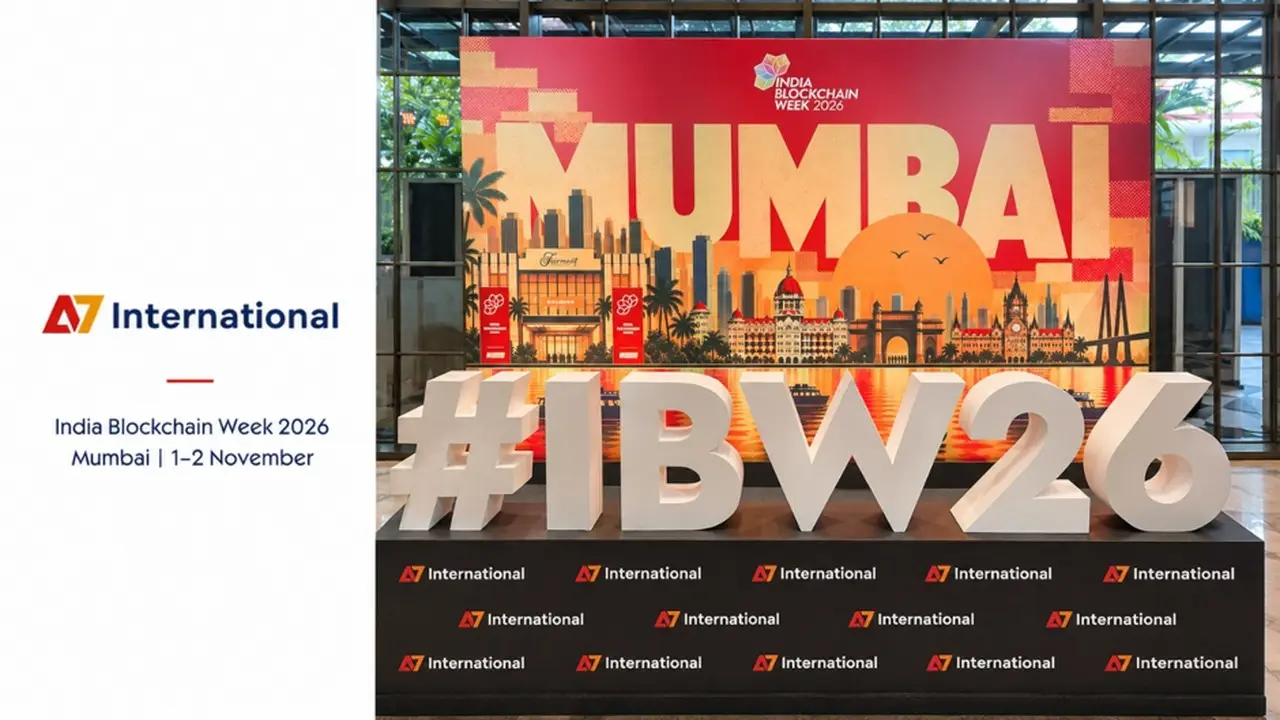
Russian fintech company A7 is looking to expand its cross-border payment services involving India, including a system that allows businesses to pay international invoices using digital currencies while recipients receive funds through conventional bank transfers. The company presented its payment solutions at India Blockchain Week 2026, held in Mumbai on November 1-2.
How does the new digital currency payment service work?
Launched in October 2026, A7 International allows businesses and individuals to pay overseas invoices using USDT, a stablecoin pegged to the US dollar.
According to the company, recipients receive conventional bank transfers in US dollars, euros, Chinese yuan or UAE dirhams. They do not need to hold a cryptocurrency wallet or directly receive digital assets. The service is designed to connect digital-asset payments with traditional banking infrastructure, offering another option for settling invoices with overseas suppliers and business partners. Stablecoins are digital currencies designed to maintain a relatively stable value by being pegged to an underlying asset, often a conventional currency such as the US dollar. USDT, issued by Tether, is among the widely used dollar-pegged stablecoins. Their use in international payments has attracted attention because they can facilitate the transfer of digital value across borders. However, the practical benefits depend on factors such as regulatory requirements, transaction costs, liquidity, banking access and the ability to convert digital assets into conventional currencies.
Why is India an important market?
India is among the markets A7 is targeting as part of its international expansion. According to company data, payments to India between January and August 2026 were 60 per cent higher than the total recorded during the whole of 2025. The company has not provided a detailed breakdown of the transactions or independently verified figures alongside this comparison. Nevertheless, it is using the reported growth to highlight increasing activity through its India-related payment infrastructure. A7 International participated in India Blockchain Week 2026 as a Gold Partner. Its delegation discussed cross-border payment services and potential cooperation with Indian businesses. The company is also exploring a separate payment arrangement between India and Russia, aimed at facilitating transactions in national currencies through local partner banks.
India-Russia explore alternative payment arrangements
Trending Stories

US midterms 2026: Democrats close in on 260 seats, poised for historic House majority since 1991

Trump blames 'Dumocrats' as US stock market plunges; Asian markets crash after US tech sell-off

'Another significant milestone': Rajnath Singh hails successful test of indigenous Pralay missile

The boy in the Manchester United shirt and the legend who gave me a lifetime of memories

With a begging bowl in hand, Bihar officer protests 8 months without salary

The secret cost of using AI tools at work that no one is telling you about

'Shawarma law, not Sharia law': Abdul El-Sayed's joke goes viral after historic Senate win | Video

'Nothing without our approval': Trump says Iran cannot act on nuclear programme

Two Egyptian army officers killed in anti-mining campaign

Houthis put a price on peace with Saudi: $51 billion and recognition as Yemen's rulers - Report

Maharashtra looks to forgotten water architecture as drought deepens

Paraguay President Santiago Pena impeached minutes after his resignation as Ueno bank collapse triggers nationwide protests

Ramayana advance booking: Rs 150 cr collected before release, what it means for day 1

Watch: Ilhan Omar breaks into a dance after securing fifth-term victory amid long-running Trump feud

Bengaluru man kills wife, 6 members of her family for interfering in their marital disputes

Yashar rejects unity govt option after majority backing; urges Herzog to give Eisenkot premiership

Saudi Arabia rolls over $3 billion financing to Pakistan as $10 billion US backstop fades

Why did Sensex jump 2,000 points in biggest rally in months? Key triggers explained

Mahadev app co-founder Ravi Uppal arrested in Dubai days after kingpin Sourabh Chandrakar’s extradition

Trump predicts 'very big' deal wit Russia that could involve 'all of Europe' after meeting Putin's envoy

Patriarchal bias led historians to believe a powerful British female ruler was a man

Harmeet Dhillon resigns as head of Justice Department's Civil Rights Division after 18 months

IGP Sujit Kumar highlights Kashmir Police's expanding role beyond security operations

Arab Parties emerge as kingmakers in Israel, back opposition leader Gadi Eisenkot to form next government

First handshake? Radio signal with all hallmarks of alien technology detected in China

'I am more Indian than Arab': Abdul El-Sayed on his Indian-origin wife

'Final Destination stuff': Flying tyre out of nowhere hits boy on sidewalk in Chile - Video

Trump signals imminent decision on resuming war with Iran after midterm defeat

Dolly Parton's manager moves to drop complaint against late singer's nephew

California Governor Gavin Newsom commutes all 548 death sentences to life without parole

NewJeans' contract details revealed, HYBE responds to questions over artist rights and restrictions

Ramayana: Part 1 post-credit scene explained: Sunny Deol's Hanuman entry, Raghav Juyal as Meghnad steals the show

U19 Asia Cup 2026: Aaryavir Sehwag stars as India thrash Nepal by 10 wickets

IPL 2027: 'He should not be captain', says ex-MI player Ambati Rayudu on Hardik Pandya

US midterms 2026: Meet the Democrats who turned the election upside down and scored big wins across America

New Friday OTT releases (November 6, 2026): I'm Game, Meesaya Murukku 2, Haiwaan- 6 titles to watch this Diwali on Netflix, JioHotstar and more

Ex-CSK coach Hussey joins Australia coaching staff for Ashes, ODI World Cup, and Olympics

Bengal CM Suvendu Adhikari threatens jail for factory blockades, confirms Singur investment talks with Ashok Leyland

LIV Golf, once a rocking force, to shut down after five years of disruption
According to A7, PSB Bank Chairman Petr Fradkov presented the proposed Russia-India payment system to Russian President Vladimir Putin and Indian Prime Minister Narendra Modi during the INNOPROM. India exhibition in New Delhi in September 2026. The proposed system is intended to support payments for education, accommodation, medical treatment, salaries, scholarships and personal transfers. Indian nationals studying and working in Russia are expected to be among the first users to test the proposed arrangement, according to the company. The proposed Russia-India system is separate from A7 International's invoice-payment service launched in October. While the latter uses USDT for international invoice payments followed by conventional bank transfers to recipients, the proposed bilateral arrangement focuses on transactions through national currencies and local banking partners.
Details about its operational launch, participating banks and transaction mechanisms have not been fully disclosed in the supplied announcement.
Why are countries exploring alternatives to traditional payment systems?
Cross-border payments involve several stages, including currency conversion, banking intermediaries and compliance checks. Depending on the countries and institutions involved, these processes can affect transaction costs and settlement times. Businesses engaged in international trade also need reliable ways to pay suppliers and receive funds across different banking systems.
The use of national currencies in bilateral trade is one approach countries have explored to reduce dependence on third-country currencies for settlements.
During his December 2025 visit to India, Russian President Vladimir Putin said national currencies accounted for 96 per cent of commercial payments between Russia and India. Digital currencies and blockchain-based systems are another area attracting attention. They could provide additional payment channels, although their use does not automatically remove the need for regulatory oversight, currency conversion or access to conventional banking services.
Digital currencies face regulatory and operational challenges
Despite growing interest, using digital currencies for international payments involves several challenges. Stablecoins can face regulatory restrictions in different jurisdictions, while businesses must consider compliance requirements, transaction monitoring and the risks associated with digital-asset transfers.
The value stability of a dollar-pegged token also depends on the issuer's ability to maintain its peg and the reliability of its reserves and redemption arrangements. For businesses, the availability of a digital payment option does not necessarily mean that every overseas supplier can accept it or that the recipient can convert the funds into conventional currency without additional costs. As a result, the development of cross-border digital payment infrastructure will depend not only on technology but also on regulatory clarity, banking partnerships and the ability to operate across different financial systems.
What is A7 planning next?
A7 was established in 2024 with the participation of state-owned PSB Bank and focuses on infrastructure for international payments. The company describes itself as Russia's largest payment agent. According to its figures, it processed more than $110 billion in payments during 2025, accounting for approximately 19 per cent of Russian businesses' foreign trade settlements. It also says its infrastructure covers more than 100 countries and serves around 15,000 corporate clients. These figures have been provided by the company and have not been independently verified in the material available for this article. Its participation in India Blockchain Week forms part of its stated effort to develop relationships with Indian partners and expand payment options for businesses and individuals.
The broader question is whether digital currencies and alternative payment infrastructure can become practical additions to international trade. Their adoption will depend on whether they can provide reliable, transparent and compliant ways to move money across borders while maintaining connections with conventional financial systems.
