

&imwidth=800&imheight=600&format=webp&quality=medium "US Supreme Court makes it easier to deport Green Card holders: What does it mean for Indians? | WION Horizons")
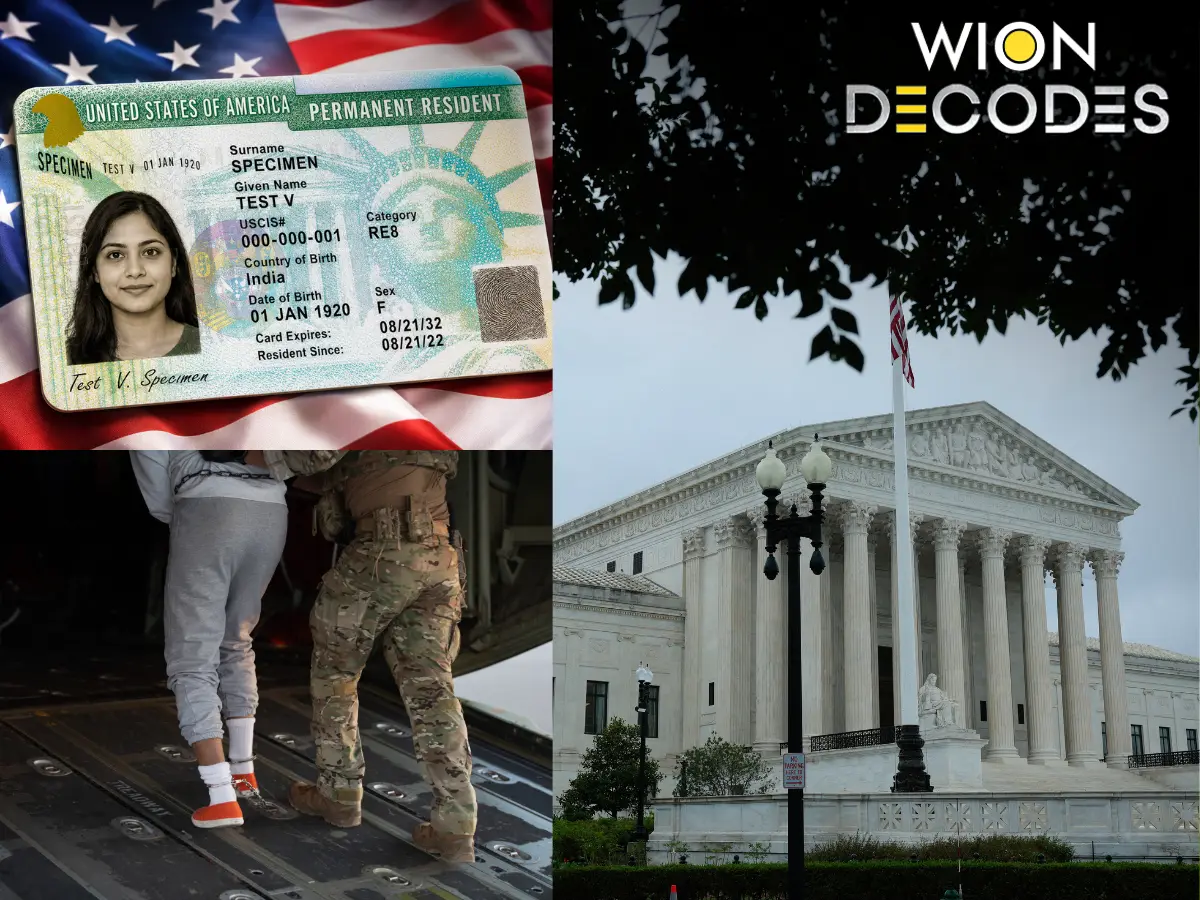
The US Supreme Court on Tuesday (Jun 23) handed the federal government broader powers to deny entry and deport green card holders accused of certain crimes. The court ruled that immigration officials do not have to meet a higher standard of proof when deciding whether a returning lawful permanent resident should be treated as someone seeking admission to the country. The ruling could have major implications for lawful permanent residents, including thousands of Indians living in the United States. It could affect about 6.7 million Indians who were in the US as of January 2026.
What did the Supreme Court rule?
In a 6-3 decision in Blanche v. Lau, the court ruled that immigration authorities do not need to conclusively prove, using "clear and convincing evidence" that a returning Green Card holder committed a disqualifying crime before treating them as someone seeking admission into the country. Instead, border officials only need a "reason to believe" that the person may have committed a crime involving what US immigration law calls "moral turpitude".
"The Immigration and Nationality Act does not impose that requirement," Thomas wrote in the majority opinion issued following the ruling.
The ruling effectively lowers the burden on immigration authorities when deciding whether a returning permanent resident should be allowed back into the country.
Trending Stories
&imwidth=180&imheight=135&format=webp&quality=medium)
'This is humiliation': Vijay Deverakonda under fire over controversial marriage proposal remark on Koffee With Karan 9
&imwidth=180&imheight=135&format=webp&quality=medium)
Shikhar Mohan earns maiden India A call-up, replaces KL Rahul
&imwidth=180&imheight=135&format=webp&quality=medium)
AI slop or smart strategy? South African author Coral Hart defends Her 370 AI- assisted books in 20 months
&imwidth=180&imheight=135&format=webp&quality=medium)
Two BrahMos missiles on Tejas, triple the range and 100% indigenisation, says former BrahMos CEO
&imwidth=180&imheight=135&format=webp&quality=medium)
India-China face-off continues near Arunachal’s Taksing, reveals ITBP chief in first official confirmation of tensions
&imwidth=180&imheight=135&format=webp&quality=medium)
Ilhan Omar breaks silence over alleged marriage to her brother; Trump thinks it's 'really good answer'
&imwidth=180&imheight=135&format=webp&quality=medium)
WATCH: Trump demands Ilhan Omar removal from Congress for 'using fake name to be sworn in'. So what is her real name?
&imwidth=180&imheight=135&format=webp&quality=medium)
Netanyahu dials PM Modi, invites him and Capt Smit Machchhar to light torch on Israel’s Independence Day
&imwidth=180&imheight=135&format=webp&quality=medium)
Pakistan airline PIA unveils new crew uniforms, faces online criticism
&imwidth=180&imheight=135&format=webp&quality=medium)
Christa Pike's failed execution: Tennessee team struggled to insert IV lines, lawyer says
&imwidth=180&imheight=135&format=webp&quality=medium)
Did Neha Bora call for Bangladesh-like GenZ protest, 'anarchy' in India? WION Fact-checks viral claim
&imwidth=180&imheight=135&format=webp&quality=medium)
US midterms 2026: US Supreme Court allows New Hampshire to restrict student IDs for voting
&imwidth=180&imheight=135&format=webp&quality=medium)
A secret code, a midnight escape and 300 deaths: The Russian officer who turned on Putin
&imwidth=180&imheight=135&format=webp&quality=medium)
Trump ordered to answer questions under oath in BBC defamation lawsuit by December 11
&imwidth=180&imheight=135&format=webp&quality=medium)
Putin says Russia is ready to resume Ukraine-US peace talks but rejects 'short ceasefire' amid deadly attacks
&imwidth=180&imheight=135&format=webp&quality=medium)
Horrific video shows the moment 18-year-old fell to her death from Mexico amusement park ride
&imwidth=180&imheight=135&format=webp&quality=medium)
'It's a crime not to see this scene': Tehran puts Trump 'behind bars'
&imwidth=180&imheight=135&format=webp&quality=medium)
IND-W vs ZIM-W, 1st ODI: Rawal, Charani star in India’s nine-wicket win over Zimbabwe
&imwidth=180&imheight=135&format=webp&quality=medium)
Meghan Markle’s father Thomas under investigation over alleged child abuse images: Report
&imwidth=180&imheight=135&format=webp&quality=medium)
SA vs AUS 2nd Test: Temba Bavuma reveals 'Tendulkar inspiration' behind career-best 179
&imwidth=180&imheight=135&format=webp&quality=medium)
China's dancing robot turns violent bodyguard, lifts cars and fights intruders - Watch
&imwidth=180&imheight=135&format=webp&quality=medium)
Watch: India rejects ‘imprecise and unsupported’ references in UN migrant rights report
&imwidth=180&imheight=135&format=webp&quality=medium)
US to get 850 F-35 stealth fighter jets under 10-year Pentagon-Lockheed deal
&imwidth=180&imheight=135&format=webp&quality=medium)
GRAVITAS | Putin fires nuclear-capable hypersonic missiles, Zelensky ready to surrender 25% territory
&im=FitAndFill=(700,400)&imwidth=180&imheight=135&format=webp&quality=medium)
New Friday OTT releases (October 23, 2026): Gajab Raat, Dorothy, Chaar Yaar- Watch these 6 new movies and TV shows on Netflix, Prime Video and more
&im=FitAndFill=(700,400)&imwidth=180&imheight=135&format=webp&quality=medium)
Serbia elections: Nearly 150,000 people take to streets in massive rally against Aleksandar Vucic | In pics
&imwidth=180&imheight=135&format=webp&quality=medium)
BCCI’s CoE cautious over Hardik Pandya’s fitness, sets expected comeback timeline
&imwidth=180&imheight=135&format=webp&quality=medium)
'This is despicable': Amy Acton hits back at Vivek Ramaswamy over Ohio campaign ad featuring her estranged mother
&imwidth=180&imheight=135&format=webp&quality=medium)
First Lady Melania Trump secures ceasefire between Russia, Ukraine in Oleshky: White House
&imwidth=180&imheight=135&format=webp&quality=medium)
Finance influencer dies by suicide in Chennai; father accuses tech CEO, who denies charge
&imwidth=180&imheight=135&format=webp&quality=medium)
'Vivek should keep it up': Trump defends Ramaswamy's controversial campaign ad targeting Amy Acton
&imwidth=180&imheight=135&format=webp&quality=medium)
One man, 8 months of work, and a river dirty again: Why Bittu Tabahi may quit
&imwidth=180&imheight=135&format=webp&quality=medium)
450 villagers in UP rush to take anti-rabies shots after consuming 'charnamrit'
&imwidth=180&imheight=135&format=webp&quality=medium)
US midterms 2026: Elon Musk’s political spending hits $445 million as Republicans battle to retain Senate control
&imwidth=180&imheight=135&format=webp&quality=medium)
ENG vs SL: Harry Brook breaks Shubman Gill’s record for fastest ODI double century
So what exactly has changed? WION Decodes below.
What is a "crime involving moral turpitude"?
The phrase has long existed in US immigration law but remains broadly defined.
According to the Immigrant Legal Resource Center (ILRC), US immigration law uses the term "crime involving moral turpitude" (CIMT) to describe offences considered inherently dishonest, immoral, or harmful. However, notably, there is no single, universally accepted definition.
Traditionally, US immigration authorities and courts have treated crimes involving fraud, theft, forgery, serious assault, and offences involving an intent to cause significant bodily harm as CIMTs. Some crimes involving recklessness, malicious conduct, or sexual offences committed with lewd intent can also fall under the category.
According to immigration guidance, authorities generally look for factors such as:
- Intent to defraud another person
- Intent to permanently deprive someone of property
- Intent to cause serious bodily harm
- Certain reckless or malicious actions
- Sexual offences involving lewd intent
- Also read | Trump just made it nearly impossible for Indians to work in the US — Here's how
Blanche v. Lau: What was the case about?
The case involved Muk Choi Lau, a Chinese national and Green Card holder, who was stopped at New York's John F. Kennedy International Airport in 2012 while returning from China. At the time, Lau was facing trademark counterfeiting charges in New Jersey. He was eventually allowed to be conditionally readmitted. Lau was later convicted, and immigration authorities sought to deport him.
However, Lau continues to argue that the offence did not qualify as a crime involving moral turpitude and challenged the government's actions. The Supreme Court ultimately sided with immigration authorities.
Why does this matter for Indians?
Indians make up one of the largest immigrant communities in the United States.
According to India's Ministry of External Affairs, around 6.7 million people of Indian origin and Indian citizens were living in the US as of January 2026. That includes roughly 3.77 million people of Indian origin and 2.31 million Non-Resident Indians (NRIs).
Data from the US Office of Homeland Security Statistics shows that 66,800 Indians received Green Cards in 2024, making India one of the largest sources of new lawful permanent residents.
What are critics saying?
The court's three liberal justices dissented. In a dissent note, Justice Ketanji Brown Jackson warned that the decision gives the government excessive power and weakens protections traditionally available to Green Card holders.
"I worry that the court has now handed the government a massive blank check," she wrote.
She further noted that "With today's decision, the Court allows the government to return an LPR to the status of 'seeking admission' upon his entry at the border, so long as the government is able to show later that he was eventually convicted. That sequencing undermines the plain terms and basic operation of the law."
Critics argue that lawful permanent residents, many of whom have lived and worked in the US for years, could now face greater uncertainty when travelling abroad if they have unresolved criminal allegations or past convictions.
Does this mean Indians and other immigrants can be automatically deported from the US?
No, the ruling does not mean Green Card holders can be deported automatically. However, it does make it easier for immigration authorities to deny entry and to strip lawful permanent resident (LPR) status from people as they arrive at U.S. ports of entry if and when criminal concerns arise.

