
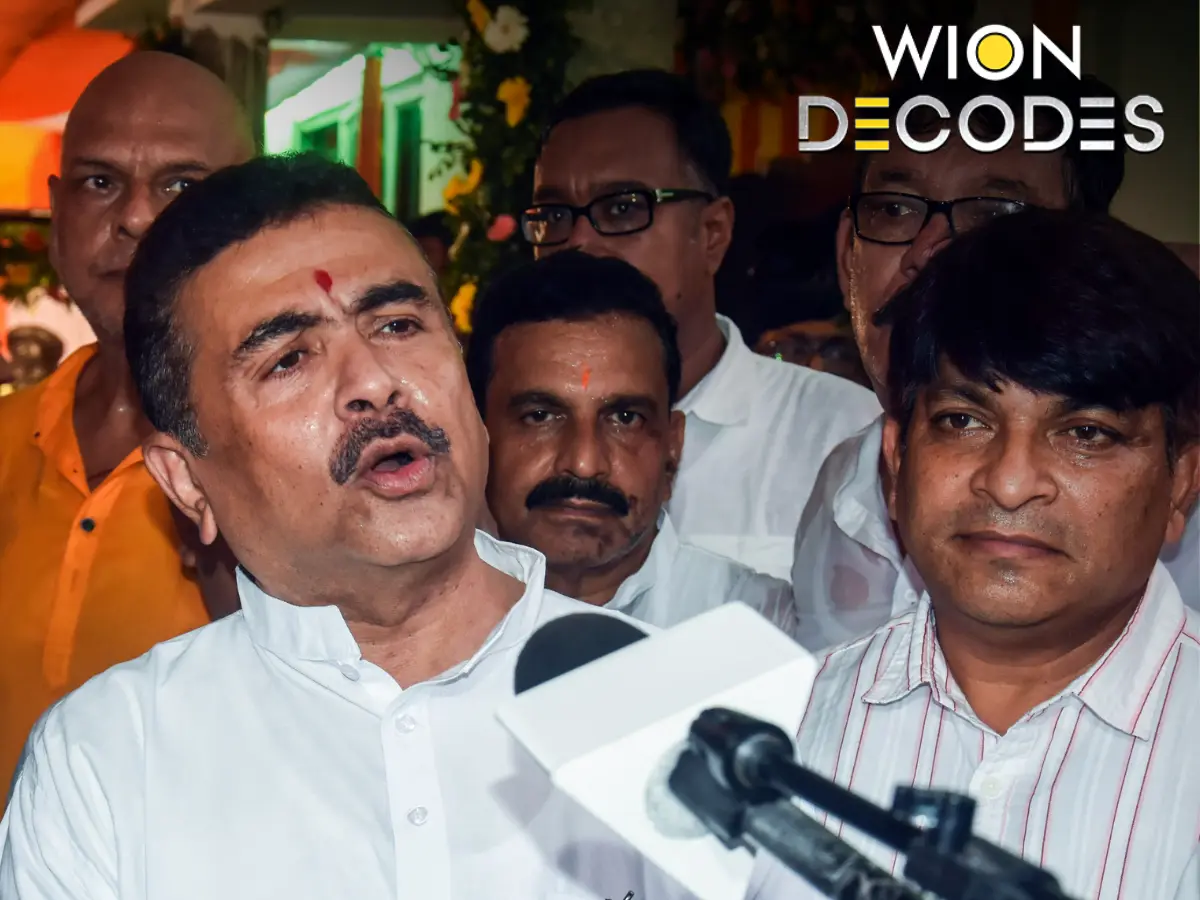
&imwidth=800&imheight=600&format=webp&quality=medium "Suvendu Adhikari proposes anti-conversion law to tackle 'love jihad' in West Bengal: Key provisions, penalties and more | WION Decodes")
West Bengal Chief Minister Suvendu Adhikari on Friday (Jun 26) announced that his government will enact a strict anti-conversion law in West Bengal, while also implementing the Uniform Civil Code (UCC) and the National Register of Citizens (NRC) in the state. The proposals could significantly reshape the state's legal landscape and are likely to trigger intense political, legal and constitutional debates. While the final drafts have not yet been made public, clues from BJP statements, existing laws in other states and recent policy positions offer a glimpse of what could be on the table. Here's what we know.
What is the proposed anti-conversion law?
Addressing a programme at Rabindra Sadan to mark the 150th anniversary of Vande Mataram, Adhikari proposed an anti-conversion law for West Bengal. He alleged that infiltration through the state’s international border had contributed to religious conversions, “love jihad”, and demographic changes. This, Adhikari said, poses a threat to West Bengal’s social fabric and national security. However, he did not provide evidence to support the claims.

Notably, anti-conversion laws already exist in several BJP-ruled states, including Uttar Pradesh, Madhya Pradesh, Uttarakhand and Gujarat. These laws are generally aimed at preventing religious conversions carried out through force, fraud, coercion, inducement or misrepresentation.
If West Bengal follows a similar template, the law could include:
Trending Stories
)
Justice eludes Air India 1985 bombing victims as Canada probe goes 'inactive' | Gravitas
)
Trump revives India-Middle East-Europe economic corridor as India emerges central to West Asia’s future: What is it?
)
Erdogan again raises Kashmir issue at UNGA, calls for dialogue under UN Charter
)
Major League Soccer referee sacked for sexist comment about female match referee
)
Trump signs Greenland security deal with Denmark, paving way for two new US military bases
)
IND vs JPN T20I: How an overturned wide became point of difference between India's win and a tie
)
Trump-Xi summit: From trade to Taiwan, what will the US and Chinese presidents discuss in Washington?
)
Cyclone Arnab: Landfall expected before midnight tomorrow as IMD issues orange alerts across six states
)
ICC plans T20I expansion and fewer ODIs in 2027–2031 FTP cycle: Report
)
US-China tech war: Businesses in the front line
)
'Mumma’s boy from Gwalior who dared to dream': Kartik Aaryan pens long note after first National Award win
)
Gravitas | Boosting NHS productivity could save 20,600 lives in UK annually: Report
)
Nor'easter could batter 13 US states this week. What you should know
)
US and China vie for AI dominance as calls grow for regulation | Gravitas
)
Yemen clashes kill 154 people in two days as cornered Saudi battles Houthi offensive | Gravitas
)
Bomb scare in New York amid UNGA: Suspicious suitcase found near UN headquarters
)
IND vs JPN, one-off T20I: Japan captain Kendel on pushing India to the brink - ‘It was special’
)
Mikel Arteta verbally agrees to three-year extension with Arsenal after title-winning Premier League season
)
WION Iconic Tourism Summit and Awards 2026: Key voices to discuss India’s tourism future
)
WION Iconic Tourism Summit and Iconic Awards 2026: India's travel economy leaders gather in Delhi
&im=FitAndFill=(700,400))
New OTT releases this week (September 21-27, 2026): Shaque: Trust No One, Hunkkaar, Don’t Be Shy- 5 new titles coming to Netflix, Prime Video and more
)
81st UN General Assembly: Burnham announces UK-US AI defence tie-up
)
Trump calls on nations to quit ‘rogue’ and ‘out-of-control’ International Criminal Court, rips UN
)
Infections transmitted from pregnant woman linked to autism risk
)
'What kind of confession is this?': Pakistan PM Shehbaz Sharif’s 'terrorists would be roaming New York' remark goes viral, raises alarm online. Watch
)
Elephants hide behind trees, stage surprise attack on poachers targeting rhinos in South Africa
)
IIT Bombay professor Suryanarayana Doolla sent on leave amid Sahil Wakode death probe
&im=FitAndFill=(700,400))
National Film Awards 2026: Kartik Aaryan, Mammootty, Yami Gautam, Randeep Hooda and other key winners
)
El Niño 2026 heats up to become strongest in 1,000 years
)
Anne Hathaway to run in supporting race for Nolan's epic
)
Over 4,200 books withdrawn from circulation in J&K colleges, 94% from Kashmir
)
From Gaddafi tearing up UN Charter to Trump’s ‘escalatorgate’: Most unforgettable UNGA moments
)
Explainer: Why rare-earth export licences and Board of Trade are US priorities ahead of Trump-Xi summit
)
Asia prepares for record El Nino, food shock
)
Forget apps: Qualcomm CEO says AI agents will change how we use smartphones
)
Four female students raped during 'Red Zone' at California university. What we know
- Ban on forced or fraudulent conversions: Conversions obtained through coercion, threats, deception, marriage solely for conversion purposes or material inducements could be declared illegal.
- Advance notice requirements: Individuals seeking to convert may be required to notify district authorities before and after the conversion process. Religious officiants conducting conversions could also face reporting obligations.
- Criminal penalties: Violations may attract prison terms and financial penalties, with stricter punishment in cases involving women, minors, Scheduled Castes, Scheduled Tribes or persons with disabilities.
- Burden of proof provisions: Like some existing state laws, the responsibility to prove that a conversion was voluntary could shift partly onto the person conducting or facilitating the conversion.
How could West Bengal's law differ from other states?
The proposal appears likely to go beyond conventional anti-conversion legislation in three ways.
- First, BJP leaders have repeatedly linked religious conversion with what they describe as "land jihad", suggesting that property transactions and land ownership issues may become part of the legal framework.
- Second, the proposal is being discussed alongside concerns about illegal immigration and border security. Given Bengal's long international border with Bangladesh, enforcement mechanisms could be tied more closely to identity verification and residency issues.
- Third, the anti-conversion law is expected to be introduced alongside a Uniform Civil Code, creating a broader package of legal reforms rather than a standalone measure.
What is the Uniform Civil Code?
A Uniform Civil Code seeks to replace religion-specific personal laws with a common set of rules governing civil matters, such as:
- Marriage
- Divorce
- Adoption
- Maintenance
- Inheritance
- Succession
Supporters argue that a common civil code promotes equality before the law. Critics contend that it may affect religious freedom and cultural autonomy.
How could a UCC affect existing personal laws?
If implemented, the UCC could override or replace civil provisions contained in several personal laws, including:
- Hindu Marriage Act, 1955
- Hindu Succession Act, 1956
- Hindu Adoptions and Maintenance Act, 1956
- Indian Christian Marriage Act, 1872
- Indian Divorce Act, 1869
- Parsi Marriage and Divorce Act, 1936
- Muslim personal laws governing marriage, divorce and inheritance
Marriage and live-in relationships
A common framework could standardise marriage registration, minimum age requirements, consent provisions and rules governing live-in relationships, regardless of religion.
Divorce and maintenance
Different religious procedures for divorce could be replaced by a single legal process. Rules relating to alimony, maintenance and child custody may also become uniform.
Inheritance and property rights
One of the most significant changes could involve inheritance laws. A UCC could establish common rules on property distribution among heirs, replacing religion-based succession systems.
Adoption
A uniform law may allow all citizens equal access to legal adoption frameworks, irrespective of religious affiliation.
Succession and wills
The code could create standard rules governing estates, wills and succession rights, reducing variations across communities.
Why is the proposal significant?
Unlike some states that have debated or implemented aspects of a Uniform Civil Code, West Bengal would be the first large state with a substantial Muslim population, around 27 per cent according to recent estimates, to move towards such a framework.
That makes the proposal politically significant as well as legally consequential.
The final shape of both laws will depend on the text eventually introduced in the legislature. However, if implemented as outlined by BJP leaders, West Bengal's anti-conversion law and Uniform Civil Code could become among the most far-reaching legal reforms undertaken by any Indian state in recent years, affecting everything from religious conversions and marriage registration to inheritance rights and family law.

