

&imwidth=800&imheight=600&format=webp&quality=medium "PM Modi to flag off India's first hydrogen train between Jind and Sonipat: Here's how it works")
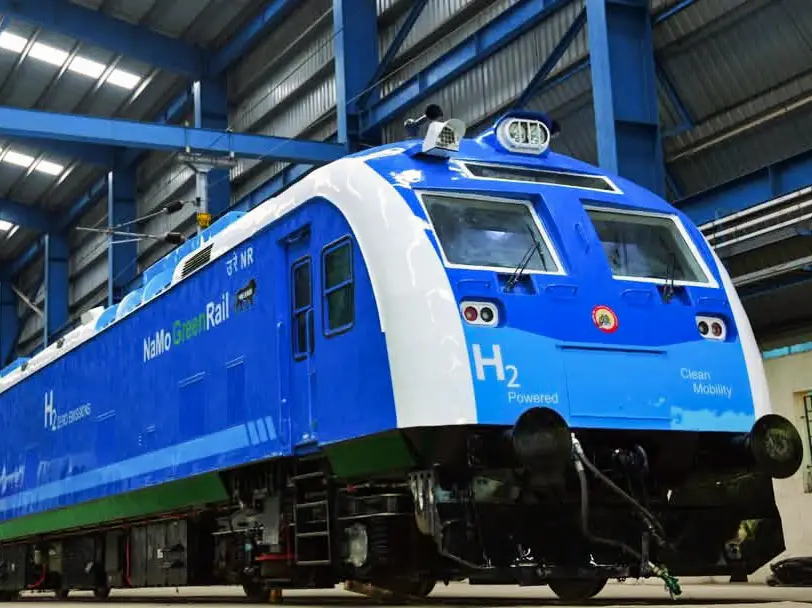
India is set to get its first hydrogen-powered train on Friday as Prime Minister Narendra Modi announced that he will flag off the service between Jind and Sonipat in Haryana. The Prime Minister said the launch will place India among a select group of nations that have successfully demonstrated the technology.
Calling it an important step towards cleaner transportation, Modi said the hydrogen-powered train reflects India's growing focus on adopting clean technology in the railway sector.
"From Jind tomorrow, India’s first hydrogen-powered train will be flagged off, which will connect Jind and Sonipat. India becomes one of the select group of nations that has such trains. This will go a long way in ensuring that India adopts clean technology in the railway sector," he wrote on X.
The launch follows the completion of one of the world's largest railway electrification drives, with more than 99 per cent of India's broad gauge network now electrified. The Hydrogen Fuel Cell Trainset marks the next stage of this transition by generating electricity onboard while producing only water vapour and heat as by-products. The project also establishes the country's first integrated hydrogen railway ecosystem, covering hydrogen production, storage, refuelling infrastructure and train operations.
Also Read: Stampede-like situation during India's Puri Rath Yatra festival: One feared dead, say reports
How a hydrogen train works
Trending Stories
India's first Hydrogen Fuel Cell Trainset generates its own electricity using hydrogen instead of overhead electric lines or diesel engines. It relies on a hydrogen fuel cell that produces electricity through a chemical reaction between hydrogen and oxygen, with heat and water vapour as the only by-products.
Power is generated through a Proton Exchange Membrane fuel cell. Hydrogen stored in cylinders on the train combines with oxygen from the air inside the fuel cell to produce electricity. The electricity powers the traction motors that drive the wheels without combustion, resulting in zero smoke or tailpipe carbon emissions.
Indian Railways has established what it describes as the country's largest railway hydrogen refuelling facility at Jind. The process begins with hydrogen production through electrolysis, where electricity is used to split water into hydrogen and oxygen.
Jind to Sonipat route and key stations
The 10-coach train can accommodate around 2,600 passengers and will operate on the 89-kilometre Jind to Sonipat section of the Northern Railway in Haryana.
The route connects Jind Junction, Gohana Junction and Sonipat while serving intermediate stations and proposed halts, including Jind City, Pandu Pindara Junction, Lalit Khera Halt, Bhambhewa, Isapur Kheri Halt, Butana Halt, Khandrai Halt, Rabrah Halt, Lath Halt, Mohana, Barwasni Halt and Sonipat New.
The train will initially run at a maximum speed of 75 kmph on the Jind to Sonipat route. However, it has been designed for a top speed of 110 kmph.
With the launch, India joins a select group of countries that possess hydrogen-powered rail technology. Germany pioneered the commercial use of hydrogen-powered passenger trains, while Japan, China, Italy and France are currently undertaking restricted pilot programmes or limited deployments.
