ISRO EOS-05 launch: GSLV to lift heaviest payload in its 25-year flight history

&imwidth=600&imheight=450&format=webp&quality=medium "ISRO EOS-05 launch: GSLV to lift heaviest payload in its 25-year flight history")
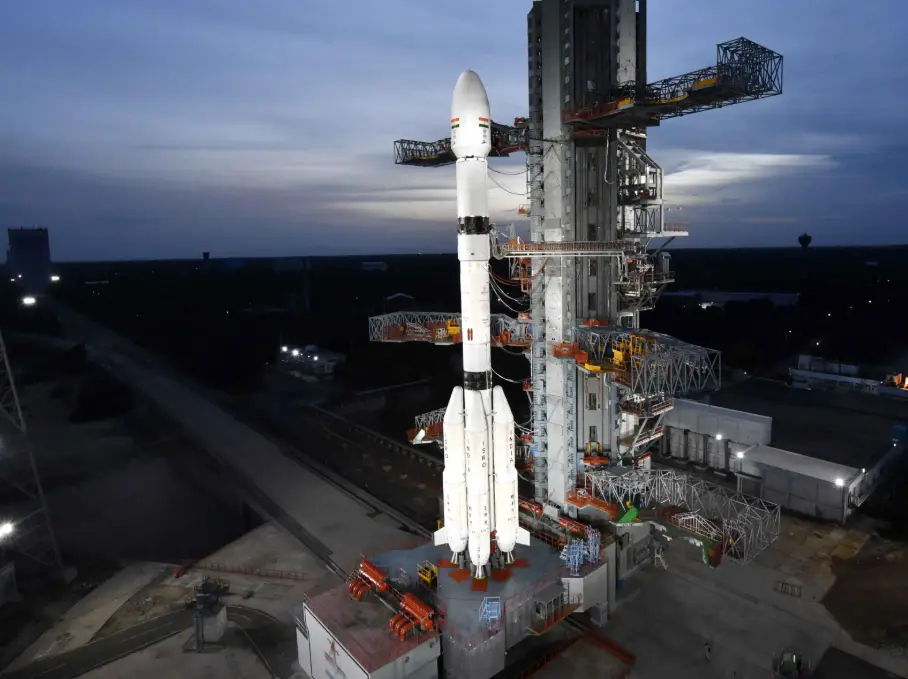
ISRO's heavy lift: GSLV prepares for historic EOS-05 launch Photograph: (Credit: ISRO)
ISRO prepares for the historic EOS-05 mission as the GSLV rocket (designated GSLV-F17) is set to carry its heaviest payload in the vehicle's 25-year flight history.
India's GSLV rocket, also known as GSLV Mk2, is expected to lift off from the second launchpad at Satish Dhawan Space Centre, Sriharikota, carrying the 2,367 kg EOS-05 satellite to space at 2:55 am Indian time on Friday (Sep 4). In the 25-year operational history of this launch vehicle, this will be the heaviest payload that it will carry. In the mission dubbed ‘GSLV-F17/EOS-05,’ the GSLV-F17 rocket will carry a strategic-use Earth-imaging satellite known as GISAT-1A or EOS-05, a replacement for the GISAT-1 that ISRO lost during a mid-flight GSLV-F10 rocket failure in August 2021.
The 27-hour, 30-minute countdown to this mission commenced at 11:25 pm on Wednesday and has been progressing smoothly, officials at the ISRO spaceport in Sriharikota confirmed to this author. The countdownis a well-planned technical process during which the final health checks of various systems of the rocket and satellite are carried out, and the liquid-fuelled stages of the rocket are tanked up. The GSLV rocket is powered by three stages: the first one includes four liquid-fuel boosters and one solid-fuel motor, while the second stage has a liquid-fuel engine, and the final stage is a cryogenic engine powered by super-cooled liquid hydrogen and liquid oxygen.
Weighing over 2,200 kg, the EOS-05/GISAT-1A is an agile Earth observation satellite that is eventually to be placed in geostationary orbit, about 36,000 km above the Earth. It is also India's first imaging satellite to be placed in such a high perch. Typically, imaging satellites are placed around 600 km above the Earth.
This EOS-05 satellite is meant to provide near real-time imaging of large-area regions of interest at frequent intervals for quick monitoring of natural disasters, episodic events and any short-term events, to obtain spectral signatures for agriculture, forestry, and water bodies as well as for disaster warning, cyclone monitoring, cloud burst/thunderstorm monitoring, etc.
Also read: 2/3rd of glacier detached, collapsed: ISRO satellite images reveal what triggered Nepal floods
First GSLV launch to Sub-GTO
Typically, heavy satellites used for communication and broadcast purposes are carried to a temporary parking orbit known as GTO, and then the satellite fires its engines to reach the final destination. In the 25-year operational history of the GSLV rocket, this mission marks the first time that the rocket would be carrying a satellite to a sub-GTO orbit or an orbit lower than Geosynchronous Transfer Orbit (GTO).
Trending Stories
)
)
&im=FitAndFill=(700,400))
)
)
)
)
)
)
)
)
)
)
)
&im=FitAndFill=(700,400))
)
)
)
)
)
)
)
)
)
)
)
)
)
)
)
&im=FitAndFill=(700,400))
)
&im=FitAndFill=(700,400))
A satellite in a GTO would be 170-200 km above Earth at its nearest approach (perigee) and about 36,000 km above the Earth at its farthest approach (apogee). However, the EOS-05 will first be hurled into sub-GTO by the GSLV-F17 rocket, where it will be 170 km above the Earth (perigee) and 28,934 km above the Earth (apogee).
In simple terms, let's say that an elevator can carry 10 people and lift them to the 10th storey of a building. But when 11 people get in, it can only go up to the 7th floor. The passengers will have to get down at the 7th floor and then climb to the 10th floor. The elevator has not become more powerful to lift 11 people, instead, the effort is being distributed differently between the elevator and the passengers. Similarly, the GSLV rocket has not become more powerful to lift its heaviest-yet satellite; instead, the rocket and satellite are distributing the lifting effort among themselves. ISRO officials explained to this author that this launch is being carried out to Sub-GTO, as the GSLV rocket's lifting power to GTO cannot be enhanced any further.
Given that the EOS-05 exceeds the lifting power of this rocket to the GTO orbit, ISRO is to loft it to sub-GTO and then use satellite thrusters to raise the orbit.
So far, the GSLV rocket has predominantly lifted satellites weighing less than 2,300 kg to GTO. While it did attempt to carry the 2,310 kg GSAT-5P satellite in the GLV-F06 mission in the year 2010, the rocket faced a mid-flight anomaly, causing a mission failure and loss of the satellite.
An ISRO launch after 7 months of lull
The launch will also mark the end of ISRO's seven-month period of lull. The government-run ISRO has not launched any of its rockets so far in 2026, after the mid-flight failure of the PSLV-C62 rocket in January this year, which happened to be the second PSLV failure in a row. The PSLV-C61 rocket had also failed mid-flight in May 2025. Such back-to-back failures are unprecedented in the 33 years of PSLV flights. While the C-61 carried ISRO's strategic-use Earth-imaging satellite EOS-09, the C-62 carried an Earth-imaging satellite EOS-N1 and more than a dozen customer satellites.
