
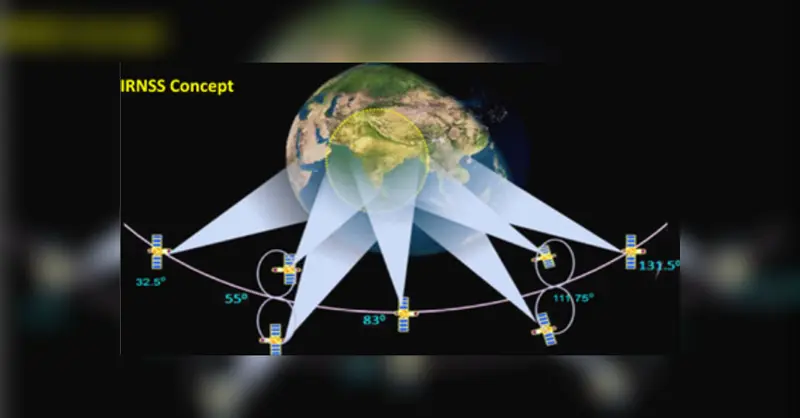
India’s strategic NAVIC (Navigation with Indian Constellation) series of satellites, built and maintained by the space agency ISRO, are nearly defunct, with only a bare minimum of four among 11 satellites fulfilling their core purpose, government data shows. Of these four operational satellites, one (IRNSS-1B) has already exceeded its planned life of 10 years and could stop functioning anytime, while another (IRNSS-1F) has less than a year to complete its decade in service and has suffered partial equipment failure. NAVIC is India’s own version of America’s GPS, Russia’s GLONASS, China’s Beidou and Europe’s Galileo systems. According to ISRO, India’s NAVIC constellation is meant to have five or seven operational satellites. At present, the depleted and near-defunct fleet of NAVIC satellites requires urgent replacement, given that they serve India’s strategic forces and are meant to augment warfighting capabilities.
While GPS, GLONASS, Beidou, Galileo provide global coverage, India’s NAVIC provides services only in the Indian neighbourhood (Indian mainland and 1,500 km beyond Indian borders). The Indian Government decided to fund and operationalise the NAVIC series of satellites, after precise GPS services were denied to the Indian military amid the 1999 war against neighbour Pakistan. It is well established that all operators of GPS-like satellite constellations use them for civilian and military purposes.

According to the Indian space agency ISRO, which builds and operates NAVIC, the constellation of satellites serves terrestrial, aerial, and maritime navigation, precision agriculture, emergency services, and fleet management, Location-based services in mobile devices, marine fisheries, timing services for financial institutions, power grids, and other government agencies, Internet-of-Things (IoT) based applications, and strategic applications.
As is the case with GPS and other foreign services, NAVIC is also meant for use by the Indian armed forces for navigation, assigning targets to and guiding drones, missiles, smart bombs, precision-guided munitions, among others. It is learnt that NAVIC-based systems are in active use and are also being integrated with more warfighting systems of the Indian Armed Forces.
Five of eight First-generation NAVIC satellites failed
Between the year 2013 and 2018, ISRO launched a total of nine NAVIC satellites, which were then known as Indian Regional Navigation Satellite System (IRNSS). These satellites in the first-generation series were designated as IRNSS1A, 1B, 1C, 1D, 1E, 1F, 1G, 1H, 1I.
Of these nine, IRNSS 1H failed to reach orbit, due to a rocket-related failure. Therefore, only eight IRNSS satellites were successfully placed in orbit.
Trending Stories
)
The Early Spring is proof not everyone can talk about their real feelings, and it is perfectly OK
)
UN votes to ‘correct the map’ as India backs fairer world view
)
Nigerian Navy discovers 99,000 litres of suspected stolen, illegally refined products as it intensifies anti-crude oil theft operations
)
Who is Aditi Paudel? 17-year-old becomes Japan's first literacy ambassador
)
Bengaluru: Officials find 40 kg expired chilli at chairman's club
)
Jaishankar rejects trade link to ending Ukraine war
)
Israeli strikes on Lebanon kill three, injure 23 despite truce
)
Alpine glacier was covered with sheep wool sheets to prevent melting. It worked
)
South Korea mulls deploying military assets to Strait of Hormuz
)
World's fifth-largest economy, British army can't afford to train
)
Breaking | Vance takes the podium: First White House briefing since Leavitt's exit
)
Taiwan raises 'concerns' over China's missile test
)
BRICS 2026: $1 trillion sovereign capital set to converge in Delhi for first iBRICS Summit
)
What is Iran's Pickaxe Mountain that Trump has again threatened to bomb?
)
UN votes to correct world map that visually shrank Africa for 450 years
)
Former NewJeans member Danielle launches YouTube channel, hints at new solo journey
)
Bangladesh batter Towhid Hridoy creates history with 350 not out in South Africa
)
Brendan Fraser’s transformation fuels The Mummy 4 excitement as fans welcome back Rick O’Connell
&im=FitAndFill=(700,400))
Krishna Janmashtami 2026: From Dhaniya Panjiri to Makhana Kheer- 5 best sweet dishes perfect for celebrating Lord Krishna’s birth
)
Donald Trump plans to travel to Ireland on Qatari-donated jet amid security concerns
)
Nazi-looted art to return to Jewish heirs
)
Eight killed in Kerala’s Thrissur after car rams into lorry parked on highway
&im=FitAndFill=(700,400))
Why Russian fighter jets use bulky, low-pressure tyres compared to US jets
)
FBI-wanted fraud accused arrested in Jalandhar over $600,000 scam
&im=FitAndFill=(700,400))
Why US tanks weigh over 20 tons more than Russian tanks
&im=FitAndFill=(700,400))
New Friday OTT releases (September 4, 2026): GDN, Dhamaal 4, Jagamae Sangeetham- Watch 6 new movies and TV shows on Netflix, Prime Video and more
)
Killing the Himalayas slowly: Human urine is melting a glacier on Mount Everest
Of these eight IRNSS satellites in orbit, over the years, five satellites (1A, 1C, 1D, 1E,1G) have experienced a total failure of all three atomic clocks. Each satellite carries three onboard atomic clocks and all of them failed, government data sourced via RTI shows. Further, the 1F satellite has witnessed the failure of two of three atomic clocks. According to ISRO, these atomic clocks have been sourced from Swiss firm SpectraTime, a leading provider of such high-precision atomic clocks.
As per government data, of the eight first generation satellites only three—1B, 1F, 1I—satellites are fully functional and providing Position, Navigation, Timing Services. Among these three, 1B has already exceeded its planned life of 10years (which means it could become defunct soon), while 1F has less than a year to complete its planned decade in service, but it also faces partial atomic clock failure. 1I was launched it 2018 and it expected to work till 2028, but doubts remain given the other five premature failures.
One of two Second Generation NAVIC satellites failed
In order to replace the ageing fleet of IRNSS (first gen NAVIC) satellites, ISRO began launching the NVS-series of satellites. NVS is meant to be a constellation of five satellites. ISRO launched NVS-01 in May 2023 and that satellite has been working as designed, but the successor satellite NVS-02 which launched in January 2025 failed to reach its destined orbit. The satellite remains stuck in its initial orbit, as the satellite’s onboard engine could not fire to lift it higher. Stuck in the initial orbit, NVS-02 cannot provide Position, Navigation, Timing services. So far, ISRO has not publicly revealed the exact cause that led to the engine not firing.
NAVIC satellites need urgent replacement; ISRO must speed up
With only four operational satellites (1B, 1F, 1I, NVS-01), another failure could render NAVIC completely ineffective and inaccurate, which also affects Indian Armed Forces and their warfighting capabilities. Therefore, ISRO needs to urgently launch NVS-03, NVS-04, NVS-05. The Indian government has said in Parliament that all three remaining NVS satellites would be launched by the end of 2026. However, this seems like an unrealistic timeline, given ISRO’s pace so far.
ISRO launched NVS-01 in May 2023; NVS-02 was launched in January 2025, which shows a gap of 19 months between the two launches. With NVS-02 having failed, ISRO would have to conduct thorough studies and work towards preventing similar failures in subsequent missions, and this whole process could take time. Further, the flaws identified must be corrected and software/hardware changes must be implemented in the upcoming NVS satellites.
At the time of writing, ISRO has conducted only two launches in seven months of 2025 and both these missions have failed. In the first mission, NVS-02 satellite failed to reach orbit, and in the second mission the PSLV-C61 rocket failed mid-flight and the EOS-09 Earth-imaging satellite was also destroyed in the process.
In recent years, ISRO has been performing a maximum of five or seven launches in a calendar year. Therefore, ISRO needs to work on both the rocketry front and the satellite front to ramp up its launch activity, ensure a higher rate of mission success and reliability, so that India's public-funded NAVIC can get back on track, in addition to a host of other critical missions.
