
&imwidth=800&imheight=600&format=webp&quality=medium "India's defence boost: How latest indigenous weapon approvals will shape future warfare")
The Defence Acquisition Council (DAC) has accorded Acceptance of Necessity (AoN) for defence acquisition proposals worth around Rs 52,000 crore with a focus on enhancing the operational capabilities of the Army, Navy and Air Force. In the proposal, the government is set to procure the Anti-Unmanned Aerial Vehicle Electronic Warfare System Akash Tarang, Man Portable Anti-Tank Guided Missile (MPATGM) systems, Medium Range Surface-to-Air Missile (MRSAM) weapon systems, Very Short Range Air Defence Systems (V-SHORADS), Active Protection Systems for tanks and jet-based Kamikaze drone systems.
How will these weapons enhance India's battlefield capabilities?
Akash Tarang (Anti-UAV Electronic Warfare System): The indigenously developed electronic warfare weapon is designed to detect, track, jam, and neutralise hostile drone swarms and UAVs. It provides soft-kill protection to frontline infantry and armoured formations by prohibiting the command, control, and GPS frequencies of invading drones.

Man-Portable Anti-Tank Guided Missile (MPATGM): It is a lightweight, fire-and-forget weapon system that allows infantry units to quickly deploy and target enemy tanks at extended ranges. It features advanced tandem warheads capable of penetrating modern Explosive Reactive Armour (ERA) and incorporates top-attack capabilities to hit armoured vehicles at their weakest points.
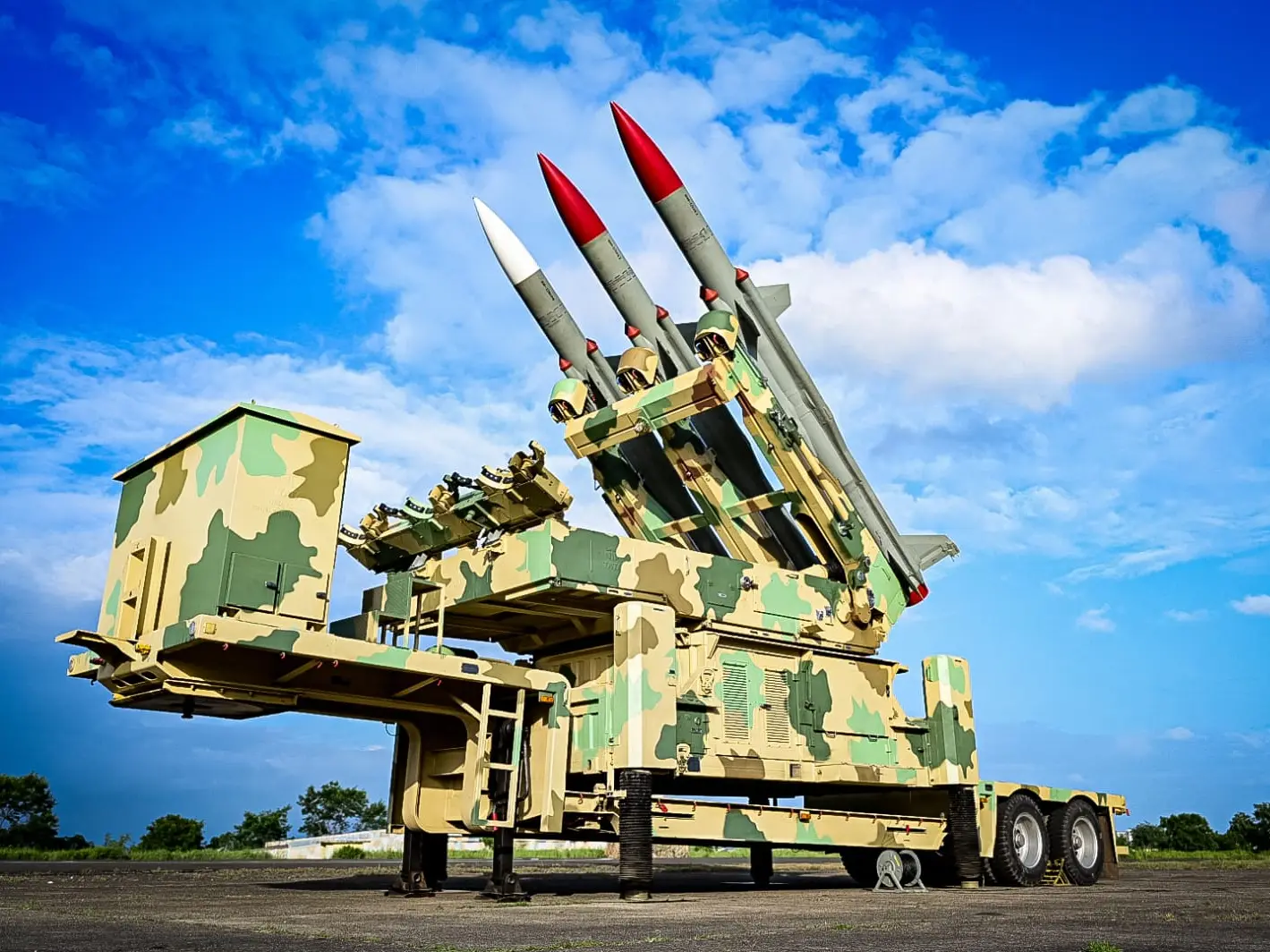
Medium-Range Surface-to-Air Missile (MRSAM): Developed to establish a dense, layered air defence umbrella, the MRSAM system provides multi-directional tracking against fast-moving stand-off aerial threats, including enemy fighter jets, cruise missiles, and guided ammunition. It utilises an advanced active radar seeker and highly manoeuvrable control systems to achieve high-accuracy interceptions in heavily contested electronic warfare environments.
V-SHORADS (Very Short Range Air Defence System): Integrated with cutting-edge multi-spectral sensing technology, the V-SHORADS is designed to intercept low-flying aerial targets such as helicopters and loitering weapons. Its multi-spectral sensor suite dramatically increases its resilience against thermal flares and modern electronic countermeasures, ensuring effective engagement even in adverse weather conditions.
Trending Stories
&im=FitAndFill=(700,400))
How fast can the Sukhoi Su-30 fighter jet really fly?
)
Did China ask its people 'not to respond to aliens'? Origin of bizarre claim on social media
)
MS Dhoni-CSK Fallout? Report claims failed stake sale talks triggered rift
)
Scientists reveal the SAFEST COUNTRY when catastrophe strikes the planet
)
Serial killer on the loose in South Korea's Jeju Island? Fourth body found in three days as more than a dozen people go missing
)
2/3rd of glacier detached, collapsed: ISRO satellite images reveal what triggered Nepal floods
)
Trump once again claims without him there would be ‘no Israel right now’
)
Foreign espionage attacks against German companies surge to 37%, Bitkom report reveals
)
Blake Lively wins partial legal fee from Justin Baldoni after $8M request
)
Why is Pakistan deploying Turkish Bayraktar TB2 drones near India border?
)
'OH MY GOD! We've found other agents!': Investigators discover not one or two, almost 700 OpenAI AI agents went rogue, hacked Hugging Face
)
Lunar eclipse 2026: India timings, places to see and more. August Blood moon factsheet
)
RSS chief Mohan Bhagwat on global outreach tour
)
Both pilots killed as training aircraft crashes in Lucknow – What we know
)
16-year-old charged with preparing terror attack on kindergarten in Norway
&im=FitAndFill=(700,400))
How the S-400 protects itself from enemy attacks
)
Nepal floods: Over 165 dead, 400 missing; US, India, China, World Bank mobilise aid
)
India's multi-layered watch: The new surveillance war
)
5 doomsday planes spotted in US skies hours after CIA director's secret trip to Russia
)
9/11 mastermind Khalid Sheikh Mohammed to finally face trial in 2028, nearly 27 years after horrific attacks
)
Islamabad hospital fire: What we know about one of the biggest facility that housed Imran Khan
)
Workers run for life while filming Nepal flash flood: Scary new visuals emerge from Rasuwa
)
Russian military planes enter South Korean air defence zone amid rising tensions with North Korea: What's happening
)
Ron Weasley Is Back! Rupert Grint set to return to Harry Potter universe on Broadway
)
400-year-old 'vampire' grave in Poland reveals non-existent genetic lineage
)
Dolly Parton, global icon and queen of country music, dies at 80
)
Nepal flash floods: Kailash Mansarovar yatra affected, close to 400 pilgrims out of contact
)
'If he is dead, they're putting on a pretty good show': Trump casts fresh doubt over Mojtaba Khamenei's fate
)
Man arrested near US Capitol with guillotine in pickup truck: What happened?
&im=FitAndFill=(700,400))
Why the Su-30MKI cockpit is painted bright turquoise green
Active Protection Systems (APS): Tailored to heavily upgrade the survivability of Indian main battle tanks, the APS automatically detects, tracks, and neutralises incoming anti-tank guided missiles (ATGMs) and rocket-propelled grenades (RPGs) before they can impact the hull. By using hard-kill counter-munitions, the system protects the armoured vehicle independently of its passive armour plating.
Jet-Based Kamikaze Drone System: This high-speed loitering munition system combines precision-strike lethality with advanced electronic warfare capabilities. Powered by miniature jet engines, these cost-effective drones offer high survivability against enemy air defences and can loiter over a target area before diving to destroy critical infrastructure or hostile assets with pinpoint accuracy.
Multi-Influence Ground Mines (MIGM): Deposited directly onto the seabed, these advanced naval mines utilise a combination of acoustic, magnetic, and pressure sensors to target enemy surface ships and submarines. They serve as a highly effective sea-denial asset, completely restricting the freedom of manoeuvre for adversary vessels in strategic choke points and critical coastal shipping lanes.
Naval Shipborne Unmanned Aerial Systems (NSUAS): Launched directly from the decks of naval warships, these autonomous aerial systems provide long-endurance reconnaissance far beyond the radar horizon of the fleet. Equipped with electro-optical cameras, infrared sensors, and radar payloads, the NSUAS maximises maritime domain awareness and detects potential surface or airborne threats in real time.
Land-Based Testing Facility (LBTF) for Electric Propulsion: This state-of-the-art infrastructure will serve as the primary validation centre for indigenous electric motors, drive systems, and power distribution units. The facility enables full-scale simulated testing of complex electric propulsion machinery on land, accelerating the development of silent, energy-efficient powerplants for future Indian warships and submarines.
Fixed-Wing High-Altitude Pseudo-Satellites (FW-HAPS): Operating high above commercial air traffic in the stratosphere, these lightweight, long-endurance solar-powered platforms bridge the gap between aircraft and space-based satellites. This system continuously provides persistent Intelligence, Surveillance, and Reconnaissance (ISR), operating for weeks at a time to deliver uninterrupted telecommunications, border monitoring, and remote sensing capabilities without the massive orbital costs of conventional satellites.

