Explained | India set to become world's most populous nation. What does it mean?

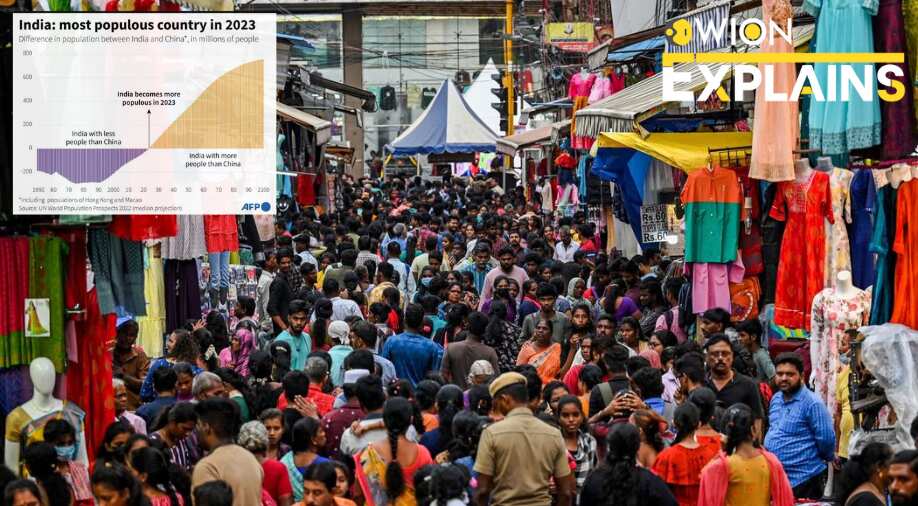
India has nearly overtaken China as the world's most populous country. What does it mean?
As was long predicted, India is set to overtake China as the world's most populous country by the end of June, according to the United Nations' new 'State of World Population' report. The seismic shift means that India's population will hit 1.4286 billion, compared to China's 1.4257 billion by the middle of this year.

Occupying only 2.4 per cent of the world's land mass, India is now home to nearly a fifth of humanity (we surpassed 8 billion number in November 2022). As India attains the 'world's biggest population' title, a few simple questions beg for answers. What does it mean to have such a population? Is it good or bad? Are we doomed or is this the beginning of something special?
The questions might be simple but the answer certainly is not straightforward - one that can be painted with only black or white hues.
Though the connotations of world's most populous nation are often perceived as negative, it also brings with itself a set of remarkable opportunities.
&imwidth=180&imheight=135&format=webp&quality=medium)
Rahul Gandhi's plea against Election Commission delayed as Supreme Court registry flags 14 ‘defects’
&im=FitAndFill=(700,400)&imwidth=180&imheight=135&format=webp&quality=medium)
Navratri 2026: 9 days, 9 forms of Goddess Durga and 9 colours- Check the complete list
&imwidth=180&imheight=135&format=webp&quality=medium)
Korean peninsula tensions escalate as North Korea launches multiple ballistic missiles, PACOM says 'no threat to US personnel'
&imwidth=180&imheight=135&format=webp&quality=medium)
Trump weighs firing Kimberly Guilfoyle as US ambassador to Greece amid misconduct allegations: Report
&imwidth=180&imheight=135&format=webp&quality=medium)
Anti-SIR protest in Mumbai: Protestors wear black masks & ribbons in Mumbai
&imwidth=180&imheight=135&format=webp&quality=medium)
UK PM Andy Birnham renews claims of Russian meddling in Brexit vote
&imwidth=180&imheight=135&format=webp&quality=medium)
BCCI rejects venue shift reports, India vs Sri Lanka 1st ODI to remain in Delhi
&imwidth=180&imheight=135&format=webp&quality=medium)
'Absolutely disgusting': Australia slams US plan to livestream Nidal Hasan's execution; Mike Johnson raises concerns, warns of terrorist propaganda
&imwidth=180&imheight=135&format=webp&quality=medium)
1,500 drones illuminate Mumbai sky as Cordelia Cruises unveils second ship, Cordelia Sky
&imwidth=180&imheight=135&format=webp&quality=medium)
Houthis warns US of 'painful response' if Washington joins Saudi war in Yemen as airlines suspend flights to Saudi Arabia
&imwidth=180&imheight=135&format=webp&quality=medium)
India Rejects Pakistan-China Boundary Commission, Tells Islamabad to Drop 'Theatrics' | GRAVITAS
&imwidth=180&imheight=135&format=webp&quality=medium)
Congress demands action against chief election commissioner
&imwidth=180&imheight=135&format=webp&quality=medium)
Apple HomeView smart home hub may launch soon with A18 chip, display and Siri controls: What to expect
&imwidth=180&imheight=135&format=webp&quality=medium)
'Turn approver, resign, we'll forgive you': Rahul Gandhi claims receiving messages from CEC Gyanesh Kumar
&imwidth=180&imheight=135&format=webp&quality=medium)
'I will not be silenced': Ilhan Omar alleges political intimidation after federal officers search her Washington home
&imwidth=180&imheight=135&format=webp&quality=medium)
Robotic surgery, advanced treatment: What is coming to this small Gujarat town?
&imwidth=180&imheight=135&format=webp&quality=medium)
Pakistan's government blames PTI for rise of terrorism in Khyber Pakhtunkhwa
&imwidth=180&imheight=135&format=webp&quality=medium)
‘This is just the start’: Maaya Rajeshwaran on historic ITF title, confidence boost and future goals
&im=FitAndFill=(700,400)&imwidth=180&imheight=135&format=webp&quality=medium)
How does a robot decide what to do next?
&imwidth=180&imheight=135&format=webp&quality=medium)
Trump says he 'may' meet North Korean leader Kim Jong Un during upcoming Asia trip
&imwidth=180&imheight=135&format=webp&quality=medium)
'Ouch!!! That must hurt': Kangana Ranaut hails Kamal Haasan's sharp reply to Elon Musk over Starlink row
&imwidth=180&imheight=135&format=webp&quality=medium)
Sidhu Moose Wala’s younger brother wins hearts by recreating late singer’s signature move at Toronto Hologram Show
&imwidth=180&imheight=135&format=webp&quality=medium)
Girl 'dead' for 8 hours wakes up at her own funeral, dad insists she wasn't breathing
&imwidth=180&imheight=135&format=webp&quality=medium)
UK school ditches technology, shifts from screen to pen and paper for learning
&imwidth=180&imheight=135&format=webp&quality=medium)
Opposition’s 10 demands in Supreme Court petition range from stay on SIR to audit of voter rolls
&imwidth=180&imheight=135&format=webp&quality=medium)
'I am thoroughly unamused': Judge slams Trump administration after 400 trees cut at Washington golf course
&imwidth=180&imheight=135&format=webp&quality=medium)
Portugal Federation confirms Cristiano Ronaldo’s return to national team despite suspension
&im=FitAndFill=(700,400)&imwidth=180&imheight=135&format=webp&quality=medium)
New OTT releases this week (October 12-18, 2026): Sacrifice, Koffee with Karan S9, Roadies Rebirth- 6 titles coming on Netflix, JioHotstar and more
&imwidth=180&imheight=135&format=webp&quality=medium)
India's Ajit Doval, Iran's Mohsen Rezaei hold talks amid escalating West Asia tensions, discuss 'issues of mutual interest'
&imwidth=180&imheight=135&format=webp&quality=medium)
'Almost certainly': UK Prime Minister Andy Burnham says Iran's IRGC behind RAF Fairford threat
&imwidth=180&imheight=135&format=webp&quality=medium)
Elon Musk pumps $276 million into Republican campaigns ahead of US midterm elections
The opportunities
India is yet to compile its own population data as it has not conducted a census since 2011. The one supposed to happen in 2021 was delayed due to the Covid pandemic and the government does not seem particularly enthused to get the census campaign back on track.
However, according to a Time Magazinereport, nearly half the population of India (650 million people) is below the age of 25 - meaning the country won't be hitting its peak until 2065.
Adults aged 65 and older comprise only seven per cent of population compared with 14 per cent in China and 18 per cent in the US. The share of Indians who are 65 and older is likely to remain under 20 per cent until 2063 and will not approach 30 per cent until 2100, under the UN’s medium variant projections.
Considering that the younger population errs on the side of caution and only procreates one or two children per couple, the population will only stabilise after the said year.
Until then, India and its mostly young populace could help put the country's economic future into overdrive. The economy can be boosted up to levels hitherto unseen.
WATCH |WION Fineprint | India the world's most populous country?
It is a generation brought up on high-speed internet and facilities that were a far cry in the past decades when population expansion was deemed as the end of civilisation. India can create industries and provide services in new fields, all the while sustaining a healthy growth rate. Even in a post-pandemic world, India is one of the few bright spots economically, generating growth ratesmuch higher than nations across the globe.
Numerous reports have predicted India and China to lead the economic growth story in the coming decades. India under Prime Minister Narendra Modi is already taking financial decisions that it may not have taken earlier. It is trading with Russia to buy oil without the use of the US dollar, it has created its own nexus of power in the Indio-pacific by playing a key part in militarising the Quad grouping.
In fact, one of the biggest benefits of India's population is the ability it imparts to its leaders to put their foot down and get their way in major political, financial and geopolitical decisions.
However, having the biggest share of the population should automatically bolster India's claim for a permanent seat in the UN Security Council (UNSC).
The challenges
It is not to say that increase in population will not come with its own set of challenges. To unlock the true potential of India's young population to drive the economic chariot, the country's government will have to massively focus on addressing core problems like healthcare, education, infrastructure and food availability.
The division of resources will be a major headache and the problem could be exacerbated by climate change. Then, there is a lack of employment. only five per cent of the workforce currently comes under the formally skilled bracket.
Schools, and universities will have to step up majorly so that new avenues of employment are generated for the youth. If India's overwhelming majority of youth sits without a job, it will be a wastage of resources and human capital. Something India can ill-afford to do.
ALSO READ | India to surpass China to become most populous country: UN population estimate
Does India need to panic?
India need not take China's stance in decreasing the population numbers. China took evasive measures such as imposing the one-child rule that led to steep decline in numbers, forcing the government to take a 180 on the issue.
Increasing the education levels ought to suffice as aware people are much more likely to limit the number of offspring they want. Moreover, the total fertility rate is already going down and in the coming years, it may automatically offset the numbers.
The National Family Health 5 Survey (2019-21) found that India attained a Total Fertility Rate (TFR) of 2.0 for the first time, less than the replacement level of 2.1, falling from 2.2 in NFHS 4 (2015-16).
Countries like Japan and Italy have been witnessing an alarming drop in population levels which has caused serious concerns. Thus, trying to solve a problem that does not really exist for India would be a huge blunder. Instead, the government should perceive the large population as human capital and work to use them efficiently.
(With inputs from agencies)
WATCH WION LIVE HERE: