BRICS shows hidden clout in tech and trade, but needs platforms to make it work

&imwidth=600&imheight=450&format=webp&quality=medium "BRICS shows hidden clout in tech and trade, but needs platforms to make it work")
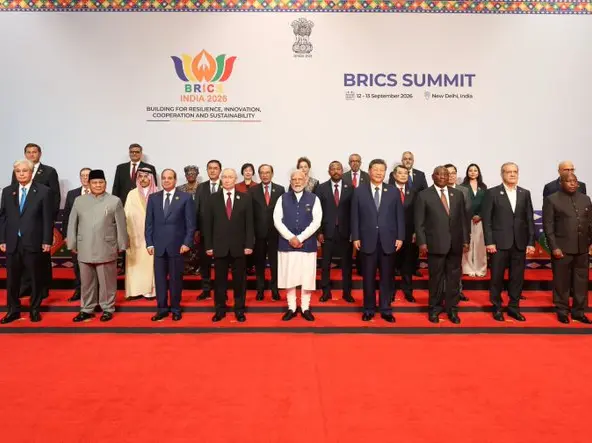
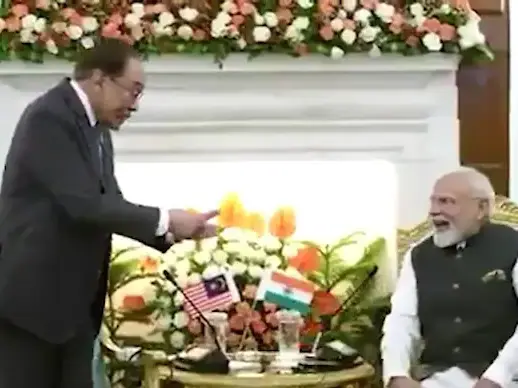
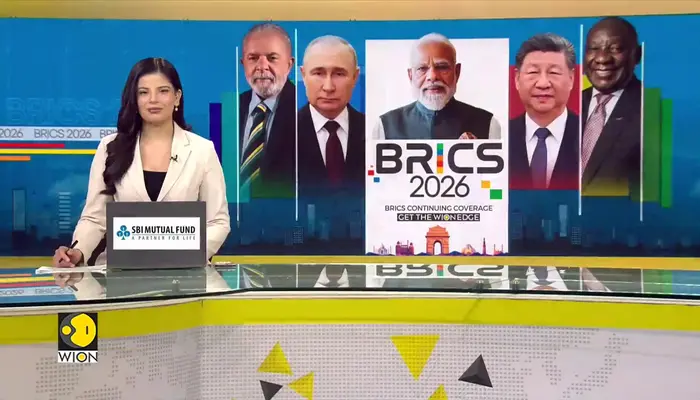
BRICS Summit 2026 hosted by New Delhi at Bharat Mandapam Photograph: (Credit: X/@narendramodi)
While BRICS holds significant hidden leverage in global technology and cross-border trade, the bloc must build shared digital and institutional platforms to unlock its full potential.
Is this old wine in a new bottle? That is the question I asked myself as I waded through the 45-page, 140-paragraph Delhi declaration of the BRICS Summit sealed at the weekend in New Delhi’s Bharat Mandapam. There is indeed plenty in the 10,000-plus-word “consensus document” that smells like old wine or whine, if you will, as laggard developing countries and their elder brothers, emerging economies, talk implicitly about US/Western domination of the world order and ask for reforms in bodies like the UN and the IMF that traditionally showed Western clout.
But God, it seems, is in the details much like his opponent, the Devil. While the Devil still lies in the contradictions embedded in bringing disparate political ideologies and state systems under a single documentary roof (such as a paragraph on women’s rights in a meeting where the Islamist president of Iran is a key figure), God might lie in the economic power of BRICS countries now being embraced by other significant economies of the Global South. And I am not talking just of the fact that BRICS economies now account for 40% of the global GDP that was underlined at the summit.
The wise thing is to look for teeth that can bite. And BRICS economies do have teeth to bite, but they are not showing it enough as the temptation of old-world multilateralism lingers amid an undercurrent of caution on what a tariff-drunk US could do next. The takeaway for me is not the official “Differences should not become disputes” line that shows a desire for consensus, but more like “We have got power that we are not ready to display yet.”
Flashback to the 1970s, when the United Nations Conference on Trade and Development (UNCTAD) became a forum of developing countries to seek better prices for commodity exports to the developed economies, or the quest for a New International Economic Order (NIEO), proposals for which were adopted by the UN General Assembly in 1974. The idea then was to eliminate inequalities between the North and the South (the Global prefix is a recent addition to include some laggard economies of Europe). Inequalities within countries and between countries remain a BRICS theme, but we need to look beyond platitudes.
Trending Stories
)
)
)
)
)
)
)
)
)
)
)
)
)
)
)
&im=FitAndFill=(700,400))
)
)
)
&im=FitAndFill=(700,400))
)
)
)
)
)
)
)
)
)
)
)
)
)
)
There are references in the New Delhi declarations that smell much the same but I was impressed by the groundwork done by BRICS under India’s role as its chair that outlines specific areas where what used to be called South-South trade can emerge as Intra-BRICS collaboration in trade, technology and economic ventures. This would stretch beyond traditional merchandise or services trade to include joint ventures, manufacturing collaborations or service delivery mechanisms.
Also read: BRICS Summit climate change stance: Delhi Declaration hints at changing priorities of Global South
Where I see a glaring hole is that there is no mechanism yet to facilitate this on a large scale. What I am looking for is a single platform or set of platforms that can lead to the discovery of opportunities and prospects between business entities of BRICS economies and their newfound allies. What has changed since the 1970s is the emergence of new technology-driven opportunities in which emerging economies are strong entities capable of being significant global players. There is delicious irony in the fact that the Internet, birthed in the US defence department, provides an easy information exchange mechanism where the discovery of price and opportunities can produce dramatic results in trade within the Global South.
This is where I believe BRICS as a group (Brazil, Russia, India, China and South Africa) can emerge from the old wine of glorified petitioning to a new brew of collective clout.
Talk of joint defence manufacturing between Russia and India is only the tip of what could be a solid iceberg that might make Uncle Sam think twice about threatening emerging economies with unilateral tariffs. For decades now, old colonial economies have been driven by what some academics have described as “Eurocentrism” (effectively including the US as a global superpower). US tariff threats potentially wake up countries in Asia, Africa, and Latin America, besides Russia, to look at each other more vigorously as economic partners. This could well be a case of threats generating opportunities.
The declaration talks of “strengthening capacities, promoting innovation, and advancing sustainable development and resilience” and includes people-to-people exchanges. While it meanders into a nostalgic recollection of the 1955 Asian-African Conference in Bandung in Indonesia to forge a post-colonial consensus that gave rise to the now-defunct Non-Aligned Movement that attempted equidistance from both the former Soviet Union and the US, the new reality that now includes Russia spells a power shift that has implications for geo-economics.
The declaration spells out in detail initiatives taken in areas like power distribution, solar energy, education, health, digital economy, sustainability, and the environment for cooperation; its mention of the potential for special economic zones (SEZs) provides a tangible character for future action.
However, we need a reality check on some of the subtly underlined ambition of the BRICS group to reduce US dollar dominance. The declaration’s mention of “efficient cross-border payment mechanisms” with an emphasis on local currencies needs some hard testing. Currencies are only symptoms of underlying economic value. Much like the Cold War era’s rupee trade between India and the former Soviet Union, any attempt by BRICS nations to boost local currencies needs a higher emphasis on sectors where they could minimise Western dominance by identifying areas where trade value lies in hard deliverables. This is where the idea of an efficient platform for price and opportunity discovery makes sense.
It is undeniable that both Europe and the US remain key creation zones for emerging technologies protected and led by high-value patents. Where BRICS can score—and is already doing to some extent—is in the exploitation of opportunities and ecosystems generated by the new technologies. India showed that to the world in making affordable pharmaceuticals. China’s DeepSeek and other initiatives in artificial intelligence and robotics show a new possibility.
There is no substitute for hard economic value in trade. A shift away from “Eurocentrism” can generate a solid counterpoint in trade, education, and environmental initiatives. BRICS can do that by looking at the details of emerging ecosystems and spotting opportunities where the West’s leadership or trading edge is based more on inertia of the past than genuine value for the future. That should be the next thing to do.
