
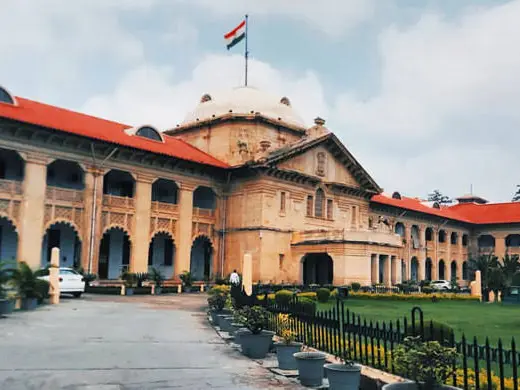
&imwidth=800&imheight=600&format=webp&quality=medium "Allahabad High Court orders ₹5L compensation from DM’s salary over DU graduate’s NSA detention")
The Allahabad High Court has ordered that ₹5 lakh in compensation be paid to 25-year-old Delhi University graduate Akriti Chaudhary, who spent nearly five months in judicial custody in connection with the April 2026 Noida workers’ protest. The court directed that the compensation be recovered from the salary of Gautam Buddha Nagar District Magistrate Medha Roopam, who had ordered Chaudhary’s preventive detention under the National Security Act (NSA). The court quashed the detention order on September 2.
In its detailed order, which was made public on Monday, a bench comprising Justices Atul Sreedharan and Achal Sachdev strongly criticised the conduct of the district administration and police. The court described the district magistrate’s conduct as “worthy of derision” and observed that she had sought to “set an example” out of a peaceful student activist in an apparent attempt to deter others from participating in protests. The bench also directed that its displeasure with the conduct of the district magistrate and police officials be recorded in their service records.
‘Loyalty to Constitution, not political executive’

The High Court also criticised what it termed bureaucratic overreach and reminded IAS and IPS officers that their primary allegiance must be to the Constitution rather than the political executive. “They (civil servants) should realise that their loyalty is towards the Constitution and not the political executive, and the honesty and impartiality are towards the people whom they serve while bearing in mind at all times that they are the servants who serve the people, the masters in a democracy,” the court said. The bench warned that officers who lose sight of this constitutional responsibility could risk turning Uttar Pradesh into “an Orwellian Dystopia.”
The court examined the material relied upon by the administration to justify Chaudhary’s detention, including WhatsApp conversations, videos, case diary entries and timestamps of messages retrieved from her phone. After scrutinising the evidence, the bench concluded that the material on record did not support the prosecution’s version of events.
Trending Stories
)
The Early Spring is proof not everyone can talk about their real feelings, and it is perfectly OK
)
UN votes to ‘correct the map’ as India backs fairer world view
)
Nigerian Navy discovers 99,000 litres of suspected stolen, illegally refined products as it intensifies anti-crude oil theft operations
)
Who is Aditi Paudel? 17-year-old becomes Japan's first literacy ambassador
)
Bengaluru: Officials find 40 kg expired chilli at chairman's club
)
Jaishankar rejects trade link to ending Ukraine war
)
Israeli strikes on Lebanon kill three, injure 23 despite truce
)
Alpine glacier was covered with sheep wool sheets to prevent melting. It worked
)
South Korea mulls deploying military assets to Strait of Hormuz
)
World's fifth-largest economy, British army can't afford to train
)
Breaking | Vance takes the podium: First White House briefing since Leavitt's exit
)
Taiwan raises 'concerns' over China's missile test
)
BRICS 2026: $1 trillion sovereign capital set to converge in Delhi for first iBRICS Summit
)
What is Iran's Pickaxe Mountain that Trump has again threatened to bomb?
)
UN votes to correct world map that visually shrank Africa for 450 years
)
Former NewJeans member Danielle launches YouTube channel, hints at new solo journey
)
Bangladesh batter Towhid Hridoy creates history with 350 not out in South Africa
)
Brendan Fraser’s transformation fuels The Mummy 4 excitement as fans welcome back Rick O’Connell
&im=FitAndFill=(700,400))
Krishna Janmashtami 2026: From Dhaniya Panjiri to Makhana Kheer- 5 best sweet dishes perfect for celebrating Lord Krishna’s birth
)
Donald Trump plans to travel to Ireland on Qatari-donated jet amid security concerns
)
Nazi-looted art to return to Jewish heirs
)
Eight killed in Kerala’s Thrissur after car rams into lorry parked on highway
&im=FitAndFill=(700,400))
Why Russian fighter jets use bulky, low-pressure tyres compared to US jets
)
FBI-wanted fraud accused arrested in Jalandhar over $600,000 scam
&im=FitAndFill=(700,400))
Why US tanks weigh over 20 tons more than Russian tanks
&im=FitAndFill=(700,400))
New Friday OTT releases (September 4, 2026): GDN, Dhamaal 4, Jagamae Sangeetham- Watch 6 new movies and TV shows on Netflix, Prime Video and more
)
Killing the Himalayas slowly: Human urine is melting a glacier on Mount Everest
Court questions Section 130 BNSS notice
Another significant issue before the court concerned a notice issued to Chaudhary under Section 130 of the Bharatiya Nagarik Suraksha Sanhita (BNSS). The provision allows police, in specified circumstances, to require a person to execute a bond for “good behaviour”. According to the police, Chaudhary was served the notice on April 12 and was required to furnish a ₹50,000 bond. The police claimed she was arrested only after refusing to execute the bond.
Chaudhary, represented by senior advocate Colin Gonsalves, disputed this version. She maintained that she had already been taken into custody on the evening of April 11 and had never been given a genuine opportunity to furnish the bond. The High Court found that the General Diary entry number recorded in the Section 130 notice could only have been generated after Chaudhary’s arrest. This, according to the court, indicated that the notice had been prepared retrospectively.
“Mentioning the G.D. number in the notice under Section 130 of the BNSS reveals that the Petitioner was already arrested and the procedure of giving a notice under Section 130 of the BNSS was ex post facto the arrest and nothing more than a sham,” the court said. When the State government was asked to explain what the court described as the “visible fabrication in the record”, the bench said there was “no answer” forthcoming.
Court says NSA cannot be used to curb peaceful protest
The bench also examined WhatsApp messages and videos submitted by the State as evidence against Chaudhary.
The court found that there was not “a single message” or video showing that Chaudhary had encouraged people to riot, commit arson or damage public or private property. The violence that broke out on April 13, therefore, could not be attributed to the alleged conspiracy said to have been hatched by Chaudhary, the court held on the material placed before it.
The High Court reiterated that preventive detention under the NSA is an “exception” and cannot be invoked simply to keep a person behind bars because they may otherwise obtain bail in an ordinary criminal case. The bench stressed that preventive detention involves a direct impact on the fundamental right to life and personal liberty guaranteed under Article 21 of the Constitution. It said such extraordinary powers “cannot be exercised lightly on the basis of surmises, biases, conjectures and opinions”.
‘Preventing protests on assumed breach of peace’ criticised
The court also cautioned authorities against restricting peaceful demonstrations merely because they might potentially result in a breach of peace. “Preventing people from gathering in public spaces or agitating their rights on the grounds of assumed breach of peace,” the bench said, would amount to “throwing the baby out of the bath water”.
Rather than restricting peaceful assemblies on the basis of assumptions, the State should strengthen its police response to large gatherings, the court said. The bench suggested that police forces should be trained to manage large crowds and that videography should be used to establish accountability when violence actually occurs. The ruling thus raises significant questions about the use of preventive detention powers, police procedure and the constitutional limits on administrative action against protesters.

