
&imwidth=800&imheight=600&format=webp&quality=medium "12 years of Modi govt: How India became $4 trillion economy and set its sights on $5 tillion")
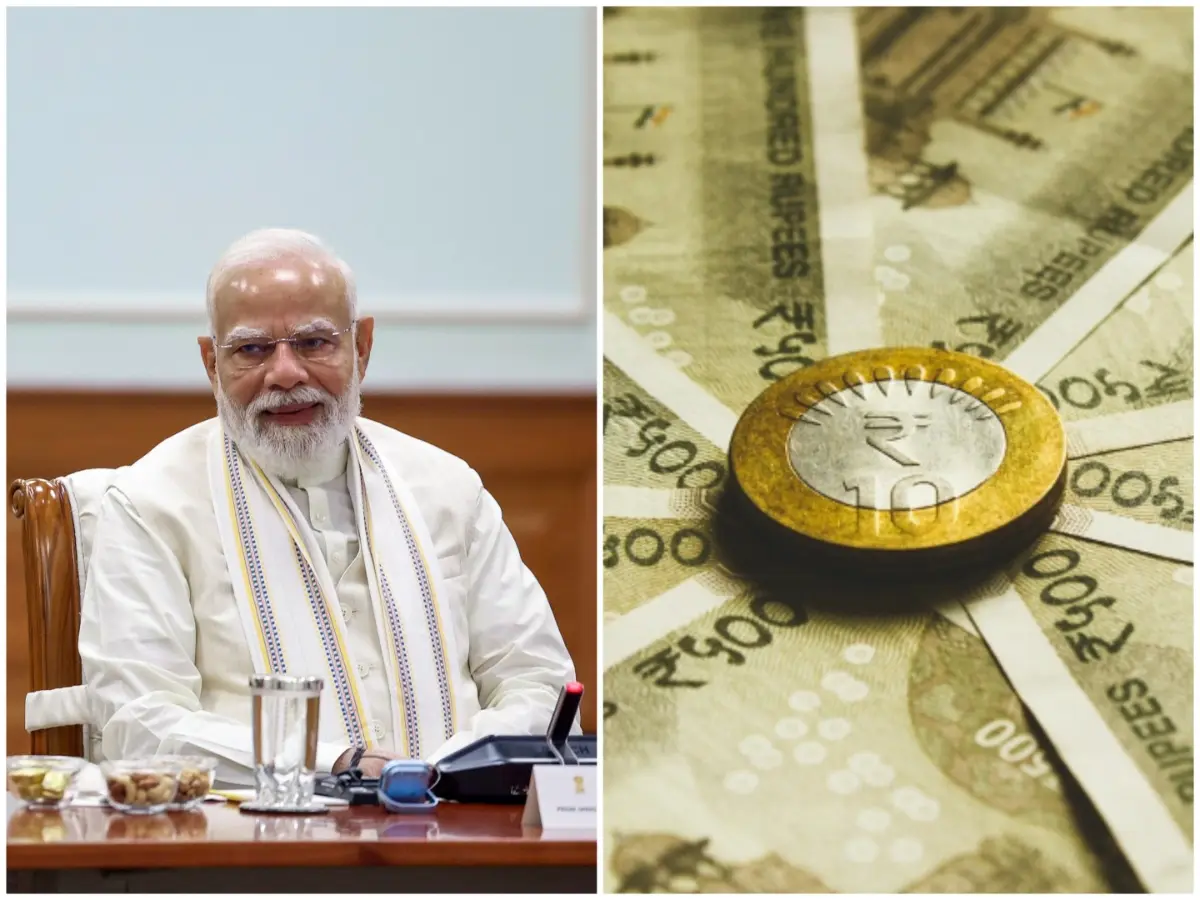
Prime Minister Narendra Modi’s government has marked its 12 years since it came to power in the centre in 2014. During his tenure, various development projects and initiatives have been launched to foster growth in every sector with the aim of making India a 5 trillion economy. These results can be seen in India's economy, which continued its strong growth trajectory in FY 2025-26, with the country's Gross Domestic Product (GDP) at current prices surpassing Rs 345 lakh crore, reflecting sustained momentum driven by reforms, digital transformation, exports and industrial expansion. According to official data, India has emerged as one of the fastest-growing major economies, attracting increasing global attention. The government has also revised the base year for GDP calculations to 2022-23 to better reflect the current economic structure.
The country's economic rise has been particularly significant over the past decade. While it took nearly 60 years after Independence for India to become a $1 trillion economy, the nation has rapidly expanded from a $2 trillion economy in 2014 to over $4 trillion today. If the current pace continues, India is expected to achieve the $5 trillion milestone within the next two years.
"Today, India’s economy is moving forward rapidly. Now, India does not avoid challenges; it confronts them. Amidst all the turmoil in the world, India has kept up the speed of its progress," PM Modi said.

Also read: 12 Years of Modi Govt: How India’s shift to zero tolerance on terrorism reshaped national security
Growth in electronics sector
India's growing economic influence is also being recognised globally. According to the World Bank, the country has become the second-largest contributor to global GDP growth. The electronics sector has emerged as a key driver of industrial growth. Electronics production has increased sixfold from Rs 1.9 lakh crore to Rs 11.3 lakh crore, while exports have surged eightfold from Rs 0.38 lakh crore to Rs 3.3 lakh crore. More than 25 lakh jobs have been created in the sector, supported by the Production Linked Incentive (PLI) scheme, which has helped position India as a global manufacturing hub.
Trending Stories
)
Emmys 2026: Matthew Rhys wins Best Actor twice, sets historic 78-year record
)
3 Italians fly from Delhi to Munich without immigration clearance; Air India gets notice on major security lapse
)
Did India risk its US trade deal despite softer stance at BRICS?
)
Pakistan puts Pak Rs 70 lakh bounty on UN terrorist Masood Azhar; move draws skepticism in Delhi
)
‘US ensuring global energy supplies’: Trump demands reimbursement for securing Strait of Hormuz
)
'Huge destructive power': North Korea calls its latest missile launches 'live-fire drill' even as US dismisses 'immediate threat'
)
‘Let’s go’: Newly declassified videos show dramatic rescue of US Air Force officers downed in Iran
)
Historic first: ‘Ganga aarti’ performed on River Thames in London
)
Emmy Awards 2026: Widow's Bay and The Pitt win in lead categories- check out the complete list of winners
&im=FitAndFill=(700,400))
Why European Meteor missiles use ramjet engines compared to standard US solid rockets
)
Iran, India agree to deepen humanitarian and political ties, President Pezeshkian says
)
‘Want to reset ties with India, have engagement based on mutual interests,’ says Bangladesh minister
&im=FitAndFill=(700,400))
Emmys 2026 Red Carpet: Zendaya, Nicole Kidman and Julia Garner lead the glamour peak
)
Turkish Airlines plane flies through a storm three times, triggering severe turbulence
&im=FitAndFill=(700,400))
Why Chinese PL-15 air-to-air missiles use dual-pulse motors compared to European interceptors
)
What is Hyrox, in news for athlete who soiled herself, but kept running and using common equipment?
)
Russia proposes to build 360 kmph Ivolga FG trains in India: What happened on sidelines of BRICS
)
800 million years old - Scientists discover 'fingerprints' of supercontinent Gondwana in ancient rocks
)
China discovers vast gold and silver 'mine' in the Pacific with unheard-of deposits
)
Plane carrying prominent figure crashes at Libya’s Misrata airport: Report
&im=FitAndFill=(700,400))
New OTT releases this week (September 14-20, 2026): Lust Stories 3, Waiting Hai, Irumudi- 5 new titles coming on Netflix, Prime Video and more
)
Sent home midway from UK tour, Pakistan's Salman Agha hits 300* in domestic return
)
Nigerian Navy seizes 10,000 litres of suspected illegal fuel in Rivers State crackdown
)
Who is Kalyan Bainsla, accused in the Gurugram hit-and-run case involving woman biker?
)
Saudi Arabia discovers 110 million tonnes of Uranium-rich ore in Madinah region
)
Dodgers beat Reds for playoff berth in bid for third consecutive World Series
)
Ecstasy tablets are rage in 'drug haven' Libya | Gravitas
)
'Now Trump is copying us': Shivakumar links US $5,000 plan to Congress guarantees
)
Video of Pakistani lawmaker struggling to read English tribute to Jinnah goes viral - WATCH
)
Trump downplays China's alleged 'help' to Iran in strike on Jordan base | Gravitas
)
Baba Vanga's first prophecy for 2027 is out, and straight out of science fiction
)
Trump loses Supreme Court battle over mail ballots ahead of US midterms: What happened?
)
Photographs, LeT labels vanish from two 2008 Mumbai attack entries in Pakistan’s most wanted list
)
Delhi govt to roll out ₹13,820 crore development projects under Seva Sankalp Abhiyan: CM Rekha Gupta
)
UK man admits drugging, raping wife for 20 years in shocking abuse case
)
Extreme warming in Indian Ocean added 695 billion tons of ice to Antarctica ice sheet
)
China thinned Himalayan troop presence in 2025, India defence report says; terms border situation 'stable'
India's exports reached a record Rs 79 lakh crore in FY26, strengthening manufacturing activity and employment generation. Foreign exchange reserves stood at Rs 67 lakh crore, enough to cover 11 months of imports and 94 per cent of external debt, providing a strong buffer against global economic uncertainties.
Tax slab rationalisation
The government also highlighted next-generation reforms aimed at easing the tax burden on citizens. Tax slab rationalisation and GST simplification have benefited the middle class, boosting domestic consumption by nearly Rs 2 lakh crore and supporting greater economic formalisation through digital payments. Meanwhile, investments worth Rs 1.64 lakh crore have been mobilised under the Semicon India Programme. Twelve semiconductor projects across six states have received approval, laying the foundation for a robust domestic chip manufacturing ecosystem.
In addition, public sector banks reported a record profit of nearly Rs 2 lakh crore in FY26, reflecting improved financial stability. Additionally, over 25 crore people have reportedly moved out of poverty, contributing to the rise of a new middle class and expanding domestic consumption. The Unified Pension Scheme, approved in August 2024, is also expected to benefit 23 lakh government employees.
Industrial growth
In the industrial and manufacturing domain, the electronics sector has seen a major production revolution, surging by 500 per cent from Rs 1.9 lakh crore in 2014 to over Rs 11 lakh crore by 2026, alongside a 700 per cent increase in electronics exports to over Rs 3 lakh crore. This momentum is heavily driven by mobile manufacturing, which grew 28 times to reach Rs 5.5 lakh crore, while mobile phone exports skyrocketed 163 times to Rs 2.6 lakh crore. Simultaneously, heavy industry expanded, with crude steel production capacity doubling from 109.85 million tonnes in 2014-15 to 220.3 million tonnes in 2025-26.
Financially, macro stability has improved as general CPI-based inflation dropped from an average of 9.84 per cent (2011-2014) to 4.7 per cent (2014-2026). Public wealth and governance have also seen structural gains: India's stock market capitalisation crossed Rs 410 lakh crore in March 2026, foreign remittances hit a global high of Rs 13 lakh crore in FY25-26, and digital public infrastructure successfully secured over Rs 51 lakh crore in direct benefit transfers while preventing Rs 4.3 lakh crore in leakages.

