

&imwidth=800&imheight=600&format=webp&quality=medium "‘Devi’ struts the runway! Rahul Mishra brings ancient Indian temple sculptures to life at Paris Haute Couture Week")
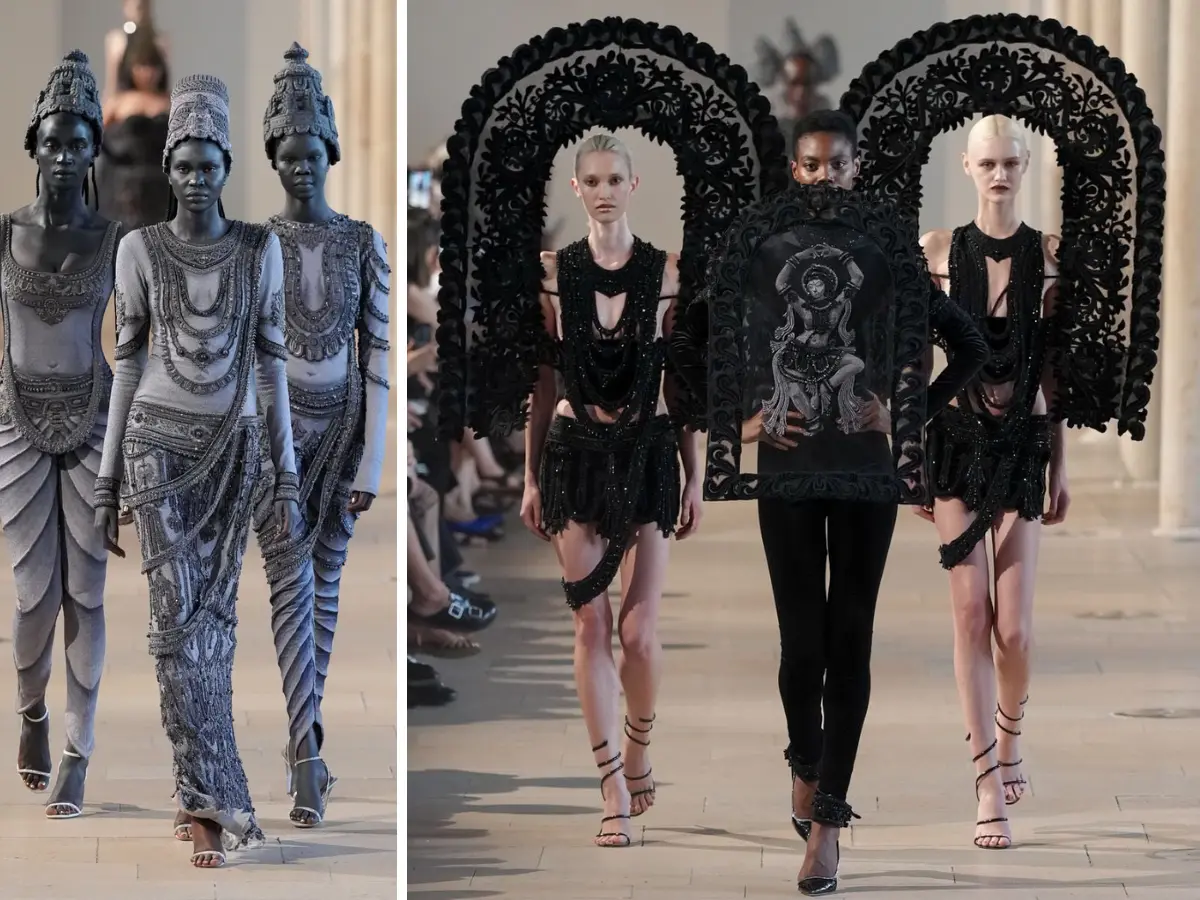
Paris Haute Couture Week commenced on Monday, July 6, 2026, welcoming fashion’s most elite houses to debut their Autumn/Winter 2026/27 collections. Indian fashion designer Rahul Mishra made heads turn as he debuted his breathtaking new collection, Devi: The Eternal Muse. The collection serves as a masterclass in wearable art that seamlessly bridges ancient Indian heritage with contemporary global couture.
The front row had Grammy-winning rapper Cardi B and Indian entrepreneur Isha Ambani. The ladies turned heads in a custom Rahul Mishra couture ensemble that perfectly highlighted the designer’s latest collection, which had a dramatic, sculptural silhouette and dense, intricate embroidery. While Cardi wore an Ivory creation by Mishra, Isha was dressed in a grey outfit by the designer.
Hours before the show, Mishra gave audiences a behind-the-scenes look on social media, sharing footage of his karigars (artisans) meticulously adding final hand-stitched touches to the garments. The resulting showcase carried an ethereal, powerful undertone, evoking a visual parallel to the thematic essence of Ariana Grande’s “God Is A Woman.”
A sculptural tribute to the divine feminine
Devi: The Eternal Muse draws its core inspiration from the sacred, intricate carvings found across ancient South Indian temples. Rather than merely replicating historical attire, Mishra reinterpreted centuries-old stone artistry into avant-garde fashion.
Models glided through the historic Parisian venue in a sophisticated colour palette of stone grey, jet black, stark ivory, beige, and antique gold, resembling living, breathing statues. The clever use of skin-toned bodysuits blurred the boundary between fabric and human form, while exceptionally dense embroidery created the optical illusion of chiselled stone.
Mishra’s trademark hand-embroidery was executed on an unprecedented, grander scale. Massive layers of threadwork made delicate textiles appear as solid as rock, while the strategic application of metallic zardozi and dabka work mimicked the weathered textures of ancient shrines. This heavy architecture was balanced by the delicate shimmer of precisely placed freshwater pearls, crystals, and bugle beads.
Trending Stories
&imwidth=180&imheight=135&format=webp&quality=medium)
Over 100 US lawmakers urge FBI to probe foiled Hindu temple shooting as hate crime
&im=FitAndFill=(700,400)&imwidth=180&imheight=135&format=webp&quality=medium)
New OTT releases this week (October 19-25, 2026): Gajab Raat to Chaar Yaar-8 titles to watch during Dussehra week on Netflix, Prime Video and more
&imwidth=180&imheight=135&format=webp&quality=medium)
'Tap dancing through a minefield': Musk backs SpaceX-Tesla merger as AI boom fuels rocket firm's first profit
&imwidth=180&imheight=135&format=webp&quality=medium)
'They are not even telling us' - Mysterious metallic object discovered in Minnesota field
&imwidth=180&imheight=135&format=webp&quality=medium)
French military plane crashes in northeast France, one dead
&imwidth=180&imheight=135&format=webp&quality=medium)
Feds obtain DNA evidence that could prove Ilhan Omar married her brother: Report
&imwidth=180&imheight=135&format=webp&quality=medium)
The Verdict | Trump, Putin and Xi: A superpower triangle that could reshape global diplomacy
&imwidth=180&imheight=135&format=webp&quality=medium)
'UN experts is an oxymoron': Rubio mocks UN over India protests criticism, refuses to comment on India's internal matter
&imwidth=180&imheight=135&format=webp&quality=medium)
India moves to buy 10,000 more AI chips for a national compute pool open to startups
&im=FitAndFill=(700,400)&imwidth=180&imheight=135&format=webp&quality=medium)
Priyanka Chopra to Shilpa Shetty: 6 Bollywood actresses and their fitness secrets
&imwidth=180&imheight=135&format=webp&quality=medium)
‘Even legends can fall ill’: Badshah, Anupam Kher and other stars defend Daler Mehndi after Uttarakhand stage controversy
&imwidth=180&imheight=135&format=webp&quality=medium)
Boeing 737 MAX10 gets FAA certification, deliveries expected to begin in 2027
&imwidth=180&imheight=135&format=webp&quality=medium)
Ukrainian drone airlifts wounded soldier in what is likely a world first
&imwidth=180&imheight=135&format=webp&quality=medium)
Ukrainian soldier rescued by a drone chopped off own leg while hiding for 491 days
&imwidth=180&imheight=135&format=webp&quality=medium)
Trump says Ilhan Omar 'could go to jail' amid federal probe, calls Somalia a 's***house'
&imwidth=180&imheight=135&format=webp&quality=medium)
Trump considers removing White House press corps to restore historic indoor swimming pool
&imwidth=180&imheight=135&format=webp&quality=medium)
What the Mecca Joint Defence Agreement says about withdrawal and military support. Read full text of the pact here
&imwidth=180&imheight=135&format=webp&quality=medium)
India to develop first indigenous aviation gun for Prachand, Rudra attack helicopters, SSS Defence CEO confirms
&imwidth=180&imheight=135&format=webp&quality=medium)
India vs New Zealand T20I Series 2026: Complete schedule, match timings, squads and live streaming details
&imwidth=180&imheight=135&format=webp&quality=medium)
Man marries off wife of 17 years to her lover in Uttar Pradesh
&imwidth=180&imheight=135&format=webp&quality=medium)
Punjab CM Bhagwant Mann allegedly detained for three hours at Delhi airport, fined ₹50,000: AAP
&imwidth=180&imheight=135&format=webp&quality=medium)
Shastri backs Shami comeback; lauds Bhuvi and warns Bumrah on format workload ahead of World Cup
&imwidth=180&imheight=135&format=webp&quality=medium)
US-Iran war | Tehran: Must end port blockade, oil sanctions and regional attacks
&imwidth=180&imheight=135&format=webp&quality=medium)
Musk ordered Starlink restrictions that caught Ukraine off guard amid escalating tensions: Report
&imwidth=180&imheight=135&format=webp&quality=medium)
Dandiya Nite ’26: Indian High Commissioner hails diaspora as bridge between India and Nigeria
&imwidth=180&imheight=135&format=webp&quality=medium)
India-US ties: Marco Rubio seeks India's oil & energy co-operation Ad Ad options Learn more
&imwidth=180&imheight=135&format=webp&quality=medium)
Iran rejects US talks until demands are met, rules out moving enriched uranium out of the country
&imwidth=180&imheight=135&format=webp&quality=medium)
'You are not Gen Z': Delhi HC pulls up CJP's Das, Ranka over bail bond breach after Jantar Mantar trespass
&imwidth=180&imheight=135&format=webp&quality=medium)
Trump waves at 'empty space' in viral video,' critics claim 'mental decline getting worse' | WATCH
&imwidth=180&imheight=135&format=webp&quality=medium)
Zohran Mamdani's Garba dance goes viral as he joins Indian community's Navratri celebrations | WATCH
&imwidth=180&imheight=135&format=webp&quality=medium)
IND vs NZ T20Is: Will Sooryavanshi play? Skipper Shreyas Iyer clears the air on Samson vs Vaibhav debate
&imwidth=180&imheight=135&format=webp&quality=medium)
US midterms 2026: With Republicans spending big, Bloomberg opens his wallet for Democrats. Here's how much he is pouring
&imwidth=180&imheight=135&format=webp&quality=medium)
US midterms 2026: Red seats once deemed safe now appear shaky as Republicans spend big on ads
&imwidth=180&imheight=135&format=webp&quality=medium)
SBI confirms data breach: 3,897 records flagged on dark web. Is your money safe?
&imwidth=180&imheight=135&format=webp&quality=medium)
Pujara says 'Samson and Vaibhav cannot be in Playing XI' for India on NZ tour
&imwidth=180&imheight=135&format=webp&quality=medium)
Delhi HC agrees to hear Neha Bora's plea against 'maintain peace' directive on 'urgent basis'
&imwidth=180&imheight=135&format=webp&quality=medium)
Ramayana advance booking: Ranbir Kapoor, Yash's film cross $500K ahead of Diwali release
&imwidth=180&imheight=135&format=webp&quality=medium)
Cattle-feed bran in biscuits, detergent in milk: FSSAI acts against 3 companies
&imwidth=180&imheight=135&format=webp&quality=medium)
'What's wrong with you? Are you a sick person?': Trump at it again as he snaps at reporters, faces backlash
Wearable art and collaborative craft
Defying traditional gown structures, the lineup heavily featured exaggerated sculptural frames, oversized collars, dramatically carved shoulder plates, and bold silhouettes. The collection also extended into menswear, featuring fluid, flowing ivory silhouettes heavily accessorised with layered pearl jewellery.
The collection’s surreal, immersive quality was amplified through key artistic collaborations. Traditional clay artisan Sumant Kumar assisted in creating ceremonial headpieces reminiscent of temple crowns, while Mishra’s ongoing partnership with Tanishq integrated natural diamonds and heritage temple jewellery directly into the structure of the clothing. Famed British milliner Stephen Jones further elevated the presentation with gravity-defying, sculptural headwear.
Reflecting on the deeper philosophy behind the collection in an Instagram video, Mishra described the creative process as "almost like time travel."
"We have created something which takes all the symbolisms of an ancient sculpture which probably is more than 2,000 years old, found in the southern part of India... as if we are reliving culture with the same ideas that created these sculptures and what created a muse for these sculptors," Mishra shared.

