

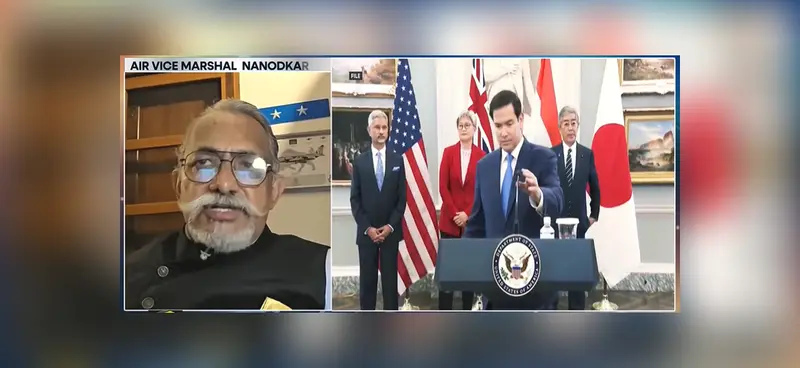
India's pursuit of advanced American military technology has returned to focus with US Secretary of State Marco Rubio's visit, as New Delhi seeks greater cooperation in fighter jet engines, artificial intelligence, semiconductors and other critical technologies.
The India-US TRUST initiative, launched in February 2025, aims to strengthen strategic technology cooperation. However, questions remain over Washington's willingness to transfer sensitive technologies and India's continued dependence on foreign suppliers.
Speaking to WION's Defence Pulse, Air Vice Marshal Sunil Jayant Nanodkar (Retd.), former Assistant Chief of Air Staff, questioned whether American commitments would translate into meaningful technology transfers.
Fighter engine delays expose India's dependence
India's Tejas Mk1A programme has faced delays linked to deliveries of American GE F404 engines. The proposed agreement to manufacture GE F414 engines in India, intended for the Tejas Mk2 and initial AMCA aircraft, also remains crucial.
Also read: NATO is ‘behind’ Russia’s low-cost drone threat, warns former US Army Europe Commander Ben Hodges
Trending Stories

What is the real meaning behind Pete Hegseth's tattoos?

Kim Jong Un death rumours: State media shares photos to prove dictator is alive amid reports of brain haemorrhage

Two Indians among 28 arrested in California over alleged voter registration fraud, DOJ says

‘Nuclear-use decision should be taken by humans’: India flags AI risks at UN

Flying car race: Alef Aeronautics welcomes Tesla Roadster '11 years' later, but are the two models the same?

Dussehra 2025: Why is Ravana not burnt but worshipped in these places of India?

Shastri backs Shami comeback; lauds Bhuvi and warns Bumrah on format workload ahead of World Cup

Netanyahu rival Benny Gantz quits Israel election race, vows to push for unity government

US Midterm 2026: What do opinion polls and prediction markets say less than two weeks before voting

WATCH | Albania protesters set Supreme Court on fire as anti-Rama riots escalate

Indian Air Force turns to homegrown firefighting robot developed under iDEX programme

Trump Commerce Secretary Howard Lutnick’s family fortune more than doubles to $7.3 billion, outpacing his boss

Pete Hegseth meets Benjamin Netanyahu during unannounced visit to Israel ahead of election

Ghaziabad is world's fastest-growing city; Surat, Patna, Rajkot also feature on list

'It's a joy to see the makers bring it on such a grand scale': SS Rajamouli on Ramayana

WATCH | Japan launches historic mission to collect samples from Mars' moon Phobos

India begins National Red List Assessment of 1,211 bird species to boost conservation

PCB omits Atherton, Hussain from tri-series commentary panel over Imran Khan interview row

Trump calls on New Mexico to become 'New America', claims 'home values and incomes would rise'

Priyanka Chopra to Shilpa Shetty: 6 Bollywood actresses and their fitness secrets

Girl 'dead' for 8 hours wakes up at her own funeral, dad insists she wasn't breathing

Pujara says 'Samson and Vaibhav cannot be in Playing XI' for India on NZ tour

US midterms 2026: From Pooja Sethi to Vivek Ramaswamy, here are Indian-origin candidates to watch out for

New OTT releases this week (October 19-25, 2026): Gajab Raat to Chaar Yaar-8 titles to watch during Dussehra week on Netflix, Prime Video and more

Baby orangutan rescued in India returns to Indonesia

India moves to buy 10,000 more AI chips for a national compute pool open to startups

'Not going to let it happen here': From Kansas, Trump ramps up US midterm campaign, points to ‘what’s happening in France’

Prince Harry, Meghan Markle never accepted Queen Elizabeth’s terms for royal exit: Report

'Whatever I can do to end this war': Trump floats China Summit with Putin and Xi, questions Zelensky's role in peace talks

'Paris is going to be a Muslim city very soon': Trump blames immigration for France unrest, urges Macron to tighten border policies

'We feel like Mr India': Gujarat’s undercover SHE team guard garba nights at Navratri

Cattle-feed bran in biscuits, detergent in milk: FSSAI acts against 3 companies

Feds obtain DNA evidence that could prove Ilhan Omar married her brother: Report

Ramayana advance booking: Ranbir Kapoor, Yash's film cross $500K ahead of Diwali release

AUS vs SA: Boland grabs opportunity with both ends to help Australia dominate
"We keep blaming HAL for everything," Nanodkar said, pointing out that Hindustan Aeronautics Limited depends on overseas engine supplies to meet production commitments. He acknowledged that F404 deliveries had resumed but said supplies remained slower than required. Nanodkar also stressed the importance of finalising the F414 manufacturing agreement, particularly for India's future combat aircraft programmes.
India's fighter engine ambitions
Developing a modern fighter jet engine remains one of the most demanding challenges in aerospace engineering. Only a small group of countries has demonstrated the ability to independently develop and manufacture advanced fighter aircraft engines. India has pursued that capability through indigenous research programmes, including the Kaveri engine. India's continued investment in domestic engine development reflects the strategic importance of joining that select group with a fully operational indigenous capability.
Will America share its most advanced technology?
Asked whether Washington would transfer its most sensitive military technologies, Nanodkar was unequivocal. "The plain and simple answer is no. They will never part with niche technology to India," he said. He cautioned that announcements about defence cooperation must be judged against actual technology transfers and manufacturing capabilities.
"No country is going to share niche technology with you. You have to develop it yourself," he added. Nanodkar advocated stronger indigenous research, sustained investment and selective international collaboration. His assessment underscores the importance of developing India's own fighter engine capabilities while securing reliable supplies for existing aircraft programmes.
WATCH VIDEO HERE

