UK exporters and manufacturers grapple with Red Sea disruption: Report

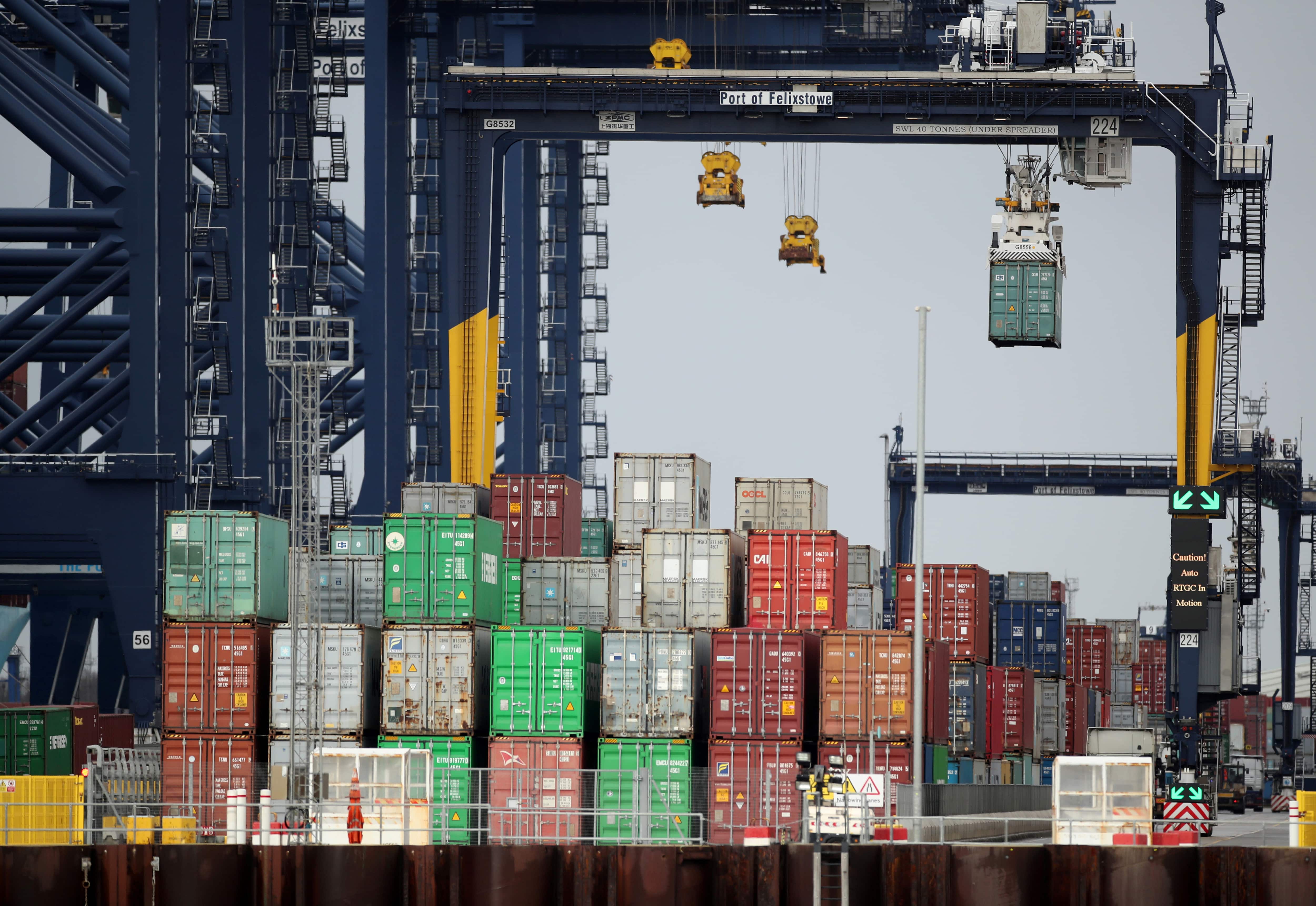
Containers are stacked at the Port of Felixstowe, Britain
A recent survey conducted by the British Chambers of Commerce has revealed that a majority of UK exporters and manufacturers have been adversely affected by the disruptions in the Red Sea, stemming from attacks on shipping vessels by Yemen's Iran-aligned Houthi rebels.
According to the survey findings, 55 per cent of exporters and 53 per cent of manufacturers and business-to-consumer services firms, including retailers and wholesalers, reported experiencing disruptions, with 37 per cent of all businesses reporting some level of impact.
"There has been spare capacity in the shipping freight industry to respond to the difficulties, which has bought us some time. But our research suggests that the longer the current situation persists, the more likely it is that the cost pressures will start to build," William Bain, the head of trade policy at the British Chambers of Commerce told Reuters.

Businesses across various sectors have encountered a range of challenges due to the Red Sea disruption, including increases in container hire costs and delivery delays ranging from three to four weeks.
Moreover, many companies have grappled with cash flow difficulties and shortages of crucial parts, exacerbating operational strains.
The Bank of England has identified the disruptions in the Red Sea as one of the primary upside risks to inflation this year.
)
'He will always be ahead': India coach Gambhir says Sooryavanshi won't walk into team ahead of Samson
)
'Gangsta' crab shoves knife blade at man and his dog in Florida - Watch
&im=FitAndFill=(700,400))
Which country has the most F-35s outside America?
)
Andhra Pradesh police pose as FBI to get X to remove tweets
)
Godfather of AI Geoffrey Hinton gives US lawmakers a one-year warning on AI
)
UNGA 2026 theme explained: What does ‘Restoring trust, managing transformation: A United Nations that delivers for all’ mean?
)
US F-16 fighter jet crashes in Michigan during training mission, pilot ejects safely
&im=FitAndFill=(700,400))
Meet top 5 Indian batters with fastest T20I centuries
)
Laura Wolvaardt sets new world record for most WT20I runs in a year
)
Ganpati Visarjan: Alia Bhatt and Ranbir Kapoor bid adieu to Bappa, watch viral videos
)
Who is Khalilur Rahman? All you need to know about 81st UN General Assembly President
)
North Korea's last nuclear test in 2017 set off 1,399 earthquakes over 8 years, each stronger than previous
&im=FitAndFill=(700,400))
New Friday OTT releases (September 18, 2026): Lust Stories 3, You+Me, Best of the Best- 8 new titles coming on Netflix, Prime Video and more
)
Xi-Trump summit may boost military links
)
Pentagon revives mandatory testosterone testing for male troops aged 30 and above
)
Asian Games 2026: Shafali stars as India thump Japan by 8 wickets to book semis berth
)
Marathi film Gondhal is India's official entry for Oscars 2027
)
The Verdict | When precision fails: US commits war crime in Minab school strike, UN finds
)
Shivakumar attends 79th Kalyana Karnataka Utsav in Kalaburagi
)
Three labourers killed as DU student loses control of his car, rams into them on Dwarka Expressway
)
US-North Korea tensions explode, Kim Yo Jong warns of 'more offensive' response
&im=FitAndFill=(700,400))
From Abhishek Sharma to Sahil Chauhan, 5 batters with fastest T20I hundreds
)
Ukraine plans record $109 bn defence spending, nearly two thirds of budget amid Russia war
)
Drone strikes cooling tower at Russia's Kursk Nuclear Plant, IAEA confirms
&im=FitAndFill=(700,400))
Suriya and Jyothika say ‘I do’ again after 20 years! See their dreamy wedding pics
)
Cristiano Ronaldo returns to Portugal squad for Nations League under new coach
)
Trump bans CNN, MS NOW and Politico from White House over ‘FAKE NEWS’
)
Spain Floods: Deadly floods hit Spain as torrential rains trigger widespread flooding
)
How did an Australian river with 500 crocodiles pass the Olympic test? Here's how
)
Hong Kong extends newborn cash support scheme by three years
&im=FitAndFill=(700,400))
Meet top 5 bowlers in latest ICC T20I rankings
)
India ‘deeply concerned’ as Houthi strikes hit Saudi civilian & energy sites
)
A first in 100 years: New cat species discovered in Bolivia is incredibly tiny
)
Africa is splitting, and a lot sooner than estimated, giving way to a new ocean
)
Indian activist-lawyer Prashant Bhushan's post brings focus on ‘conflict of interest’ appointments of ex-govt officials at Reliance, Adani groups
&im=FitAndFill=(700,400))
Meet top 5 batters in the latest ICC T20I Rankings
)
‘Will go to any extent’: Pakistan vows to defend Saudi Arabia amid Houthi attacks
)
Former India player Diana Edulji wants Smriti Mandhana to replace Harman as skipper at the earliest
)
India seeks to build a full semiconductor supply chain
Despite initial concerns about the economic impact of the attacks and broader conflicts in West Asia, the repercussions in Britain have been less severe than anticipated.
However, heightened tensions in the region have raised concerns about potential escalation and further economic ramifications.
The Houthi rebels have intensified their attacks on shipping vessels, particularly those with links to Israel, the United States, and Britain.
The ongoing conflict in the Middle East, compounded by the Israel-Hamas war, has fuelled these retaliatory actions, disrupting vital trade routes in the region.
The survey conducted by the British Chambers of Commerce, encompassing responses from 1,087 firms, sheds light on the widespread ramifications of the Red Sea disruption on UK businesses.
With the majority of surveyed businesses reporting adverse effects, the need for swift resolution and effective mitigation strategies becomes increasingly imperative to safeguard economic stability and mitigate further disruptions.
The recent spike in costs reported by British businesses, as indicated by the S&P Purchasing Managers' Index, has brought out the urgency of addressing the challenges posed by the Red Sea disruption.
While higher freight costs attributed to the ongoing disruptions have contributed to increased expenses for many manufacturers, rising wage bills remain a significant factor impacting overall costs for businesses across various sectors.
(With inputs from Reuters)