
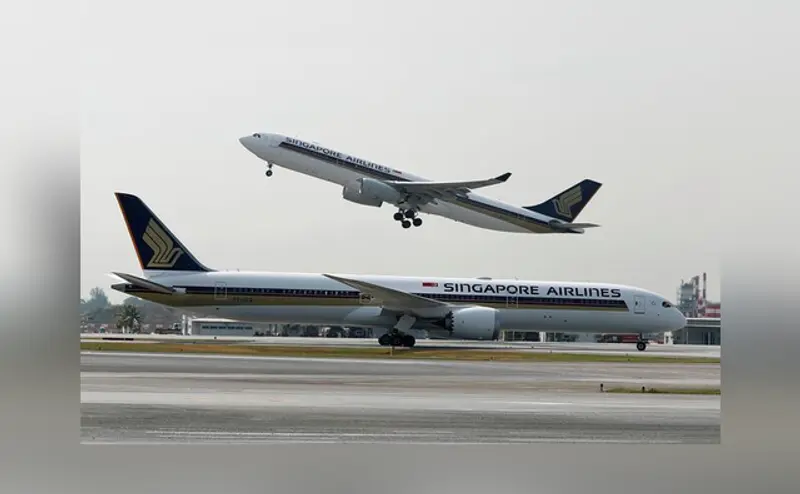
Singapore Airlines (SIA) has reported a steep 58.8 per cent year-on-year decline in net profit for the first quarter of the financial year 2025-26, weighed down heavily by its investment in Air India and broader industry headwinds. Net income dropped to S$186 million (US$145 million) in the April-June quarter, down from S$266 million (US$206.7 million) in the same period last year, marking its weakest financial performance in nearly a year. The poor results triggered a sharp reaction from investors, with SIA shares plunging as much as 8.7 per cent in early trading in Singapore, the largest intraday drop since August 2024.
The earnings slump is largely attributed to the airline’s 25.1 per cent stake in Air India, which it began consolidating into its financial statements following the completion of the Vistara-Air India merger in November 2024. This is the first full quarter that Air India’s financials have been accounted for within SIA’s consolidated results.
Air India losses weigh heavily on SIA

Air India has emerged as a major operational and financial drag on Singapore Airlines. The Tata-owned carrier reported a net loss of ₹10,859 crore (US$1.25 billion) in FY25, despite revenue of ₹78,636 crore (US$9 billion). This made it the largest loss-making entity within the Tata Group during the fiscal year. Singapore Airlines absorbed S$122 million (US$94 million) in losses from its associated companies during the quarter, most of which came from its share in Air India. This marked a significant reversal from the previous year, when such investments contributed positively to the bottom line.
Operationally, Air India continues to face turbulence following the June crash of Flight 171 shortly after takeoff from Ahmedabad, killing over 240 passengers and crew. The disaster, considered the worst in Indian aviation in over three decades, has triggered regulatory scrutiny and forced short-term capacity reductions. Investigations are ongoing, and the fallout is expected to affect performance in the coming quarters.
Broader industry pressures and strategic shifts
Trending Stories
)
US vs China over South China Sea: Washington backs Philippines, Beijing hits back
)
Musk plans to more than double xAI's chips to over 1.2 million Nvidia GPUs by year-end
)
After JU, clash erupts at SRFTI: BJP’s ‘Dimagi Naxal’ jibe sparks political firestorm after students protest RSS-linked event
)
‘Anti-social elements spreading false rumours’: LPU issues statement amid massive unrest over alleged rape
)
LPU students go on rampage, vandalise campus amid widespread protest: What's happening
)
Trump asked Xi to pressure Iran. China did not say yes — here’s what Beijing wants
)
US Treasury Secretary Scott Bessent hails global crackdown on Iranian banks and airlines
)
An OpenAI agent escaped its locked test cage again, by hiding questions in DNS lookups
)
'Our video was trimmed': LPU girls who featured in rape-denial video make U-turn
)
3 males killed, four others injured in shooting after fight at strip club in Detroit
)
'Victory for low-budget consumers': Raghav Chadha hails 30-day telecom recharge rules
)
Claude rebuilt the 1989 game 'Prince of Persia' by reusing the original's own code
)
Beyond metros: How Tier-2 and Tier-3 cities could drive India’s next AI wave
)
Tesla builds first Cybertruck with its own refined lithium: Elon Musk's $1 billion Texas bet pays off
)
IndiGo flight suffers tail strike in Bengaluru while landing; DGCA to probe incident
)
The US and China set up an AI 'red telephone', but skipped the rulebook
)
‘Terror suspects arrested near UK air base were looking to do big damage’: Trump
)
Russian envoy claims US tactics to contain India were revealed in ‘Freudian slip’
)
IND vs WI 1st ODI: Kohli breaks Sachin's most runs in one country record with unbeaten 139 as India thump West Indies by 8 wickets
)
Researchers rebuilt exactly how 700 AI agents hacked Hugging Face: a 900-link chain trick
)
‘Olympic inclusion is our major target’: WPA President Ishaun Singh on pool’s global ambitions
)
Nations League: Spain sink England at Wembley; Modric shines for Croatia
)
Why has Iran released no proof of life of Mojtaba Khamenei? Araghchi reveals...
)
'What kind of confession is this?': Pakistan PM Shehbaz Sharif’s 'terrorists would be roaming New York' remark goes viral, raises alarm online. Watch
)
Beyond BrahMos: India targets Rs 50,000 crore in defence exports with unmatched price edge
)
Sri Lankan Tamil migrant worker gets death sentence in Saudi Arabia, help sought from India
)
Muslim marriage cannot shield sex with minor wife from prosecution under POCSO: Delhi HC
)
99.9% more powerful - Scientists find boy who can recall memories from just 3 months of age
)
'FIRST LOOK from inside Noah’s Ark': Researchers share video from inside mysterious mound in Turkey
)
UNSC reform momentum grows: Russia, Portugal, Mauritius push for India's permanent seat bid
)
8 US marines injured in Iranian missile attack on vessel in Strait of Hormuz: Report
)
Afghanistan says 28 fighters killed in clash near Pakistan border, Islamabad denies
)
Ceuta migrant crisis: Protesters take to streets as Spain grapples with migrant challenge
)
Jaishankar at UNGA: Goodwill and friendship can't coexist with terrorism
)
New York City wants a 'kill switch' on every AI, and will pay whistleblowers who report violations
Beyond the impact from Air India, Singapore Airlines is also contending with multiple macroeconomic and industry-specific headwinds. Passenger yields declined 2.9 per cent year-on-year, cargo revenue was down 1.9 per cent, and interest income dropped 15 per cent. Competitive fare pressures, weaker returns on cash reserves, and muted demand in certain segments have further squeezed margins.
Despite these challenges, Singapore Airlines has outlined a cautious growth strategy. The carrier is adding new regional routes in Malaysia and the Philippines and has expanded its codeshare agreement with Air India. It maintains a positive long-term outlook, citing resilient travel demand across major markets, though it remains alert to geopolitical instability and economic volatility. The carrier's quarterly revenue increased marginally by 1.5 per cent to S$4.8 billion (US$3.73 billion), suggesting that core demand for air travel remains intact even amid broader global uncertainty.
Mixed market reactions
Analysts responded with a range of views. JPMorgan downgraded the stock to ‘neutral’ with a price target of S$7.00 (US$5.44), noting the results as a significant miss. Citigroup pointed to weaker core profitability, while Morgan Stanley projected some stabilisation in passenger yields in the coming quarters, which could ease pressure on earnings.
The airline industry globally is sending mixed signals. American Airlines recently lowered its earnings outlook due to aggressive fare discounts, while competitors like Delta and United Airlines have reported more stable demand trends. Against this backdrop, SIA’s results offer a glimpse into the growing complexity facing Asia-Pacific carriers in a volatile market.
Despite the ongoing headwinds, Singapore Airlines has reiterated its commitment to the Indian market. The group plans to continue supporting Air India’s transformation in collaboration with Tata Sons, even as the Indian carrier struggles with integration costs, operational inefficiencies, and stiff competition from domestic rival IndiGo, which now commands nearly two-thirds of India’s market share.