

&imwidth=800&imheight=600&format=webp&quality=medium "Meta AI is a lost cause but the market refuses to see it yet! Here's why")
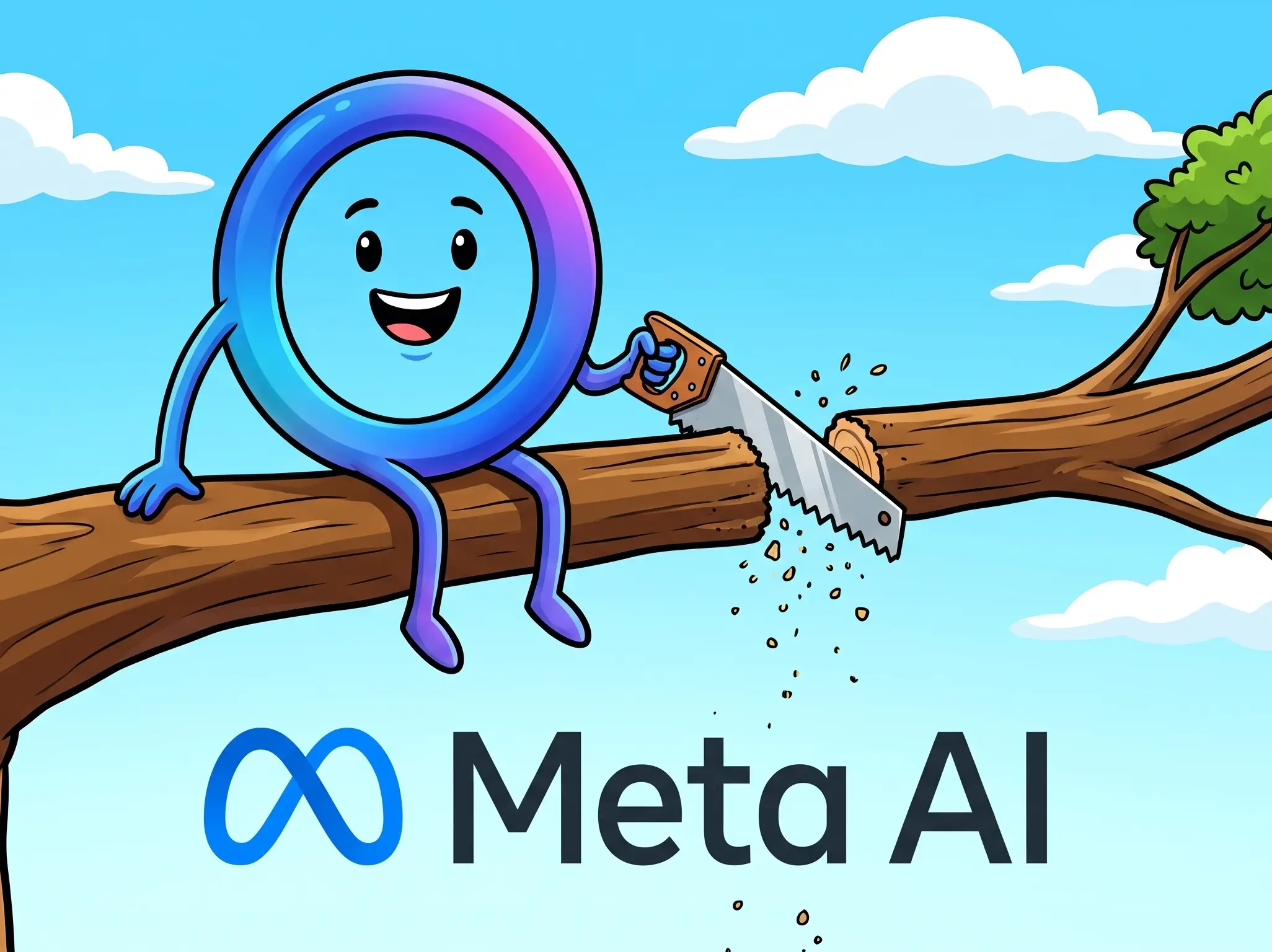
Meta AI has 1.2 billion monthly active users. That number sounds impressive until you understand how it was achieved: not by building a product people chose to use, but by embedding an AI assistant directly into WhatsApp, Instagram DMs, and Facebook feeds — apps that billions of people were already using every day. Users did not download Meta AI. They did not sign up for it. It appeared, uninvited, inside their existing conversations and search bars. Compare that to ChatGPT, which has 900 million weekly active users who actively chose to visit a standalone product — and which holds 76.85% of the AI search market. For professional tasks like coding, research, legal analysis, and writing, ChatGPT remains far superior. Meta AI is widely described as useful for quick queries and social integration, but not much else.
$83.5 Billion In Cumulative Losses And Counting
Meta's Reality Labs division — which houses its AI, VR, AR, and metaverse operations — has accumulated approximately $83.5 billion in operating losses across 21 consecutive quarters. In 2025 alone, Reality Labs burned $19.2 billion. In Q1 2026, it lost another $4.03 billion while generating just $402 million in revenue — a ratio of roughly $10 lost for every $1 earned. Meta has now laid off more than 1,000 Reality Labs employees as it pivots resources from the metaverse to AI, but the losses continue to mount with no breakeven point in sight.
$145 Billion In AI Spending — With No Cloud Business To Show For It
Meta has raised its 2026 capital expenditure forecast to between $125 billion and $145 billion — an increase of over 60% year-on-year. This money is going into data centres, Nvidia GPUs, and AI infrastructure. Google, Amazon, and Microsoft are spending similar amounts — but each of them has a cloud computing business that immediately monetises that infrastructure by selling compute capacity to other companies. Meta has no cloud business. Its revenue is almost entirely advertising. Every dollar spent on AI infrastructure is a bet that it will eventually make ads more targeted and platforms more engaging. That may happen. But right now, Meta AI, business agents, WhatsApp paid messaging, and early commerce initiatives are not generating meaningful revenue. The AI spending is improving the existing ad business — not building a new one.
The Moderation Crisis Nobody Is Pricing In
Trending Stories
&imwidth=180&imheight=135&format=webp&quality=medium)
'My name has always been Ilhan Omar': Congresswoman hits back at Trump, calls him a 'creep'
&imwidth=180&imheight=135&format=webp&quality=medium)
Gravitas | US attack could trigger WW III: Russian planes in Tehran, Israeli jets, US warships in action
&imwidth=180&imheight=135&format=webp&quality=medium)
Viral video shows cross falling on Colombia priest, no official confirmation | WATCH
&imwidth=180&imheight=135&format=webp&quality=medium)
'This is humiliation': Vijay Deverakonda under fire over controversial marriage proposal remark on Koffee With Karan 9
&imwidth=180&imheight=135&format=webp&quality=medium)
US Navy, Marine Corps boards defy Trump's transgender military ban, vote to retain troops
&imwidth=180&imheight=135&format=webp&quality=medium)
Will the US attack Iran this weekend? Trump's envoy says, 'absolutely'
&im=FitAndFill=(700,400)&imwidth=180&imheight=135&format=webp&quality=medium)
Why do army tanks have different types of armour?
&imwidth=180&imheight=135&format=webp&quality=medium)
Fauzi teaser out: Prabhas takes on the British Empire in patriotic avatar | Watch
&imwidth=180&imheight=135&format=webp&quality=medium)
India-China face-off continues near Arunachal’s Taksing, reveals ITBP chief in first official confirmation of tensions
&imwidth=180&imheight=135&format=webp&quality=medium)
Nairobi building collapse: Several feared trapped after 16-storey structure crumbles; rescue operation underway
&imwidth=180&imheight=135&format=webp&quality=medium)
Pakistan airline PIA unveils new crew uniforms, faces online criticism
&imwidth=180&imheight=135&format=webp&quality=medium)
Did Neha Bora call for Bangladesh-like GenZ protest, 'anarchy' in India? WION Fact-checks viral claim
&imwidth=180&imheight=135&format=webp&quality=medium)
'Already tired of his 9-to-5': Baby born with a moustache becomes internet sensation, video goes viral | Watch
&imwidth=180&imheight=135&format=webp&quality=medium)
Horrific video shows the moment 18-year-old fell to her death from Mexico amusement park ride
&imwidth=180&imheight=135&format=webp&quality=medium)
IND-W vs ZIM-W, 1st ODI: Rawal, Charani star in India’s nine-wicket win over Zimbabwe
&imwidth=180&imheight=135&format=webp&quality=medium)
Massive 7.2 magnitude quake off Vanuatu triggers tsunami warning for coasts within 300 km
&imwidth=180&imheight=135&format=webp&quality=medium)
Microsoft AI diagnoses complex medical cases more than twice as accurately as doctors, study finds
&imwidth=180&imheight=135&format=webp&quality=medium)
Google Fitbit Air’s new health guardian feature tracks trends: How it works
&imwidth=180&imheight=135&format=webp&quality=medium)
US midterms 2026: Trump revises Canada tariffs as Susan Collins faces tight re-election race in Maine
&imwidth=180&imheight=135&format=webp&quality=medium)
US midterms 2026: Viral video claims Lindsey Graham paid underage men for sex; clip released weeks before his sister's Senate race
&imwidth=180&imheight=135&format=webp&quality=medium)
IND vs NZ 2nd T20I: Shreyas Iyer on brink of breaking Rohit Sharma’s record
&imwidth=180&imheight=135&format=webp&quality=medium)
AI deepfakes are spreading online: Why is removing them so difficult?
&imwidth=180&imheight=135&format=webp&quality=medium)
China's dancing robot turns violent bodyguard, lifts cars and fights intruders - Watch
&imwidth=180&imheight=135&format=webp&quality=medium)
Global cybersecurity alert: PHP flaws trigger website shutdowns as hack attempts surge into millions
&imwidth=180&imheight=135&format=webp&quality=medium)
'You’re a horrible little reporter, aren’t you?': Trump snaps at NBC reporter questioning his support for Ramaswamy's campaign ad
&imwidth=180&imheight=135&format=webp&quality=medium)
Chemical warehouse explosion in Mexico: Several injured in multiple blasts, 1,000 evacuated in León
&imwidth=180&imheight=135&format=webp&quality=medium)
US charges two former FBI officials with lying to Congress about Hunter Biden probes. 'Politically motivated' Trump grievance or something else?
&im=FitAndFill=(700,400)&imwidth=180&imheight=135&format=webp&quality=medium)
New Friday OTT releases (October 23, 2026): Gajab Raat, Dorothy, Chaar Yaar- Watch these 6 new movies and TV shows on Netflix, Prime Video and more
&imwidth=180&imheight=135&format=webp&quality=medium)
Anthropic security chief issues grim cyberattack warning: ‘It’s going to get a lot worse’
&imwidth=180&imheight=135&format=webp&quality=medium)
Tu Hai Meri Kiran film review: Sonakshi Sinha and Zaheer Iqbal's thriller gets tangled in its own twists
&imwidth=180&imheight=135&format=webp&quality=medium)
First Lady Melania Trump secures ceasefire between Russia, Ukraine in Oleshky: White House
&imwidth=180&imheight=135&format=webp&quality=medium)
US-Russia relations: Is Putin playing Trump 'like a fiddle'?
&imwidth=180&imheight=135&format=webp&quality=medium)
Jenna Ortega plans TV break after Wednesday: ‘I want to leave time for new things’
&imwidth=180&imheight=135&format=webp&quality=medium)
Five killed, several injured after explosion in Bihar's Siwan as firecrackers catch fire
&imwidth=180&imheight=135&format=webp&quality=medium)
Iran targeting US diplomats? Intelligence warns of 'advanced' assassination plots: Report
&imwidth=180&imheight=135&format=webp&quality=medium)
Emmanuel Macron calls Paris suburb shooting a 'racist terrorist attack' after one killed, several injured
While Meta pours billions into AI infrastructure, the AI it has already deployed is actively destroying trust with the people who use its platforms. Meta's own Oversight Board confirmed in June 2026 that the company's account bans lack due process and transparency. Thousands of creators, small business owners, and ordinary users have had their accounts suspended or permanently deleted by AI moderation systems that falsely flag normal content — including family photos — as violations. A Change.org petition against wrongful Meta account bans has gathered nearly 56,000 signatures. Meanwhile, AI-generated bot accounts with blue tick verification badges continue to operate freely on the same platforms. Meta has gutted its human moderation teams in favour of AI enforcement — and the AI is getting it catastrophically wrong at scale.
Zuckerberg's Answer On AI Returns
When Meta reported its Q1 2026 earnings and revealed the raised capex guidance, analysts pressed Mark Zuckerberg on what measurable return on investment the company's AI spending was actually delivering. His answer was notable: he described it as ‘a very technical question.’ For a company spending up to $145 billion in a single year on capital projects — more than the GDP of most countries — that answer is not reassuring. Meta's CFO said the 2025 AI investment cohort ‘paid off,’ but what that means in practice is that ad targeting improved. It does not mean Meta AI as a product generates revenue. It does not mean the $145 billion in infrastructure will produce a new business line. It means the existing advertising machine got slightly better.
What The Market Is Choosing To Ignore
Meta's stock has fallen approximately 27.5% from its all-time high of $796.25 in August 2025, trading at around $577 as of mid-June 2026. But even after that correction, the market is still valuing Meta at roughly $1.46 trillion — a price that assumes the AI spending will eventually pay off, that Meta AI will become a competitive product, and that the moderation crisis will resolve itself. The data suggests a different picture: a company that has burned nearly $90 billion on Reality Labs over seven years with no return, that is spending $145 billion on infrastructure it cannot monetise through a cloud business, whose flagship AI product was force-embedded into existing apps rather than adopted on its own merits, and whose AI moderation system is actively destroying the creator and small business ecosystem that drives its advertising revenue. The market may be right that Meta's ad business is strong enough to survive all of this. But calling Meta AI a success — when its users did not choose it, its moderation is failing, its losses are approaching $90 billion, and its CEO calls ROI ‘a very technical question’ — requires ignoring a substantial amount of evidence to the contrary.
