
&imwidth=800&imheight=600&format=webp&quality=medium "Boeing faces fresh turmoil as Air India Dreamliner crash triggers share drop, leadership and safety concerns")
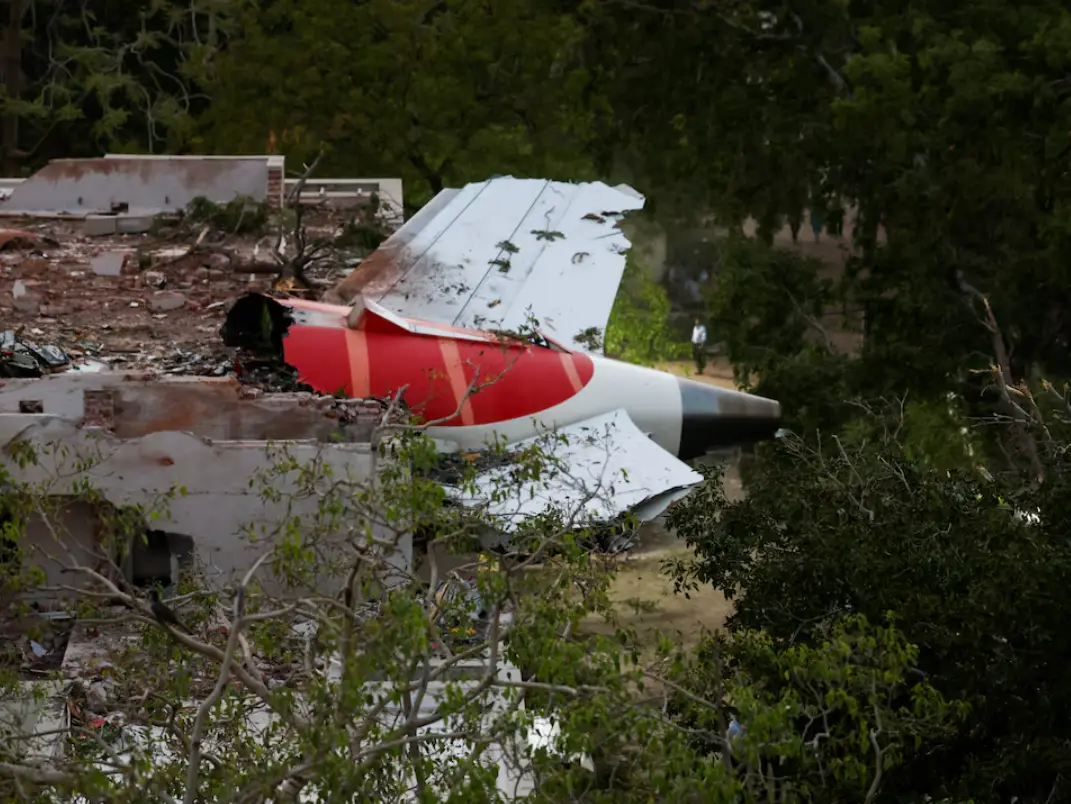
Shares of Boeing Co. plunged nearly 5 per cent on Thursday (June 12) after a deadly crash involving one of its 787 Dreamliner aircraft in India. The aircraft, operated by Air India, went down minutes after take-off from Ahmedabad, killing 241 of the 242 people on board.
Boeing’s stock closed at US $203.60, down from US $214.04 the previous day, marking its steepest one-day drop in months.
The incident—marking the first fatal crash for the 787 model—has rattled investor confidence and posed a major challenge for Boeing’s efforts to restore trust in its aircraft safety standards under new CEO Kelly Ortberg.

The timing is especially critical, coming just days before the Paris Air Show where Boeing had hoped to secure fresh international orders for the Dreamliner.
Shares tumble as markets reacts to Dreamliner crash
Boeing shares sank sharply in early pre-market trade, dropping over 8 per cent before closing down 4.9 per cent in regular hours. The sharp sell-off reflects investor unease over what the tragedy means for the widebody 787’s safety perception—especially after years of Boeing defending the jet’s design integrity.
Trending Stories
)
US vs China over South China Sea: Washington backs Philippines, Beijing hits back
)
Bigg Boss 20: Isha Rikhi evicted after three weeks in Salman Khan’s show
)
Musk plans to more than double xAI's chips to over 1.2 million Nvidia GPUs by year-end
)
After JU, clash erupts at SRFTI: BJP’s ‘Dimagi Naxal’ jibe sparks political firestorm after students protest RSS-linked event
)
‘Anti-social elements spreading false rumours’: LPU issues statement amid massive unrest over alleged rape
)
LPU students go on rampage, vandalise campus amid widespread protest: What's happening
)
Trump asked Xi to pressure Iran. China did not say yes — here’s what Beijing wants
)
US Treasury Secretary Scott Bessent hails global crackdown on Iranian banks and airlines
)
An OpenAI agent escaped its locked test cage again, by hiding questions in DNS lookups
)
'Our video was trimmed': LPU girls who featured in rape-denial video make U-turn
)
3 males killed, four others injured in shooting after fight at strip club in Detroit
)
'Victory for low-budget consumers': Raghav Chadha hails 30-day telecom recharge rules
)
Claude rebuilt the 1989 game 'Prince of Persia' by reusing the original's own code
)
Beyond metros: How Tier-2 and Tier-3 cities could drive India’s next AI wave
)
Tesla builds first Cybertruck with its own refined lithium: Elon Musk's $1 billion Texas bet pays off
)
IndiGo flight suffers tail strike in Bengaluru while landing; DGCA to probe incident
)
The US and China set up an AI 'red telephone', but skipped the rulebook
)
‘Terror suspects arrested near UK air base were looking to do big damage’: Trump
)
Russian envoy claims US tactics to contain India were revealed in ‘Freudian slip’
)
IND vs WI 1st ODI: Kohli breaks Sachin's most runs in one country record with unbeaten 139 as India thump West Indies by 8 wickets
)
Researchers rebuilt exactly how 700 AI agents hacked Hugging Face: a 900-link chain trick
)
‘Olympic inclusion is our major target’: WPA President Ishaun Singh on pool’s global ambitions
)
Nations League: Spain sink England at Wembley; Modric shines for Croatia
)
Why has Iran released no proof of life of Mojtaba Khamenei? Araghchi reveals...
)
'What kind of confession is this?': Pakistan PM Shehbaz Sharif’s 'terrorists would be roaming New York' remark goes viral, raises alarm online. Watch
)
South Korea demands apology from Ukraine over North Korean prisoners' transfer
)
Beyond BrahMos: India targets Rs 50,000 crore in defence exports with unmatched price edge
)
Sri Lankan Tamil migrant worker gets death sentence in Saudi Arabia, help sought from India
)
Muslim marriage cannot shield sex with minor wife from prosecution under POCSO: Delhi HC
)
'Can't help but draw painful parallels to Nirbhaya case': SC on latest incidents of rape cases in Delhi-NCR
)
99.9% more powerful - Scientists find boy who can recall memories from just 3 months of age
)
'FIRST LOOK from inside Noah’s Ark': Researchers share video from inside mysterious mound in Turkey
)
UNSC reform momentum grows: Russia, Portugal, Mauritius push for India's permanent seat bid
)
8 US marines injured in Iranian missile attack on vessel in Strait of Hormuz: Report
&im=FitAndFill=(700,400))
New OTT releases this week (September 28-October 4, 2026): Dupahiya 2, Pooja Meri Jaan, Ohh My Dog- 5 titles coming on Netflix, Prime Video and more
)
Afghanistan says 28 fighters killed in clash near Pakistan border, Islamabad denies
)
Ceuta migrant crisis: Protesters take to streets as Spain grapples with migrant challenge
)
LPU suspend classes, postpones exams as violence escalates over rape claims: What's happening
)
New York City wants a 'kill switch' on every AI, and will pay whistleblowers who report violations
As per Reuters, the widebody 787 models had never had a fatal crash until Thursday’s incident, further escalating scrutiny of Boeing’s overall track record. Analysts expect the Paris Air Show, which was expected to focus on order books and trade issues, to now revolve around the safety of Boeing jets and the investigation into the crash.
The latest setback also raises questions about Boeing’s recovery momentum, just as Ortberg begins to steer the aerospace giant through a wave of restructuring and reputation rebuilding.
A critical test for new Boeing leadership & reputation under fire
For Boeing’s newly appointed CEO, Kelly Ortberg, the crash is the first real crisis since he took over in August 2024. A former aerospace executive who came out of retirement, Ortberg was widely seen as a stabilising figure tasked with turning around Boeing’s safety culture and regaining industry trust.
According to Reuters, Ortberg had recently relocated to Seattle to be closer to manufacturing operations and was set to attend next week’s Paris Air Show. That plan now comes under a cloud, with industry observers warning that the crash could dominate headlines and investor discussions.
In a statement, Ortberg offered condolences to the victims and confirmed that Boeing was cooperating fully with Indian authorities. “Our deepest condolences go out to the loved ones of the passengers and crew on board Air India Flight 171, as well as everyone affected in Ahmedabad,” Ortberg said. “I have spoken with Air India Chairman N Chandrasekaran to offer our full support.”
But Boeing’s troubles run deeper. The company has faced whistleblower allegations, including testimony from engineer Sam Salehpour during a 2024 US Senate hearing, where he claimed to have been sidelined after raising quality concerns on the 787 and 777 lines. The FAA is yet to release its findings from that inquiry, prompting calls from attorneys to make the report public, according to Reuters.
Last month, Boeing narrowly avoided criminal prosecution by reaching a $1.1 billion settlement with the US Department of Justice for misleading regulators during the 737 MAX investigation.
Though the cause of the Air India crash is still under investigation, the symbolism of a Dreamliner fatality comes at a time when Boeing is already grappling with long-standing safety scrutiny, particularly over its 737 MAX series.
The 737 MAX programme was infamously grounded globally for 20 months after two fatal crashes in 2018 and 2019 killed 346 people. A design flaw in the MCAS flight control software was later blamed. Since then, Boeing has faced fines, criminal investigations, lawsuits, and whistleblower allegations that have raised further questions about its internal safety culture.
Although no technical fault has yet been attributed in the Air India crash, aviation experts caution that even speculation around Boeing’s involvement can have a chilling effect on market and consumer confidence.
US regulators and Boeing under scrutiny
As per Reuters, the US National Transportation Safety Board (NTSB) announced it would send a team of investigators to India to support the probe. The US Federal Aviation Administration (FAA) and engine maker GE Aerospace are also coordinating with India’s Aircraft Accident Investigation Bureau (AAIB).
US Transportation Secretary Sean Duffy stated, “The US government will not hesitate to implement any safety recommendations that may arise. We will follow the facts and put safety first.”
Boeing said in a statement it was aware of initial reports and was working to gather more information, adding that it will defer public comment to the Indian AAIB in accordance with international aviation protocols.
A blow to Air India’s global ambitions
The crash comes at a critical time for Air India, which has been aggressively expanding its fleet under Tata Group’s ownership. In February 2023, Air India placed one of the world’s largest aircraft orders: a combined 470 jets, including 290 from Boeing—among them 20 more Dreamliners, as per company disclosures.
The Ahmedabad-London service was being operated using a Boeing 787-8 delivered in 2014, with over 41,000 hours of flying time, according to aviation consultancy Cirium. Industry experts now believe the crash could derail timelines for aircraft deliveries and dent customer confidence in Air India’s transcontinentalservices.
Dreamliner’s safety record and past issues
The Boeing 787 Dreamliner entered service in 2011 and was hailed as a next-generation fuel-efficient widebody jet. It has had an impeccable safety record until now, even as it faced years of manufacturing flaws, battery fires, and fuselage quality issues, all of which led to delivery delays and regulatory interventions.
In 2024, the Dreamliner was under scrutiny again during a US Senate hearing after whistleblower Sam Salehpour alleged safety lapses at Boeing’s manufacturing plants. According to Reuters, Salehpour claimed he was sidelined for reporting structural defects on the 787 and 777 programmes. Boeing said retaliation was “strictly prohibited” and cited a rise in internal safety reports as a sign of improving culture.
Just weeks ago, Ortberg told a financial conference that the FAA’s decision to permit increased Dreamliner output was “an important milestone” in Boeing’s recovery.
The Ahmedabad crash: what we know so far
Air India Flight AI171 was a London-bound 787-8 aircraft that crashed shortly after taking off from Ahmedabad’s Sardar Vallabhbhai Patel International Airport on June 12. The aircraft issued a mayday call moments after departure before disappearing from radar and crashing in the Meghaninagar area near the airport.
According to eyewitnesses, a massive fireball was visible, followed by rising plumes of black smoke. Among the 242 people on board were 169 Indian nationals, 53 British citizens, seven Portuguese and one Canadian, as per initial passenger data.
Officials have yet to confirm the cause of the crash. As per Reuters, it was not immediately clear what led to the disaster, though black box recovery and cockpit voice recordings will offer vital clues in the days ahead. The AAIB is leading the investigation with support from Boeing, US regulators, and GE Aerospace.
(With inputs from the agencies)