What Russia’s full control of Ukraine’s Luhansk region means for the war and what comes next

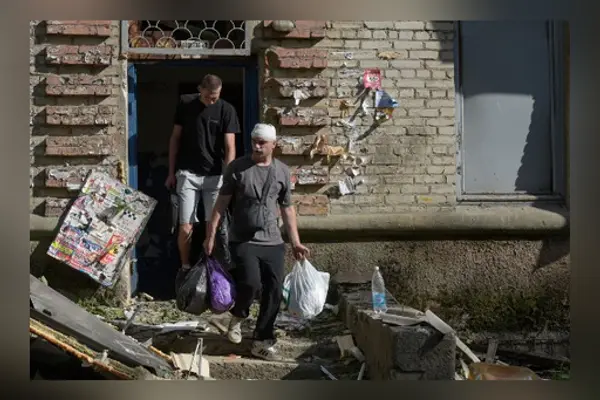
Local residents leave a destroyed residential building following a missile attack in Luhansk, Russian-controlled Ukrain Photograph: (AFP)
Leonid Pasechnik, a Russian appointed chief of the Luhansk People’s Republic, has declared full control of a Ukrainian territory in Luhansk. Since the annexation of Crimea, first time, Russia has claimed administrative control of any Ukrainian region.
Russia has declared complete control of Ukraine's Luhansk region, according to a statement on July 1 by Leonid Pasechnik, who was appointed by Russia as chief of the Luhansk People’s Republic. The announcement marks the first time Moscow has claimed full control of any Ukrainian territory since the annexation of Crimea in 2014. Luhansk, which has an area of 26,700 square km, is the first region out of the four Ukrainian regions to fall at the height of its invasion.
Speaking to the Russian state TV, Pasechnik said Luhansk was now “100% liberated.” If the claim is to be true, this means a strategic and symbolic victory for the Russian forces in a war that has dragged on for three years. Putin had earlier stated in March that Russian forces controlled 99% of the region, signalling a slow but determined consolidation of occupied territory.
What does this mean for the Russia-Ukraine war?
While the capture of Luhansk means a full annexation of any region since Crimea, the real-world implication of the annexation remains limited. After Operation Spider, which had shocked Russia domestically, the recent gains are more about domestic messaging than a significant strategic breakthrough. But this will indeed provide Moscow with a scope to strengthen administrative, logistical, and military infrastructure in Luhansk. This will also enhance the 'Russification' of Ukrainian territory with increased influence of the Russian ruble in the region. This will have a psychological impact on the Ukrainian troops who are engaged on the battlefield on multiple fronts. It places added pressure on Kyiv’s military leadership to accelerate or recalibrate its counteroffensive strategies, particularly in regions like Donetsk and southern Zaporizhzhia, where fighting remains intense.
Russia is likely bolstering its efforts to legitimise its occupation and prepare for potential referenda or administrative integration.
Ukraine, however, has not confirmed the development. Kyiv continues to reject Russia's territorial claims, calling them illegal and vowing to reclaim all occupied regions, including Luhansk, Donetsk, Kherson, Zaporizhzhia, and Crimea
Trending Stories
)
)
)
)
)
)
)
)
)
)
)
)
)
)
)
)
)
)
)
)
)
&im=FitAndFill=(700,400))
)
)
)
)
)
)
)
)
)
)
)
US President Donald Trump is trying to weaken the Russian War economy by imposing additional tariffs on Russia's trading partners like China and India. But recent developments like the US halting some shipments of weapons to Ukraine will significantly dent the morale of the military authority in Kyiv. Russia, on July 1, deployed the Yenisey combat train in Donbas to resupply and scout, reviving Soviet-era tactics for logistics and reconnaissance. In the Donbas, where fighting remains intense, the train delivers ammunition, fuel, and spare parts to frontline units, ensuring Battlegroup Centre can maintain pressure on Ukrainian positions.

