What led Delta plane to crash and flip? Here’s what experts say

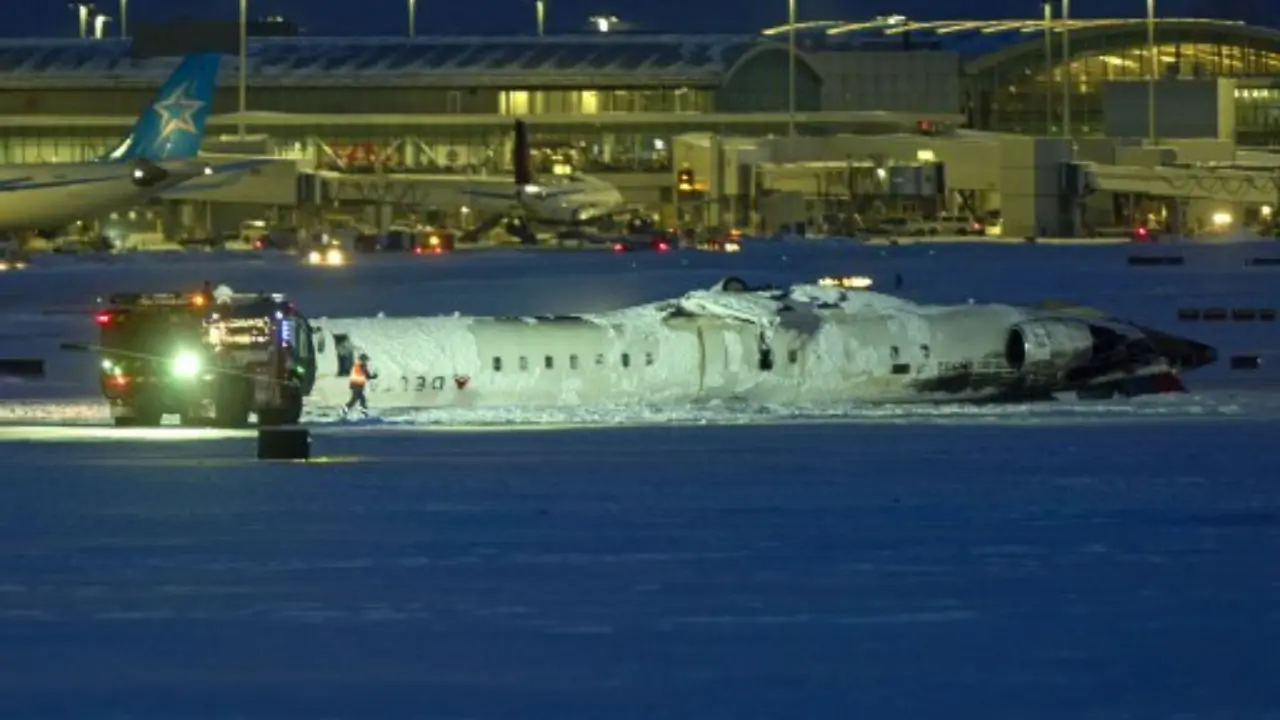
World | Trending | At the time of the crash, the Toronto airport was facing blowing snow and winds reaching 32 mph with gusts of 40 mph, according to the Meteorological Service of Canada.
Officials investigating the Delta plane that crashed at Toronto Pearson International Airport on Monday (Feb 17) will examine several factors, including weather, according to aviation experts.
In a rare incident, a Delta Air Lines plane carrying 80 passengers crashed while landing and flipped at Toronto Pearson International Airport on Monday (February 17). Fortunately, all on board the flight survived.
At the time of the crash, the Toronto airport was facing blowing snow and winds reaching 32 mph with gusts of 40 mph, according to the Meteorological Service of Canada. While the temperature was as low as minus 8.6 degrees Celsius (16.5 degrees Fahrenheit).

Investigators to examine several factors
Aviation expert Scott Hamilton told Newsweek that investigators from Transport Canada and the TSB “will be looking at runway conditions, looking at if it skidded along the runway and flipped.”
)
BRICS Summit 2026: Trump wants to weaken BRICS, but maybe doing the opposite
)
BRICS Summit 2026: PM Modi, Xi reach key consensus on ties, China to assume BRICS chairmanship in 2027
)
Trump defends Lincoln Memorial pool amid NYT report blaming renovation flaws, not vandalism
)
Indian importers urge Bangladesh to lift export ban on 'Hilsa' fish ahead of Durga Puja
)
War is making Russia stronger? How Ukraine is shaping Moscow’s next generation of weapons
&im=FitAndFill=(700,400))
Shahid Kapoor to Rajkummar Rao: Actors who rule both theatres and OTT
)
'80% of Indians are non-vegetarian': Rahul Gandhi slams BRICS Summit dinner menu, BJP calls it 'politics on food menu'
)
BRICS Summit 2026: Modi-Xi moment highlights India-China thaw at BRICS
)
800 million years old - Scientists discover 'fingerprints' of supercontinent Gondwana in ancient rocks
&im=FitAndFill=(700,400))
Meet top 5 batters fastest to 3000 runs in T20Is
&im=FitAndFill=(700,400))
Why European Meteor missiles use ramjet engines compared to standard US solid rockets
)
‘Partners, not rivals’: Xi outlines four point plan for stronger India-China ties
)
Did BRICS Summit 2026 prove that an 11-member bloc with India and China in it can still agree on key issues?
)
9-year-old Chennai prodigy clears Cambridge IGCSE grade 10 exams
)
Russian drone hits Warsaw-bound train near Polish border, Zelensky accuses Moscow of ‘deliberate’ targeting
)
US diplomat accused of possessing child abuse images secretly flown out of UK by US Marines
)
Russia-Ukraine-US talks in October? Kremlin says not ruling out possibility of trilateral
)
'He is popular...': Malaysian PM Anwar Ibrahim's praise for PM Modi during bilateral meeting | WATCH
)
Top 5 places to visit in Goa beyond its famous beaches
)
NATO under Russian threat? Drone strikes just 2 km from Poland, narrow escape for former UK PM, CIA chief
)
PM Modi and China's Xi offered to help resolve Russia-Ukraine war: Kremlin
)
Bigg Boss 20: Who Is Rohed Khan? Meet the Austrian actor from Bade Miyan Chote Miyan
)
BRICS Summit 2026: Russia-India-China grouping never formalised
)
‘Want to reset ties with India, have engagement based on mutual interests,’ says Bangladesh minister
)
The Verdict | Africa is too big to remain a guest at the BRICS table
)
Akram, Afridi, Mushtaq tear into PCB after Pakistan’s Test series collapse in UK
)
Humans may lose control of AI: Anthropic CEO calls for slowdown, Altman, Musk back him
)
'It’s going to be a war': Ben Shelton on facing Zverev in US Open title clash
)
From severe mobility problems to recovery: Madhuri the elephant’s journey of wildlife care
)
Trump says Canada eager to reach a deal, it could come ‘fairly soon’ if Ottawa treats US farmers better
)
UK breakup on the cards? Scotland, Wales and Northern Ireland push for independence
&im=FitAndFill=(700,400))
Why Chinese PL-15 air-to-air missiles use dual-pulse motors compared to European interceptors
)
Why does your skin need protection from UV rays?
)
BRICS Summit: New Delhi declaration adopted with full consensus, big diplomatic win for India
&im=FitAndFill=(700,400))
How 2nm technology improves iPhone performance
The plane’s approach speeds, thruster viability, and braking anomalies will be investigated, he said. In addition, experts may also be looking for any potential obstacles that the plane could have hit, causing it to flip upside down.
“Investigators … will look at whether there was a wind shear. A wind shear refers to a sudden change in wind speed and/or direction,” said Hamilton, who is the managing director for the aviation company Leeham Company.
Apart from this, Hamilton told KING 5 Seattle that officials will be looking if there were any ice spots on the runway. However, airport fire chief Todd Aitken said during a press conference on Monday (Feb 17) that the landing strip was dry.
Aitken also said that there were no cross-winds at the time of landing. While pilots who viewed the footage of the crash questioned that statement, according to Reuters.
John Cox, CEO of a Florida-based aviation safety consulting firm, told the Associated Press, “The weather conditions were windy.”
“The wind was out of the west at 27 to 35 knots, which is about 38 miles an hour (61 kph). So it was windy. But the airplanes are designed and certified to handle that. The pilots are trained and experienced to handle that,” he said. Cox has been involved in National Transportation Safety Board inquiries.
Cox further said that investigators will have to determine the cause for the plane’s right wing being separated to understand the reason for the accident after finding the flight data recorder and cockpit voice recorder.
Also read | Delta plane crash: 'I'm upside down,' says survivor as videos from ground zero show stunning visuals
“They will be found, if not today, tomorrow, and the Transportation Safety Board of Canada will read them out and they will have a very good understanding of what actually occurred here,” he said.
(With inputs from agencies)

