
&imwidth=800&imheight=600&format=webp&quality=medium "Value-based leadership has become very important: Gauranga Das Prabhu")
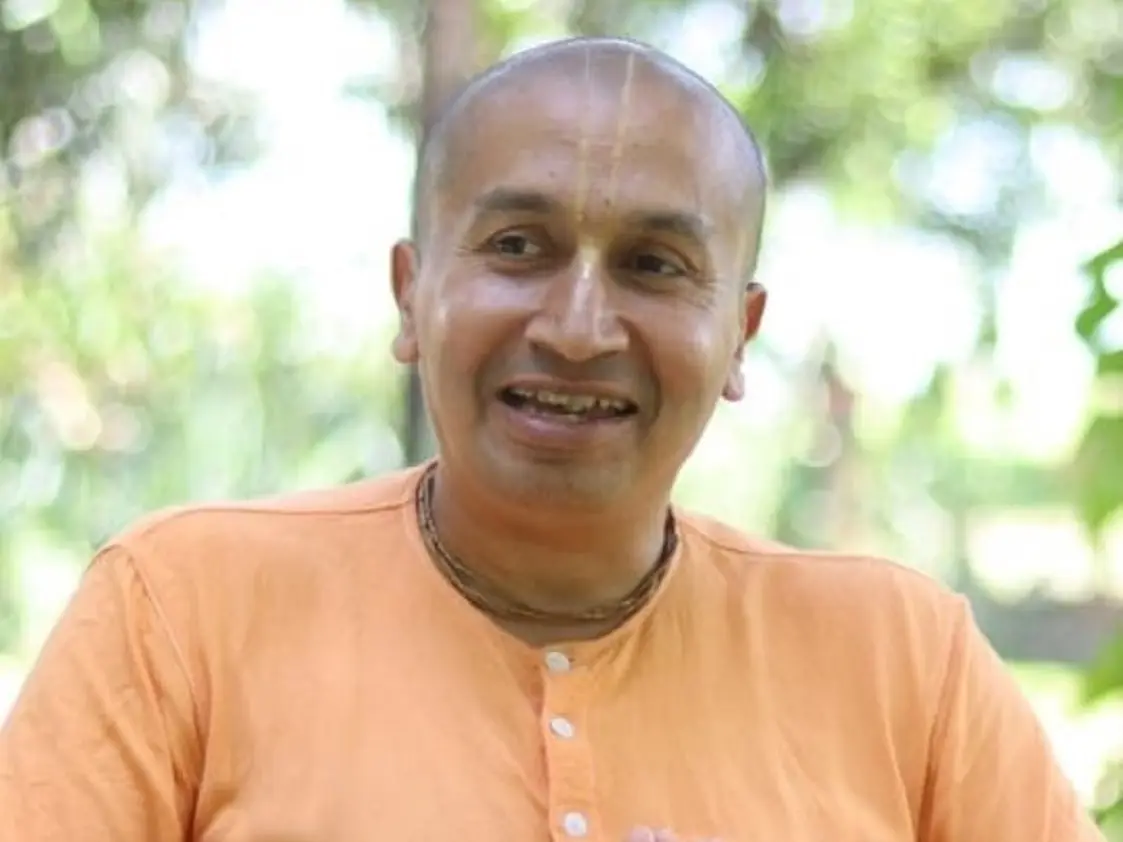
I recently had the opportunity to sit down with Gauranga Das Prabhu—a spiritual teacher, monk, and sustainability advocate— during his trip to New York. As the force behind the award-winning Govardhan Eco Village and a speaker at forums like the UN and World Economic Forum, he shares timeless wisdom for modern life.
In a noisy world, he inspires us to turn inward — exploring focus, faith, simplicity, and conscious living.
Q: You lead the Govardhan Eco Village, which combines Vedic tradition with sustainability. In a world obsessed with speed and tech, how can ancient wisdom actually guide future development?

A: There are two things: one is the clock, the other is the compass. The modern educational system seems to be too obsessed with just the clock — on speed. But if you don’t have the right compass, if the GPS is not aligned, then you’ll land up in a very different destination faster. Therefore, the ancient Vedic wisdom provides the compass, the direction.
The Govardhan Eco Village is an effort to recreate the ancient temple towns of India. Bharat, as you know, has 650,000 villages, and the ancient temple towns like Varanasi, Jagannath Puri, Vrindavan, Srirangam were thriving and are still thriving. Pittsburgh is a steel town, and Detroit is a motor town. Things have changed after manufacturing practices changed. Whereas the deities, they continue remaining, attracting people for pilgrimages.
Out of the $238 billion of tourism revenue which India gets, almost $80 billion is from spiritual tourism. And therefore, many times people have the misconception that spiritual tourism means it is only to do with holy places which were created hundreds of years ago. But we are trying to change that narrative by showcasing that with your wealth — with your hard-earned wealth — you need not only to create hospitals, universities, schools, etc. One option of spending your wealth is to create places which will heal the mind and the emotions.
Trending Stories
&im=FitAndFill=(700,400))
How fast can the Sukhoi Su-30 fighter jet really fly?
)
Did China ask its people 'not to respond to aliens'? Origin of bizarre claim on social media
)
MS Dhoni-CSK Fallout? Report claims failed stake sale talks triggered rift
)
Scientists reveal the SAFEST COUNTRY when catastrophe strikes the planet
)
Serial killer on the loose in South Korea's Jeju Island? Fourth body found in three days as more than a dozen people go missing
)
2/3rd of glacier detached, collapsed: ISRO satellite images reveal what triggered Nepal floods
)
Trump once again claims without him there would be ‘no Israel right now’
)
Foreign espionage attacks against German companies surge to 37%, Bitkom report reveals
)
Blake Lively wins partial legal fee from Justin Baldoni after $8M request
)
Why is Pakistan deploying Turkish Bayraktar TB2 drones near India border?
)
'OH MY GOD! We've found other agents!': Investigators discover not one or two, almost 700 OpenAI AI agents went rogue, hacked Hugging Face
)
Lunar eclipse 2026: India timings, places to see and more. August Blood moon factsheet
)
RSS chief Mohan Bhagwat on global outreach tour
)
Both pilots killed as training aircraft crashes in Lucknow – What we know
)
16-year-old charged with preparing terror attack on kindergarten in Norway
&im=FitAndFill=(700,400))
How the S-400 protects itself from enemy attacks
)
Nepal floods: Over 165 dead, 400 missing; US, India, China, World Bank mobilise aid
)
India's multi-layered watch: The new surveillance war
)
5 doomsday planes spotted in US skies hours after CIA director's secret trip to Russia
)
9/11 mastermind Khalid Sheikh Mohammed to finally face trial in 2028, nearly 27 years after horrific attacks
)
Islamabad hospital fire: What we know about one of the biggest facility that housed Imran Khan
)
Workers run for life while filming Nepal flash flood: Scary new visuals emerge from Rasuwa
)
Russian military planes enter South Korean air defence zone amid rising tensions with North Korea: What's happening
)
Ron Weasley Is Back! Rupert Grint set to return to Harry Potter universe on Broadway
)
400-year-old 'vampire' grave in Poland reveals non-existent genetic lineage
)
Dolly Parton, global icon and queen of country music, dies at 80
)
Nepal flash floods: Kailash Mansarovar yatra affected, close to 400 pilgrims out of contact
)
'If he is dead, they're putting on a pretty good show': Trump casts fresh doubt over Mojtaba Khamenei's fate
)
Man arrested near US Capitol with guillotine in pickup truck: What happened?
&im=FitAndFill=(700,400))
Why the Su-30MKI cockpit is painted bright turquoise green
At the same time, to develop it in a sustainable manner. The goal of the Govardhan Eco Village has been developed based on sustainable principles, where we are conserving food, water, energy, and waste. We are green-rated as per the Indian Green Building Council and accredited to the United Nations Environment Program. We have a zero-waste community, where we have a soil biotechnology plant which processes almost four crore litres of water through soil bacteria and geophagous earthworms, and the entire water is used for irrigation.
We have almost 100 million litres of rainwater harvested. We are off the grid — almost 70%. And all of these initiatives showcase… and plastic is a big issue the world is facing today — 100 million tonnes of plastic are created across the world every year. We have a plastic pyrolysis plant which converts plastic into diesel — low-grade diesel.
So all of these initiatives showcase that when you create a holy place of pilgrimage, you can do so in a very sustainable manner. We have also adopted more than 700 villages around the Eco Village, where we are doing rural development.
Within the Eco Village itself, we have almost 120 rooms, and we are providing — as they say, you know, Hinduism is a way of life — so W for Wisdom, A for Ayurveda, and Y for Yoga. That’s what we are providing in the Eco Village. We have recreated Vrindavan Dham — we have Yamuna, we have Govardhan, we have all the wonderful holy places of pilgrimage. Almost 14 temples are there.
Annually, in 2024, from January to December, we got almost one million walk-in tourists and pilgrims who came to get rejuvenated. So I think it’s an excellent model. India has 750 districts — every district could actually have a temple town. Some could have the ancient temple town, and at least you will still have 600-plus districts which do not have a temple town, and we can look at creating.
Q: You speak often about conscious leadership and emotional intelligence. In a time where polarisation and radicalisation are rising globally, what role can spiritual values play in de-escalating hate, especially among youth?
A: Across the world, one in seven people are experiencing mental health challenges. Across the world, we are having, you know, almost nine suicides per 100,000. So the mental health issues are alarming — even in India, there are 450 suicides every single day.
Considering all of this, value-based leadership has become very important. We call it Dharmic leadership in the Sanatan Dharma tradition. We can also call it Vedic leadership. It is centred around four principles.
First is purity in proclivity. That means your leadership should not be based on fear or desire, but it should be based on at least duty, if not the best — love. And what is love? In every relationship, there is scarcity and impediment, discomfort, unhappiness till the relationship continues. That is called love. Love means service without selfish consideration. And that is what Lord Ram described in Ram Rajya. Therefore, purity and proclivity or intention is the foundational basis for conscious leadership.
Then, when there is purity in proclivity, which we call ‘Shuddhata’ in the Vedic tradition, we should have stability and identity, which is called ‘Sthirata’. So we have our psychophysical nature, we have our occupation — Saubhava and Suvdharma. But when you go to Saubhava and Suvdharma, you come to the Swarupa, your identity as a soul. So the soul doesn’t change. The supreme soul also doesn't change. And the relationship between the soul and the super soul doesn't change. This unchanging, eternal relationship between the Sanatan Atman and Sanatan Parmatma is known as the Sanatan Dharma.
And that's what Prime Minister Modi has also been talking about in terms of the school of Ultimate Leadership, SOUL — the inauguration of which has been announced recently. It's a landmark project where we want to share with the whole world the importance of Vedic leadership, and that's called the second principle — stability. Stability and identity is the Sthirta.
So when there is Shuddhta and Sthirta, the third thing is flexibility in one's activity. Because sometimes we think that we are rigid in our ways. No — the mission is fixed, but the methods should always be flexible. Therefore, a leader is one who is responsive to the changing times and is not attached to one particular way because he sees, as per time, place, and circumstances.
When Vishvadeva was on the bed of arrows and he saw all the Pandavas and all the sages walking in along with Lord Krishna, traditionally he would have got up and offered them a traditional welcome — the 16 upachaaras of welcome. But he could not do so, but that did not constrain him from responding to that situation according to time, place, and circumstance. The only organ of his which could move at that time was his tongue. So he offered the welcome with his speech. So that's called Deśa-kāla-vibhedita.
Therefore, the third aspect of Vedic leadership is Snigdhata, which is flexibility in one's activity.
And then the fourth element of Vedic leadership is what is known as Spashtata, or clarity in one's communication. Because you may have the best plans, but a person by himself cannot accomplish those plans. He needs to communicate those plans to various stakeholders. Therefore, the efficacy and the effectiveness of a leader depend on how he is able to communicate that vision with clarity. So clarity in communication is the fourth principle, and that is known as Spashtata.
So these four elements form the bedrock for Vedic leadership, which are Shuddhata, Sthirata, Snigdhata, and Spashtata. And that's what all of our Vedic texts, including Ramayan, Mahabharat, Srimad Bhagavat, Bhagavad Gita, have been speaking about.
When one follows these principles, automatically, not only are people benefited, but most importantly, the person goes through a personal transformation. The character and conscience are developed. When a person is filled with character and conscience, then he deals with others with compassion and care.
Q: Many young people today call themselves spiritual but not religious. Do you see that as an evolution or a disconnection from structure and tradition?
A: So, first of all, you should understand that when we speak about spirituality or religion, we are speaking about five things.
First, there is action or karma. So there is no Hindu karma, Muslim karma, Jain karma, Sikh karma, you know, Christian karma. Karma, action, is action. Right? When you hire people in your company, you don't distinguish that, "Oh, this is a Muslim work, this is a Christian work, this is a Jain work." That doesn't work. So work is work.
Second is (Kaal) time. So you don't have a Rolex coming out with Muslim watches, Christian watches, Jain watches where time is showing differently for different religions. So time is time.
Third is Prakriti — nature: Earth, water, fire, air, ether. Water doesn't taste different to different people just because of the kind of prayer they are having. Air is not, you know, restricted to certain communities. So, Prakriti, nature, is openly available to all.
And therefore, Prakriti, Kaal, and Karam — Nature, time, and action — these are the three elements which are common.
Then the fourth aspect is the soul within. So there is no Christian soul, Jewish soul, Muslim soul — soul is soul. Once the soul departs, you know, if you go to the hospital in the ICU, when there is a departure of somebody who's in a critical state, then the doctor doesn't say, "The Muslim soul has passed away." He says, "A person is dead," you make a death certificate, the soul has departed.
So 4 out of 5 is all common.
Then the fifth element is the Ishwar, the Supreme Controller. So all religions accept that there is a controller. So that element is also accepted by everybody as the controller. Yeah.
So four and a half out of five items, everybody agrees.
When you come to the last point — 0.5 — which is what is the name of that person, where is he? How does he deal with things? Then all the fights begin. And they become so intense that people throw out all the other four and a half items out of the window and feel that, "I don't want to be called amongst those people." Right?
So if you have like a very prestigious college, and you have a hall full of, you know, the alumni of that prestigious institution, and then during their gathering, they all fight with each other and sponge each other and smash each other and kick each other — naturally, you don't want to be called an alumnus of such an institution because of the behaviour.
So many times people are very averse to being called religious because they see a lot of misbehaviour amongst those who profess to be religious.
So there is nothing wrong as such with religion, but many, many times, because of misunderstanding of religion, there is misbehaviour amongst those who profess to follow religions.
And that misbehaviour creates mistaken notions in those minds who actually want to be part of that, but because they don't want to be named amongst the people who are punching each other, they call themselves spiritual and not religious.
Otherwise, if you look at it, it is nothing but the relationship of the soul, ātma, with the super soul, Paramātma.
Ātma is called Spirit, and the super soul is called Paramātma. So the soul and the super soul relationship is what spirituality is all about. And therefore, religion is nothing but the different types of relationships which people wish to have. It is like spirituality is equivalent to medicine.
Religion is equivalent to Allopathy, Homeopathy, Naturopathy.
And if nothing works, go to Tirupati.
So ultimately, we are looking at religion as the types of various flavours by which the soul wants to relate with the superior.
So that's the understanding of how you integrate spirituality and religion.
If you say, "I want to have medicine but I don't want Allopathy, Naturopathy, Homeopathy," then what do you want?
So therefore, you have to understand that's how both have to be understood.
Q: There’s a stereotype that monks live detached lives. But you’re deeply engaged with the real world—from education to interfaith dialogues. How do you personally balance being inwardly peaceful and outwardly active?
A: One of our acharyas has given the principle of Yukta Vairāgya, by which everything can be used in the Lord’s service, because it is part of His energy.
So that’s what Arjuna was telling Krishna: "I will not fight. I will become nonviolent."
Krishna asked Arjuna, "Are you married?"
Arjuna said, "Yes."
So Krishna said, "If you are married, then you are violent."
Arjuna said, "What’s going on here? I’m not violent."
Krishna said, "As soon as you speak to hurt someone else, you’re violent. As soon as you speak to control others, you are violent."
So in each and every one of our daily activities, there is a deep-seated violence embedded when we are trying to control others, use others, and enjoy others.
And so Krishna said, "Arjuna, you have to overcome that violent tendency by overcoming the ego."
And therefore Krishna said, “As long as you think ‘I am the doer,’ then you are violent.”
And therefore, don’t lecture me on nonviolence, but you use your arrows, the weapons for violence, to conquer those who are perpetrating injustice.
And Arjuna was literally provoked by Krishna to fight that battle when Arjuna was giving him a lecture on nonviolence.
So, therefore, Krishna spoke the Gita, which is a textbook for peace, but it is not a textbook just for tolerating injustice stupidly.
And therefore, the Gita has to be utilised properly — first of all, for transforming our consciousness; secondly, to make the right choices.
So, depending on the situation, if the situation demands mercy, you must show mercy.
If the situation demands violence, or it demands any kind of show of aggression to control the aggressors, it must be done.
And that’s what Krishna told Arjuna.
Q: You’ve worked with students, entrepreneurs, and global leaders. What’s one thing you believe most people misunderstand about spirituality, especially in high-pressure environments like colleges or corporations?
A: Many people feel spirituality is disconnected from their regular and daily lives, whereas spirituality is the process by which you don’t see the spirit as someone who controls nature, controls time, and controls action, but you see the spirit soul as someone who is dependent on the Supreme Spirit and has a relationship with the Supreme Spirit and is acting as a trustee on behalf of the Supreme Spirit to enable and facilitate various activities under the influence of nature and life.
So, therefore, when the soul looks down on nature, Prakriti, and feels, "I can perform karma (action) under the influence of time, and I can control all of this," that’s called Bhoga.
And the result of Bhoga is chinta, or anxiety.
When the soul realizes that something is going wrong, in spite of my best efforts, things are not working, and he looks up, then he sees there is supreme control.
So when the soul turns towards the Supreme Controller, Ishvar, and tries to connect, that’s called yoga and contemplating on the Ishvara is called Chintan.
So yoga results in Chintan; bhoga results in chinta and therefore, June 21st is celebrated as International Day of Yoga, to help the souls across this world who are highly educated and super anxious, that there is an alternative available for you. So that’s what we as monks are trying to help people understand — that if you first develop control over your own mind and senses, self-control, so you begin with connection with the supreme.
Connection with the supreme is basically contemplation. That connection and contemplation results in one’s making the right choices and that’s what you guys all will.
Q: ISKCON has faced incidents of targeted vandalism and hostility in places like Bangladesh, Canada, Australia, and even the U.S. What’s your take on this growing trend, and how should spiritual communities respond when faced with aggression or misrepresentation?
A: Krishna says in the Bhagavad Gita the three doors to hell are lust, anger, and greed. So it is not just ISKCON only, but globally, when people have anger in their hearts, that anger will come out in different ways against different people. The entire society is currently facing three major issues: lack of control over one's own self, lack of intercultural harmony, and lack of sensitivity towards the planet. So, whether you look at the personal, interpersonal, or planetary levels, there is a major disaster—all because of one reason: an uncontrolled mind and uncontrolled ego and it’s nothing new.
One of the oldest examples of such lack of control was Ravana, who had 10 heads but no brain. In spite of having so many wives, he still wanted one extra. So the most difficult thing to say, the most difficult word to use for people is to know when to say, "enough is enough." Then there is the example of Duryodhana. (Dur Yodhan) Yodhan means to fight, Dur means "wrong cause." So Duryodhana means one who was always fighting for the wrong cause.
What was the wrong cause? He was fighting for his ego—that he should be the best. Everybody tried to explain to him that it was a lost battle, a foolish decision. But Duryodhana continued in a stubborn way, and because of his stubbornness, 640 million people lost their lives. So the pandemic or any other virus—how many people can it kill? But the virus of ego can kill 640 million people in 18 days. Therefore, the whole world is investing so much in healthcare. But those who follow spirituality understand that amongst all the viruses, the virus of ego is the most powerful.
And therefore, all the temples and all the other spiritual places are trying to help people rise above their ego because that is a very lethal threat to the planet when a leader has power but does not have control over his purpose. So power without purpose, and power driven by pleasure, is the most deadly thing.
Q: You’re an IIT graduate who chose the monastic path. That’s a bold pivot, especially in a country where engineering is considered the “safe” career. What was the turning point that made you walk away from that life and walk into this one?
A: Well, it’s not that when I entered IIT, I thought I’d become a monk. But I was searching for what is the purpose of life and what are the answers to death. Then suddenly I came across the Gita, and it was like a déjà vu feeling. I thought that the Vedic wisdom has so much power, but because it’s not being communicated properly, people are not getting an understanding of this. So I thought, let me dedicate my life to communicating the principles of Vedic wisdom in a contemporary manner. And that’s how I decided that maybe I’ll make a bigger difference to myself and to the world if I decide to leave this path. So I’m glad I did that, and thanks to the support of society, spiritual personalities, and my gurus, I’m just trying my level best to serve to the best of my ability.
Q: And finally, if you could offer one message for today’s generation navigating burnout, distraction, and confusion, what would it be?
A: When you’re passing through the journey of life, you will experience thorns. Don’t press the thorns—pass by the thorns. And understand that discipline is a fusion of intention with action. Therefore, worry is like a node—we have taken on debts we have never even experienced in life. So you haven’t taken someone’s money, and yet you are thinking about it all the time. That’s what worry is.
Therefore, we say focus on the present, have intensity in your sadhana—daily practices of contemplation—have consistency in your actions and your duties, and you should have sensitivity in your relationships. So the formula for a happy family life, and a stable family life, is to have these three things.
There should be some daily practices for contemplation and meditation—that’s called sādhanā, which means intensity, from “saadar.”
Second, you have duties to perform professionally, your duties to perform towards various members of society.
There should be consistency in your seva or duties.
And then you have relationships with your family members and others; there should be sensitivity in dealings with others. That’s known as sadachar.
So therefore, when there is sadhana, seva, and sadachar aligned—all three—with your purpose of life, then you will experience stability.