US investors bullish on India, Washington-Delhi ties mature says USISPF Chief Aghi

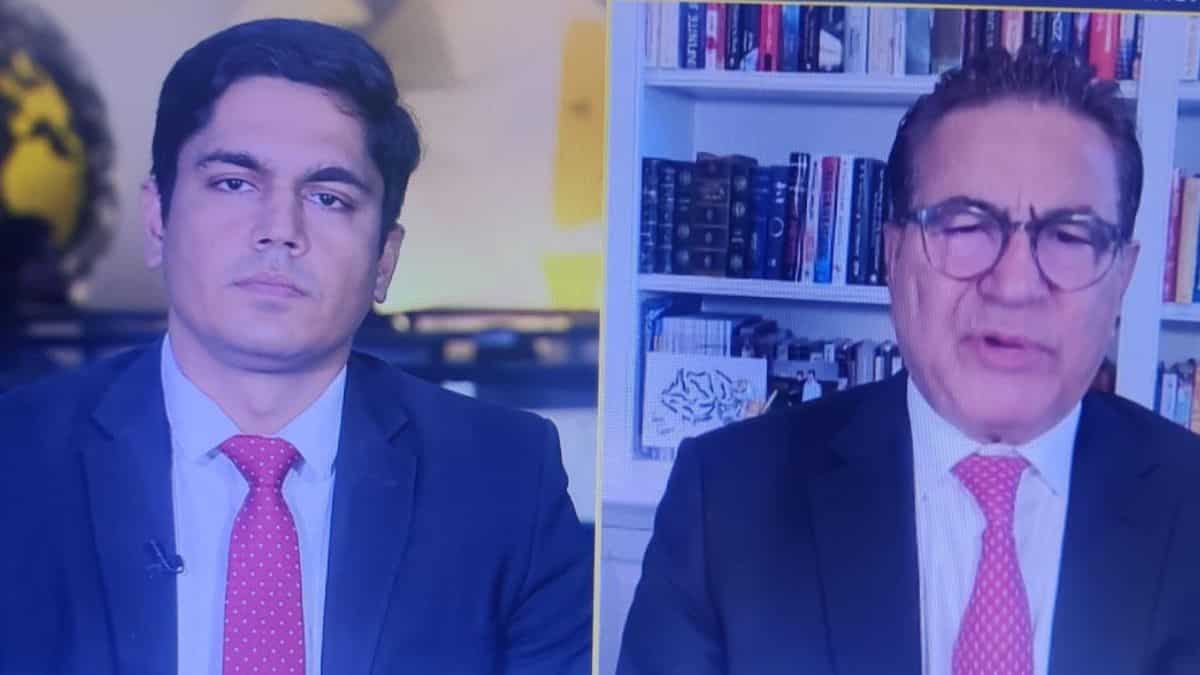
US Investors Bullish on India, Washington-Delhi Ties Mature says USISPF Chief Aghi
Mukesh Aghi, President & CEO of the US-India Strategic Partnership Forum (USISPF), has underscored the flourishing ties between the United States and India, shedding light on "bullish" sentiments of US investors on India. Speaking to our diplomatic correspondent Sidhant Sibal, Aghi stated, " relationship has gone in a very positive direction, in a win-win fashion for both countries. you have to understand that the relationship is deep, much broader, and much more strategic between India and the United States"
Highlighting the changing dynamics of global supply chains, Aghi noted, "US companies are looking at de-risking supply chain from China and India becomes a primary source from their perspective." Highlighting the significant participation of US companies in Vibrant Gujarat in January, Aghi projected a continued growth in investments, highlighting, "You have US companies creating almost three and a half million jobs in India which are High Tech, High End paying jobs."
He also spoke on President Biden not being able to attend India's Republic Day, the Nikhil Gupta case etc.

Here's the full interview.
WION: My first question to you is how do you see the India-US relationship if you can sum up how this year has been?
Mukesh Aghi: Well, I think the relationship has gone in a very positive direction, in a win-win fashion for both countries. If you look at it from a geopolitical perspective, India and the USA are aligned vis a vis China. When you look at it from an economic perspective, the trade has gone up almost $200 billion. When you look at it from a technology perspective, what we're seeing is the exports of Indian IT services and basically app platforms have gone up. And also, we've seen some critical technologies moving into India, specifically in the manufacturing arena. And then finally people to people, we have around 5 million Indian Americans in the US and they seem to work very positively building a very strong partnership between the two countries. So, I think the year 2023 shows how it has gone up as compared to the last 40-50 years.
)
The Early Spring is proof not everyone can talk about their real feelings, and it is perfectly OK
)
UN votes to ‘correct the map’ as India backs fairer world view
)
Nigerian Navy discovers 99,000 litres of suspected stolen, illegally refined products as it intensifies anti-crude oil theft operations
)
Who is Aditi Paudel? 17-year-old becomes Japan's first literacy ambassador
)
Bengaluru: Officials find 40 kg expired chilli at chairman's club
)
Jaishankar rejects trade link to ending Ukraine war
)
Israeli strikes on Lebanon kill three, injure 23 despite truce
)
Alpine glacier was covered with sheep wool sheets to prevent melting. It worked
)
South Korea mulls deploying military assets to Strait of Hormuz
)
World's fifth-largest economy, British army can't afford to train
)
Breaking | Vance takes the podium: First White House briefing since Leavitt's exit
)
Taiwan raises 'concerns' over China's missile test
)
BRICS 2026: $1 trillion sovereign capital set to converge in Delhi for first iBRICS Summit
)
What is Iran's Pickaxe Mountain that Trump has again threatened to bomb?
)
UN votes to correct world map that visually shrank Africa for 450 years
)
Former NewJeans member Danielle launches YouTube channel, hints at new solo journey
)
Bangladesh batter Towhid Hridoy creates history with 350 not out in South Africa
)
Brendan Fraser’s transformation fuels The Mummy 4 excitement as fans welcome back Rick O’Connell
&im=FitAndFill=(700,400))
Krishna Janmashtami 2026: From Dhaniya Panjiri to Makhana Kheer- 5 best sweet dishes perfect for celebrating Lord Krishna’s birth
)
Donald Trump plans to travel to Ireland on Qatari-donated jet amid security concerns
)
Nazi-looted art to return to Jewish heirs
)
Eight killed in Kerala’s Thrissur after car rams into lorry parked on highway
&im=FitAndFill=(700,400))
Why Russian fighter jets use bulky, low-pressure tyres compared to US jets
)
FBI-wanted fraud accused arrested in Jalandhar over $600,000 scam
&im=FitAndFill=(700,400))
Why US tanks weigh over 20 tons more than Russian tanks
&im=FitAndFill=(700,400))
New Friday OTT releases (September 4, 2026): GDN, Dhamaal 4, Jagamae Sangeetham- Watch 6 new movies and TV shows on Netflix, Prime Video and more
)
Killing the Himalayas slowly: Human urine is melting a glacier on Mount Everest
WION: How much are the American investors, bullish on the India growth story?
Mukesh Aghi: Oh, very much, if you look at the largest FDI investors in India, are the US companies coming directly or to Singapore or to other countries? But more importantly, if you look at the last week, the FII investment went up almost by $15 billion. You have US companies creating almost three and a half million jobs in India which are high-tech, High End paying jobs. So the other factor which makes a very big difference, US companies are looking at de-risking the supply chain from China and India becomes a primary source from their perspective.
WION: Sir we know that India had invited the US President Joe Biden to be the chief guest on Republic Day Parade. Now that's not happening. We also saw the announcement by the US Ambassador Garcetti that India has extended the invite. Any reason you think that the visit got cancelled? The US president could not make it to the grand show that we see every year at the Kartavya Path.
Mukesh Aghi: Well, I think President Biden would have loved to come for the Republic Day parade, but you have to understand multiple factors. One is you have the State of the Union speech and trying to juggle that which is also again in the third week of January, and that becomes a challenging aspect. Second, you are going into the election mode. In the US that also becomes challenging. And then the crisis, which is taking place both in Ukraine and also in Gaza, basically binds the president to be here domestically, rather than travelling to a far distant geography such as India. I don't think there is any kind of intention or any kind of I would say lack of respect but it is more about trying to work the schedule out and I think the QUAD Summit has been postponed to a later date. So I think President Biden will come to India once we have been able to drive the schedule between the two countries, and also the remaining QUAD leaders.
WION: The relationship has grown leaps and bounds, but there are certain thorny issues as well. There are Khalistani extremists in the US that are troubling New Delhi and then there is the Nikhil Gupta case as well. Do you think that the Americans could have handled the Nikhil Gupta case better?
Mukesh Aghi: Well, you have to understand that the relationship is deep, much broader, and much more strategic between India and the United States. More important is there is maturity on both sides. The US respects India's decision on the purchase of Russian oil. Basically, the US accepted that and moved on. So, I believe there's maturity on both sides to be able to respect each other's positions and differences. In the case of Gupta, I think we have to understand the Justice Department functions very, very independently of the administration, especially in the southern district of New York State. And if you look, they have indicted President Biden's son. From that perspective, I think the position of the Justice Department does not reflect the position of the administration, which is focused on building the relationship and I believe that there's enough maturity on both sides, that the administration doesn't come out swinging at India in any manner, but basically saying that India is cooperating in finding a cause of this issue and I believe that they'll be able to solve this one out.
WION: Sir I believe that Vibrant Gujarat will see a lot of American investors' participation, perhaps your view of Vibrant Gujarat that happens in Gujarat, in the month of January in a few weeks from now?
Mukesh Aghi: Yeah, so we are leading a delegation of over 50 companies for Vibrant Gujarat. You know, this is one of the pioneering investment events which started in Gujarat and other states copied, it is an area to explore more & more investment in Gujarat. So, what we will be looking at is more contact with the administrations including the Prime Minister in Gujarat. So, as I said earlier, the interest in India, and the investment in India from a US company continues to grow both from a de-risking from China and from market opportunity. So it is an event in which you will see a lot of US companies participating in the middle of January in Gujarat itself.
WION: Sir, my last question to you is, it's just not directly related to the India-US relationship but to the Red Sea situation that has implications on the global oil prices and the trade as well. What's your view? How do you see the crisis impacting the global economic sphere and of course, the crude oil prices?
Mukesh Aghi: So, I think it does impact the supply chain. When you have, let's say, a ship going from the Middle East, all the way down to Europe, normally through the Red Sea it takes 21 days. Now when you go around Africa and down to Europe, it'll take 42 days. The implications are multiple. One is you have containers basically being occupied but the goods are an extra 20-plus days, so the efficiency goes down, the cost goes up, and the insurance goes up. And when you look at it from an India perspective, India exports rice to other parts of Europe. It has an impact of 10% to 15% on the export side. It is impacting the oil, Indian oil which is coming from Russia will be impacted, from a price point perspective, from a logistic point perspective. So, it is disruptive. And we have seen the impact of that not only just on food prices going up, but oil prices going up in the United States and Europe. So, the disruption in the Red Sea will impact the food prices, the oil prices and overall inflation across the world.