Scientists baffled as pilot whales form a 'heart' before mass stranding in Australia

Whale Beaching
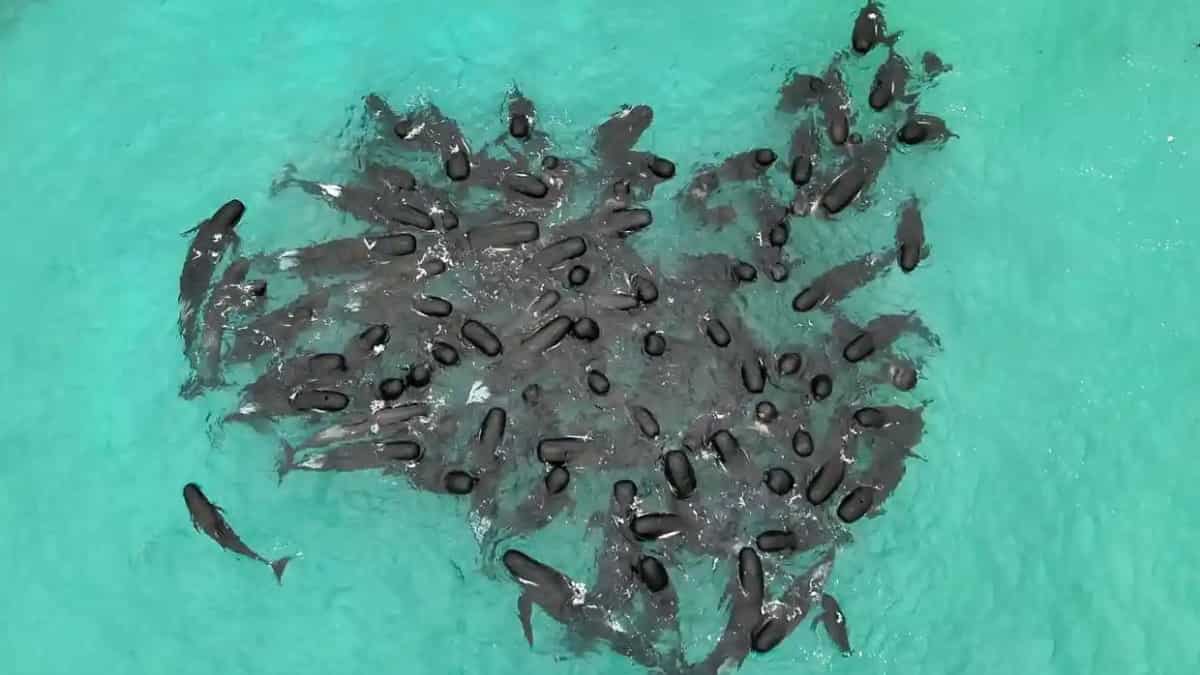
The behaviour of a large pod of nearly 100 long-finned pilot whales has baffled scientists. The whales were seen forming a heart shape before tragically stranding themselves on a remote beach in Western Australia (WA).
Drone footage captured this rare phenomenon as the whales tightly grouped together at Cheynes Beach, about 60km east of Albany before the tragic incident unfolded on Tuesday evening.
By the next morning, over 50 of the majestic creatures lay lifeless on the shore, leaving volunteers, government workers, and scientists scrambling to rescue the remaining 46.

"Unique" images
Reece Whitby, WA's environment minister, shared that researchers across Australia were baffled when they witnessed the unprecedented behaviour of the pod before the stranding. He called the images "unique" and said, "It is pretty incredible from a scientific basis in terms of learning about strandings."
Whitby said that the Department of Biodiversity Conservation and Attractions sought advice from other jurisdictions that had experienced similar events, but the consensus was "We have never seen this before."
)
Nepal Flash Floods: At least 1,050 dead And 118 Nepalese rescued from disaster zone
)
Inside the UAE defense giant rapidly scaling up amid West Asia war
)
'Why didn't you save me?' 5-year-old Nepal flood victim, who survived under rubble for 60 hours, asked parents
)
US-Israel vs Iran permacrisis: Tehran strikes back against latest US strikes
&im=FitAndFill=(700,400))
How the Su-30MKI flies up to 8,000 kilometres using mid-air refueling
)
China shock puts Germany's economy under strain
)
Nearly 1 million Indians stuck in US Green Card backlog, wait could stretch to 179 years | Gravitas
)
Iran launches retaliatory strikes with missiles and drones; Trump warns of ‘much harder’ attack
)
2,000 pairs of underwear buried in Switzerland revealed something startling
)
Iran war: IRGC strike claim raises questions as Pentagon cracks deepen
)
Nvidia is reportedly buying Hugging Face for $12.9 billion
)
Pakistan faces growing hunger crisis amid rising food insecurity
)
Iran war reshapes global LPG trade
)
This Indian AI is making stock charts easier to understand in Hindi, Tamil, Telugu and other Indian languages
)
Over 100 children aged 12 & below in UK may have been forced into marriage | Gravitas
)
UN nuclear watchdog report on Syria confirms Assad-Era nuclear reactor plan
)
Explosives found near German power plant, suspected attack sparks security alert
)
Pheromone Maxxing: The dating trend that claims scent drives attraction
)
Volcano that erupted with strength of a million atomic bombs discovered in England
&im=FitAndFill=(700,400))
Why the Su-30MKI uses a giant air brake on its back instead of its wings
)
Shakti Sharma scripts history as first woman non-medical Air Vice Marshal
)
Swara Bhasker issues video clarification over Padmaavat remarks amid ‘wild’ backlash: ‘Never said Rani Padmavati was a coward’
)
Iran attacks Bahrain, Iraqi Kurdistan as Trump claims ‘total control’ of Hormuz; Houthis back Tehran, Peru cuts ties: What's happening
)
AI agents coming to UPI: India prepares hands-free payments rollout!
)
Beginning of the end? More glacial lake outbursts threaten millions in India, Nepal and China
)
TN CM Vijay opens Mettur dam for Cauvery delta irrigation, surprises farmer with visit
)
Pentagon just launched its AI portal with ChatGPT, Grok and Gemini
)
Peptide parties: Why you should not fall for this gimmick despite the celebrity buzz
)
Pakistanis are eating less. What they are eating instead is even more alarming
)
Manchester City equal British transfer record with £125m Enzo Fernandez deal
Netflix to release docuseries on Donald Trump's secret plane switch in Turkey
)
Ariana Grande steps away from public life; bids an emotional farewell in London concert
)
US-Iran war: US strikes Iran after month-long pause
&im=FitAndFill=(700,400))
Why the glass canopy on the Su-30MKI has a distinct golden tint
)
From Red Sea fire to Pattaya nightlife: Thai police warn American soldiers
)
Rescue efforts
Efforts to save the stranded whales commenced with a rescue operation on Wednesday. Slings were deployed to drag the massive — about 1,000 kg and up to 4 metres long — animals back to the sea.
A massive team of more than 70 volunteers and 90 government agency staff working in shifts supported the whales, many of whom were weak and struggling to stay afloat in shallow water.
However, the attempt to coax some of the pilot whales into deeper waters later in the day was unsuccessful, and they beached themselves once again, reports The Guardian.
Also read |Chaos in New York as construction crane catches fire, collapses partially; 6 injured. Watch!
The animals were then dragged onto the sand, where they were carefully assessed by veterinarians from Perth Zoo and Albany, with animal welfare rather than rescue becoming the priority. Volunteers tirelessly poured buckets of water over the distressed whales in an attempt to alleviate their suffering.
Why did the whales choose mass stranding?
Murdoch University marine biologist Dr Joshua Smith speculates that since pilot whales share a tight-knit social network, it might explain why they stuck together during the incident.
As the rescue efforts continued, volunteers faced the bitter cold of the ocean, enduring temperatures that made their dedicated work even more remarkable.
Dr Vanessa Pirotta, a wildlife scientist from Macquarie University, speculated that illness or disorientation might be responsible for the unusual incident.
"The fact they were in one area very huddled and doing really interesting behaviours and looking around at times suggests something else is going on that we just don’t know."
However, even as experts investigate the cause of the stranding, the whales' behaviour remains an enigma.
Mass strandings of whales are distressing events that puzzle scientists and spark concern for marine conservation. In previous incidents in Western Australia, more than 130 whales died in a mass stranding in 2018, and the largest such event occurred in 1996 when 320 long-finned pilot whales stranded themselves in Dunsborough.
(With inputs from agencies)
WATCH WION LIVE HERE
You can now write for wionews.com and be a part of the community. Share your stories and opinions with us here.

