

&imwidth=800&imheight=600&format=webp&quality=medium "Understanding Iran’s military structure: IRGC, Quds Force, Basij, and the Army. Who are they and what are their roles?")
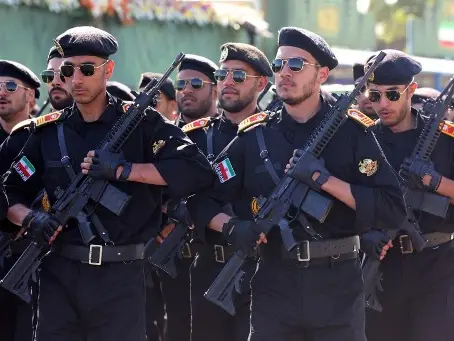
Within the dark and intricate structure of the Islamic Republic of Iran's military and security establishment, four dominant forces constitute the strength of the state: the Islamic Revolutionary Guard Corps (IRGC), its special arm the Quds Force, the volunteer Basij militia, and the regular Iranian Army, also referred to as Artesh.
Each has a separate origin, purpose, and command structure. Though all are nominally dedicated to the defense of Iran's sovereignty, their functions differ starkly in practice and ideology. Together, they create a layered and frequently overlapping system intended not only for external defense, but for survival of the regime, foreign manipulation, and domestic control.
The Islamic Revolutionary Guard Corps (IRGC)
Formed in the wake of the 1979 Islamic Revolution, the Islamic Revolutionary Guard Corps (Sepah-e Pasdaran-e Enqelab-e Islami) was founded by Ayatollah Khomeini to protect the revolution from internal as well as external enemies.
It was intended as a balance against the old Iranian military, which the new regime worried would still be loyal to the Shah or Western philosophy.
Unlike the Artesh, a professional and traditional military organisation, the IRGC is an ideologically motivated institution that owes its loyalty not to the government elected, but directly to the Supreme Leader of the Islamic Republic of Iran.
Trending Stories
&imwidth=180&imheight=135&format=webp&quality=medium)
Pakistan to head IMF, World Bank boards after 74 years amid persistent economic crisis
&imwidth=180&imheight=135&format=webp&quality=medium)
IND-W vs ZIM-W, 1st T20I: Deepti Sharma, Niki Prasad shine as India beat Zimbabwe by four wickets
&imwidth=180&imheight=135&format=webp&quality=medium)
CJP's Tiranga march: People hit streets of Delhi again, reiterate call for Gyanesh Kumar's resignation
&imwidth=180&imheight=135&format=webp&quality=medium)
US midterms 2026: Ken Paxton may have Elon Musk to thank if he wins the Texas Senate race. Here's why
&imwidth=180&imheight=135&format=webp&quality=medium)
Trump invokes national interest to waive new Russia sanctions, tariffs; India gets relief from 100% tariff threat
&imwidth=180&imheight=135&format=webp&quality=medium)
Ankita Bhandari murder case: Parents meet CBI, seek impartial investigation
&imwidth=180&imheight=135&format=webp&quality=medium)
Lizard people? Ex-US Army sniper claims soldier killed by 'reptilian beings' in battle near Area 51
&imwidth=180&imheight=135&format=webp&quality=medium)
Gravitas | Iran threatens to hit key bridges in 7 countries if US resumes strikes
&imwidth=180&imheight=135&format=webp&quality=medium)
Ukraine drone strike disrupts 22 Russian airports, over 200 flights

Not Khan but Pal: Why did Imran Khan choose his mother's surname over his father's? Family tree explained
&imwidth=180&imheight=135&format=webp&quality=medium)
A secret code, a midnight escape and 300 deaths: The Russian officer who turned on Putin
&imwidth=180&imheight=135&format=webp&quality=medium)
'Reason UN has lost credibility': Amid SIR protests India hits out at report alleging 'youth repression'
&imwidth=180&imheight=135&format=webp&quality=medium)
Oregon school shooting: 16-year-old shooter identified, used shotgun bought by mother; Trump praises bystander who shot gunman as 'great hero'
&imwidth=180&imheight=135&format=webp&quality=medium)
China tells Israel to stop West Bank settlements, calls Palestine issue ‘historic injustice’
&imwidth=180&imheight=135&format=webp&quality=medium)
‘My president, I mean my husband’: Trump's new press secretary Katie Zacharia's first briefing goes off the rails in 14 minutes
&imwidth=180&imheight=135&format=webp&quality=medium)
China responds to Trump's Press Secretary Katie Zacharia after toilet remark: 'Visit China more often'
&im=FitAndFill=(700,400)&imwidth=180&imheight=135&format=webp&quality=medium)
Who left the White House podium the fastest? Press secretaries with the shortest stints
&imwidth=180&imheight=135&format=webp&quality=medium)
Vijay Deverakonda and Rashmika Mandanna's Ranabaali X Review: Netizens call it history-rich but overstuffed
&imwidth=180&imheight=135&format=webp&quality=medium)
Israel examines Russia's Shahed-type drones sent by Ukraine to combat Iran | Gravitas
&imwidth=180&imheight=135&format=webp&quality=medium)
US midterms 2026: Alexandria Ocasio-Cortez donates $1 million to Abdul El-Sayed’s as Michigan race heats up
&imwidth=180&imheight=135&format=webp&quality=medium)
Here’s who is eyeing the White House press secretary role after Katie Zacharia’s exit
&imwidth=180&imheight=135&format=webp&quality=medium)
Infiltration bid foiled in Kupwara’s Keran sector, search operation underway
&imwidth=180&imheight=135&format=webp&quality=medium)
BCCI names India’s ODI squad for New Zealand tour, Gill and Iyer to share captaincy
&imwidth=180&imheight=135&format=webp&quality=medium)
Abhishek Sharma sets all-time record for most T20I sixes in a year
&imwidth=180&imheight=135&format=webp&quality=medium)
US midterms 2026: Dan Sullivan’s ‘gotcha’ attempt backfires against Mary Peltola in fiery Alaska Senate debate
&im=FitAndFill=(700,400)&imwidth=180&imheight=135&format=webp&quality=medium)
Inside Tesla's Roadster: 10 features of Elon Musk's 'flying car' that push the limits of electric vehicles | In Pics
&imwidth=180&imheight=135&format=webp&quality=medium)
India’s naval priorities: Ex-Navy Chief calls for third aircraft carrier, more warships and submarines
&imwidth=180&imheight=135&format=webp&quality=medium)
Starlink says 'ready to connect India with high-speed internet' amid Reliance row
&imwidth=180&imheight=135&format=webp&quality=medium)
One species, two lineages: Why Sri Lanka’s spectacled cobra differs genetically from Indian variant
&imwidth=180&imheight=135&format=webp&quality=medium)
Oil tanker carrying over 2M barrels of crude hits mine in Strait of Hormuz, catches fire, says Iran
&imwidth=180&imheight=135&format=webp&quality=medium)
Selma Blair’s team responds to flight incident, says actress ‘did not intend to harm anyone’
&imwidth=180&imheight=135&format=webp&quality=medium)
India's Gen Z rebellion: Can the 'Lehra Do Tiranga' movement reshape the political order? | The Verdict

US ends automatic work permit extensions; Indian workers lose 540-day safety net: What it means
&im=FitAndFill=(700,400)&imwidth=180&imheight=135&format=webp&quality=medium)
New Friday OTT releases (October 16, 2026): DC, Sacrifice, Aasha- 6 new movies and TV shows coming on Netflix, Zee 5, Prime Video and more
Its role is to safeguard Islamic values, propagate Iran's revolutionary ideology, and guarantee the survival of the regime.
Decades have seen the IRGC grow into a huge military-industrial complex. It has its own land forces, navy, aerospace unit (including Iran's missile program), intelligence unit, and cyber units. It economically dominates large sectors of the Iranian economy by means of front companies and state-sponsored foundations.
It is politically rooted to a great extent. Large numbers of members of the executive and judicial branches as well as the parliament have been IRGC veterans, and the IRGC is responsible for formulating national strategy.
Quds force
As the premier extraterritorial force of the IRGC, the Quds Force (Sepah-e Qods) conducts foreign operations, clandestine activities, and proxy warfare.
Its existence was formally recognised in the late 1980s, and its stature grew exponentially under General Qassem Soleimani, who died in a US drone attack in Baghdad in 2020.
The Quds force has provided the mission of exporting Iran's ideological and strategic interests outside of its borders. It offers weapons, finance, and training to a broad range of non-state actors and militant groups all across the Middle East, ranging from Hezbollah in Lebanon, Hamas and Islamic Jihad in Palestine, Shia militias in Iraq, the Houthis in Yemen, and pro-Assad forces in Syria.
With a history of strategic patience and asymmetric warfare, the Quds Force works through diplomatic covers, local militias, and covert networks. It is both a foreign policy instrument and a military force, combining intelligence operations with presence on the battlefield.
Basij
Basij, or Basij-e Mostaz'afin ("Mobilization of the Oppressed"), is an IRGC-controlled paramilitary volunteer militia.
Established in 1979 by the directive of Khomeini, the Basij was instrumental in the Iran-Iraq War, where thousands of Basij members were involved in human-wave attacks.
Nowadays, the Basij acts as an interior security force, responsible for policing moral behavior, repressing dissent, surveillance over universities and neighborhoods, and enlisting regime support.
It is highly integrated into civilian society, with units in schools, mosques, factories, and government departments.
In times of civil unrest—like the 2009 Green Movement protests and the nationwide protests in recent years—the Basij are usually the first line of response from the regime, making arrests, infiltrating demonstrations, and cracking down on crowds.
Though less heavily armed than regular army units, the Basij have strength in numbers, ideological indoctrination, and widespread grassroots presence. It also serves as a social control mechanism and vehicle for political mobilisation during election times.
Artesh
Officially referred to as the Artesh-e Jomhouri-ye Eslami-ye Iran, the Artesh is Iran's regular army, existing before the revolution.
Comprising four branches, they include Ground Forces, Air Force, Navy, and Air Defense. Following the revolution, the Artesh was suspicious to the clerical leadership and was purposefully undermined in favor of the IRGC.
Nevertheless, it continued to be the primary line of defense against conventional military threats, especially on Iran's borders and in the Persian Gulf.
In contrast to the IRGC, the Artesh is considered more professional and apolitical, with little role in Iran's internal politics or foreign escapades. It has fewer economic assets and is more dependent on the Ministry of Defense.
As much less ideologically charged, it is hampered by older equipment and limited modernization for decades of sanctions. The Artesh is also responsible for disaster relief, logistics, and border control operations, and frequently works together with the IRGC on large exercises, although tensions between the two branches continue.
Conclusion
Iran's military and security establishment is more than a defense establishment—it is a complex network of ideological, political, and coercive power intended to protect the Islamic Republic against all threats, foreign and domestic. The IRGC and related forces are the ideological core of the regime, while the Artesh fills conventional military roles.

