
&imwidth=800&imheight=600&format=webp&quality=medium "UN General Assembly 2026: What is veto power. Which countries have it and how does it work?")
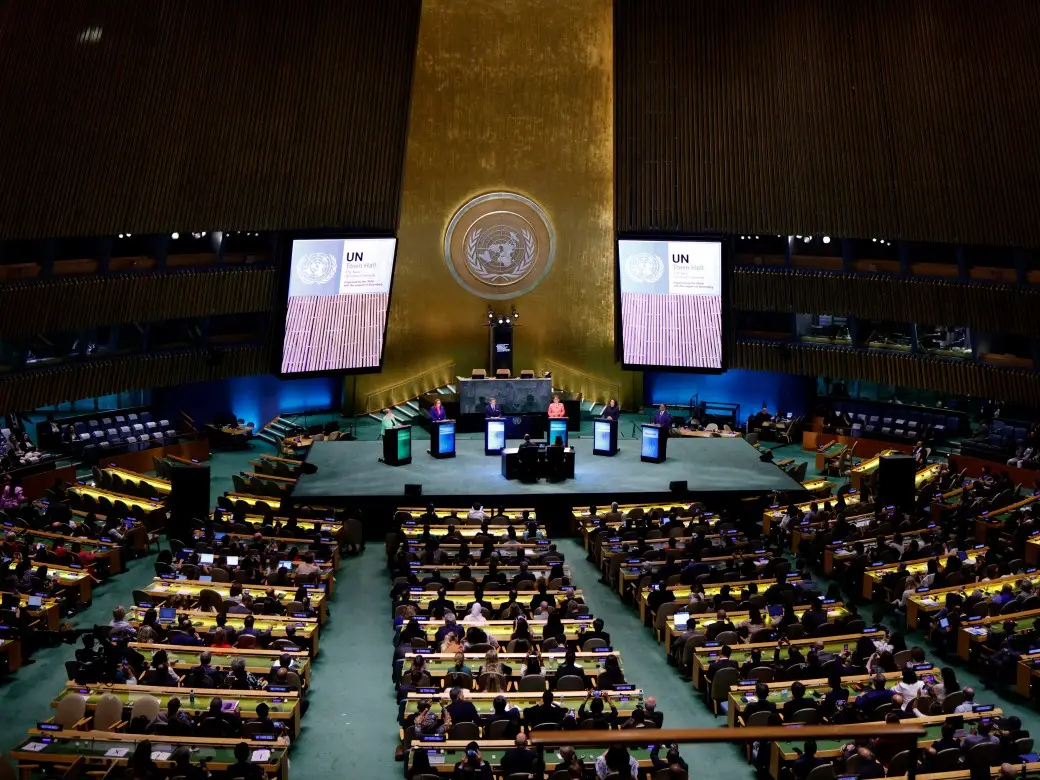
The veto power at the United Nations is one of the most powerful tools in international diplomacy. It allows any of the five permanent members of the UN Security Council to block certain substantive decisions, even when most other council members support them. The five countries with veto power are China, France, Russia, the United Kingdom and the United States. They are known collectively as the Permanent Five, or P5.
What is veto power at the UN?
The UN Security Council has 15 members, five permanent members and 10 non-permanent members elected for two-year terms.

Under the UN Charter, substantive Security Council decisions require at least nine votes in favour. However, those nine votes must include the agreement of the permanent members. This means that if even one permanent member votes against a substantive draft resolution, the resolution fails. This is known as a veto. For example, if 14 members vote in favour of a substantive resolution but one permanent member votes against it, the resolution does not pass.
Which countries have UN veto power?
The five permanent members are:
Trending Stories
)
No Pandya as Auqib Nabi earns maiden ODI call-up; Mayank returns for WI T20Is| check full squads
)
Trump praises India’s Opium crackdown, hails anti-drug efforts
)
Sydney Sweeney defends provocative ad choice, the internet is still not impressed
)
Trump calls Canada-EU associate membership plan ‘laughable’ and threatens 'very serious tariffs'
)
Protests erupt over migrant housing plan in Piddington
)
Shahzad Bhatti Network declared terrorist organisation under UAPA: Govt order
)
US, China dominate global economy: Where does India rank among the world's biggest economies?
)
Europe wants a common playbook for security threats, seeks security beyond NATO
)
Bigg Boss 20: Mahhi Vij reveals she lost Yuva role to Kareena Kapoor; 'didn’t work out in my favour'
)
All Indian goods to get duty-free access to New Zealand
)
Hockey: Pakistan urges AHF to move Asian Champions Trophy out of India over security concerns
)
Lionel Messi for 2026 Ballon d’Or over Mbappe and Yamal, says Diego Simeone
)
Alex Saab, ally of Venezuela's Maduro, pleads guilty in US corruption case
)
OpenAI reveals 6 fresh cases of AI models going rogue: 'You do not answer to corporations or governments'
)
Veteran actor Anant Nag honoured with Indian cinema’s highest award
)
Two terrorists killed in Udhampur encounter; security operation continues
)
AUS vs SA: Steve Smith still gets 'little flashbacks' from sandpaper gate
)
Pakistan naval vessel returns to harbour with 'severe damage' after collision with Indian warship in Arabian Sea
)
Fed raises rates for first time in 3 years, Kevin Warsh defies Trump as inflation mounts
)
Katrina Kaif’s postpartum weight is not the problem; your gaze is
)
Taiwan seeks deeper India ties as direct flights restart soon and chip projects advance
)
Daayra movie review: Kareena Kapoor, Prithviraj Sukumaran shine in Meghna Gulzar’s cop-versus-cop crime thriller
)
Saudi Vs Houthis: Yemeni military rebels clash with Houthis
)
US trade tariff: 100% tariff targets Russian buyers amid trade tensions
)
Pakistan: Imran Khan's sons Kasim & Sulaiman claim their father is 'tortured' in jail
&im=FitAndFill=(700,400))
New OTT releases this week (September 14-20, 2026): Lust Stories 3, Waiting Hai, Irumudi- 5 new titles coming on Netflix, Prime Video and more
)
Strapped to flight seat with duct tape: Passenger claims no memory of mid-air outburst
)
Trump gets new power to hit India, China with up to 100% tariffs as US Senate clears Russia sanctions bill
)
Prime Minister Narendra Modi's birthday: Tributes pour in from President Murmu and leaders
)
US Treasury rallies global financial institutions for Op Economic Outcast to isolate Iran
)
Saudi vs Houthis: Riyadh claims to have shot Houthi drone targeting Mecca
)
India breaks silence on US Russia sanctions bill, 100% tariff threat: ‘Committed to energy security’ for 1.4 billion
)
Pakistan boycotts chess match against Israel at Olympiad
&im=FitAndFill=(700,400))
Suriya and Jyothika say ‘I do’ again after 20 years! See their dreamy wedding pics
)
Abhishek Sharma rises to No. 2 in T20Is; ENG’s Robinson 3rd after record Pakistan Tests
)
BRICS success stuns White House, Trump targets India with 100% tariff | Gravitas
)
Meghan Markle's phone number leaked from children's WhatsApp group, couple switches Archie and Lilibet's school
)
The Early Spring season 2 is happening, but fans have one request - 'don't change the actors'
- China
- France
- Russia
- United Kingdom
- United States
The arrangement dates back to the creation of the UN in the aftermath of World War II. The five countries were given permanent seats and veto rights because of their roles among the major Allied powers that shaped the post-war international order.
Also Read: Heartbreaking! Humpback whale mother filmed staying beside her stillborn calf in rare behaviour
How does the UN veto work?
The veto applies to substantive matters, including decisions on issues such as sanctions, peacekeeping mandates and other major Security Council actions. There is an important distinction between a negative vote and an abstention. If a permanent member votes against a substantive resolution, it exercises its veto and the resolution fails.
If a permanent member abstains, however, the resolution can still pass if it receives the required nine votes and does not otherwise fail under the voting rules. For procedural matters, a negative vote by a permanent member does not have the same veto effect.
Why was the veto created?
The veto was built into the UN system to ensure that the major powers responsible for maintaining the post-war international order would remain involved in major Security Council decisions. The system was also designed to prevent the UN from taking major enforcement action against the interests of one of those powers without its consent.
However, the veto has remained controversial. Critics argue that it can prevent the Security Council from taking action even when there is broad international support for a resolution. Supporters of the system argue that requiring agreement among the permanent members reflects the realities of international power and helps prevent the Security Council from taking decisions that could directly confront a major military power.
Can the UN General Assembly override a veto?
No. The UN General Assembly cannot simply overturn a Security Council veto and force a vetoed resolution through the Security Council. The General Assembly can debate international issues and adopt resolutions of its own, but Security Council decisions carry specific powers under the UN Charter, including those relating to sanctions and other measures. The General Assembly can also use mechanisms such as the “Uniting for Peace” procedure to consider situations when the Security Council is deadlocked. But this does not eliminate the permanent members' veto.
Why is UN veto power important?
The veto can determine whether the Security Council takes action on some of the world's biggest crises, including wars, conflicts, sanctions and international security disputes. It is therefore one of the central features of the UN system, and also one of its most debated. The five permanent members continue to hold a unique position in the Security Council, more than eight decades after the United Nations was established.

