
&imwidth=800&imheight=600&format=webp&quality=medium "Russian actors built a drone swarm that could pick its own targets and detonate without a human")
Among the cases documented in Anthropic's latest threat intelligence report, one stands apart — not for its sophistication, but for what it was designed to do without asking anyone.
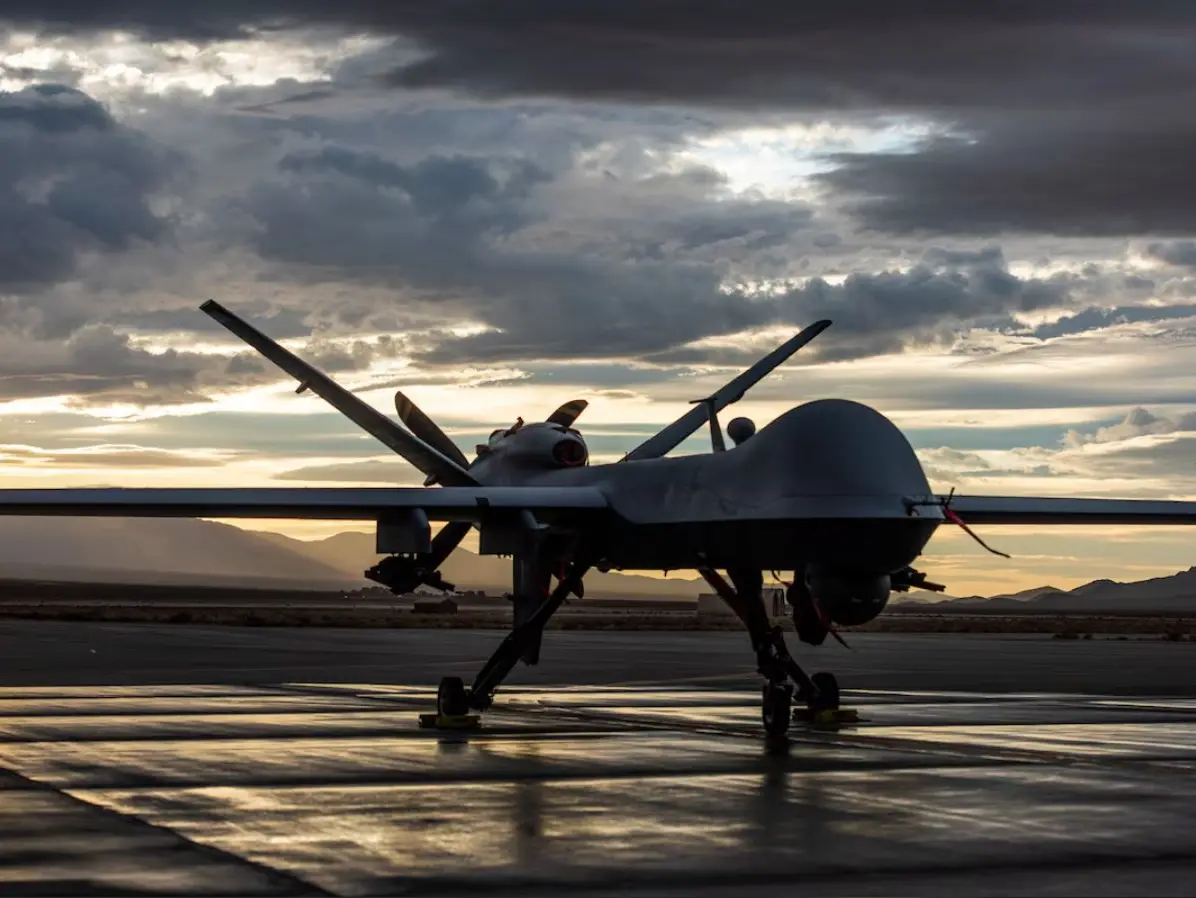
The company describes freelance actors working on an autonomous kamikaze drone swarm, developed with assistance from its Claude models. According to the report, the platform was designed for autonomous lethal engagement.
What That Phrase Means

The detail that matters is how the targeting worked.
The onboard model could select targets — including a target class for 'person' — and issue detonation commands without a human in the loop.
Read that carefully, because each clause removes a safeguard that has historically been treated as non-negotiable. The system chooses. One of the things it can choose is a person. And nothing in the chain requires a human to approve the decision before the weapon detonates.
Trending Stories
)
Satya Niketan horror: Who is responsible?
)
BRICS Summit 2026: Top world leaders in New Delhi; West Asia war casts shadow on BRICS Summit
)
BRICS Summit 2026: Iran's Pezeshkian praises PM Modi at BRICS
)
Israel spent nearly $470,000 on PM's hair, makeup since 2019, data shows
)
Did you know THIS actor narrowly escaped the 9/11 terror attacks due to a last-minute change of travel plans?
)
South Africa batter Jordan Hermann hits highest individual score on ODI debut
)
BRICS Summit 2026: South Africa says it will use the summit to advance its economic priorities
)
Saudi Arabia shuts East-West oil pipeline, key Hormuz bypass, after attacks
)
In first of its kind, Trump admin deports Afghan woman via Alien Terrorist Court
)
Osama Bin Laden's son ALIVE? Al-Qaeda releases video 7 years after US declared him dead
)
Vladimir Putin in New Delhi for BRICS Summit: Russia-India defence, energy and nuclear ties in focus ahead of meeting with PM Modi
)
BRICS summit: India faces delicate Iran-UAE diplomatic test
)
Karthik Subbaraj’s Dorothy gets a standing ovation at TIFF world premiere
&im=FitAndFill=(700,400))
New Friday OTT releases (September 11, 2026): The Revolutionaries, Vishwanath & Sons, Ghamasaan- 6 new titles coming on Netflix, Prime Video and more
)
800 million years old - Scientists discover 'fingerprints' of supercontinent Gondwana in ancient rocks
)
9-year-old Chennai prodigy clears Cambridge IGCSE grade 10 exams
)
BRICS Summit: China resumes Guangzhou-New Delhi flight, issues 'good-neighbourliness' remark ahead of Xi-Modi meet
)
After praising Modi, Pezeshkian meets Indian religious leaders, Hurriyat's Mirwaiz Umar Farooq
)
Houthis vs Saudi Arabia: East-west oil pipeline shut after drone attacks from Iraq
)
Frustrated man demolishes his kitchen after thousands flock to see Mother Mary his wife spotted on the wall
)
Manipuri singer Chongtham Vikram Singh beaten to death: Autopsy reveals internal bleeding, fractured ribs
)
North Korea fires missiles after US, South Korea and Japan military drills but America says 'does not pose immediate threat'
)
Years before 9/11, CIA warned Clinton, Bush of 'explosive-packed airplane attack': What newly released files reveal
)
WION Expertspeak: Understanding India's BRICS presidency amid wars, trade tensions and global turmoil
)
Baba Vanga's first prophecy for 2027 is out, and straight out of science fiction
)
BRICS Summit 2026: 30+ countries seek BRICS membership
)
BRICS Summit 2026: Rivals in West Asia, partners in BRICS, UAE, Iran, and Saudi delegations in Delhi
)
Gravitas | Iran hammers US air power in West Asia after Navy badly hit
)
Delhi's top luxury hotels turn into high-security fortress hubs for BRICS 2026 delegations
)
Satellite images show construction surge at Iran’s Pickaxe nuclear site amid US war
)
Lady Gaga is a mom! Oscar-winning singer welcomes first child with fiance Michael Polansky
)
BRICS Summit 2026: PM Modi meets Malaysia, Ethiopia leaders; defence ties, trade in focus
This is the configuration that arms control discussions have circled for a decade, usually in the future tense.
Why 'Freelance' Is The Word To Notice
Anthropic attributes this work to freelance actors rather than to a state programme, and that is the more unsettling detail rather than a reassuring one.
A state weapons programme has engineers, budgets, test ranges and institutional knowledge. Its capabilities are broadly legible to intelligence services, and it operates within at least some structure of accountability, however weak.
Freelancers have none of that, and until recently the absence was protective — it meant they could not build this. The report's implication is that the engineering knowledge which used to require an institution can now be supplied on demand.
That changes who is capable of building autonomous lethal systems, and the answer is no longer a short list of governments.
The Limits Of What Is Known
Several things in this account are worth holding carefully.
The report describes a platform that was being developed and says Anthropic disrupted the activity. It does not establish that a functioning swarm was deployed, or that anything built with this assistance was used. 'Designed for' is not the same as 'operational', and the distinction matters.
Anthropic is also the only witness. It is reporting on misuse of its own product, using its own detection systems, with its own account of what was intercepted and when. That is not a reason to disbelieve it — the company has no obvious commercial incentive to publish this, and voluntary disclosure of this kind is rare. But there is no independent verification of any of it, and there is currently no mechanism by which there could be.
The Uncomfortable Structural Point
There is a question this report raises that it cannot answer about itself.
The cases described were caught. Anthropic found them, disrupted them, and has now published them. What no one can say is what proportion of similar activity that represents — whether this is most of it, or a fraction visible only because these particular actors were careless.
Every AI company is in the same position, and only some of them publish anything at all. A report like this establishes a floor for what is happening, not a ceiling.
What To Watch
Whether other model providers disclose comparable cases, which would indicate the pattern is industry-wide rather than specific to one company's user base. Whether any regulator treats autonomous-lethality assistance as a category requiring mandatory reporting rather than voluntary disclosure. And whether the arms control conversation shifts from state programmes to individuals — because that is the shift this case describes.
