
&imwidth=800&imheight=600&format=webp&quality=medium "‘Not just a local tragedy’: Nepal PM Shah warns UN of growing climate threat, says Nepal floods were 'a warning to the world'")
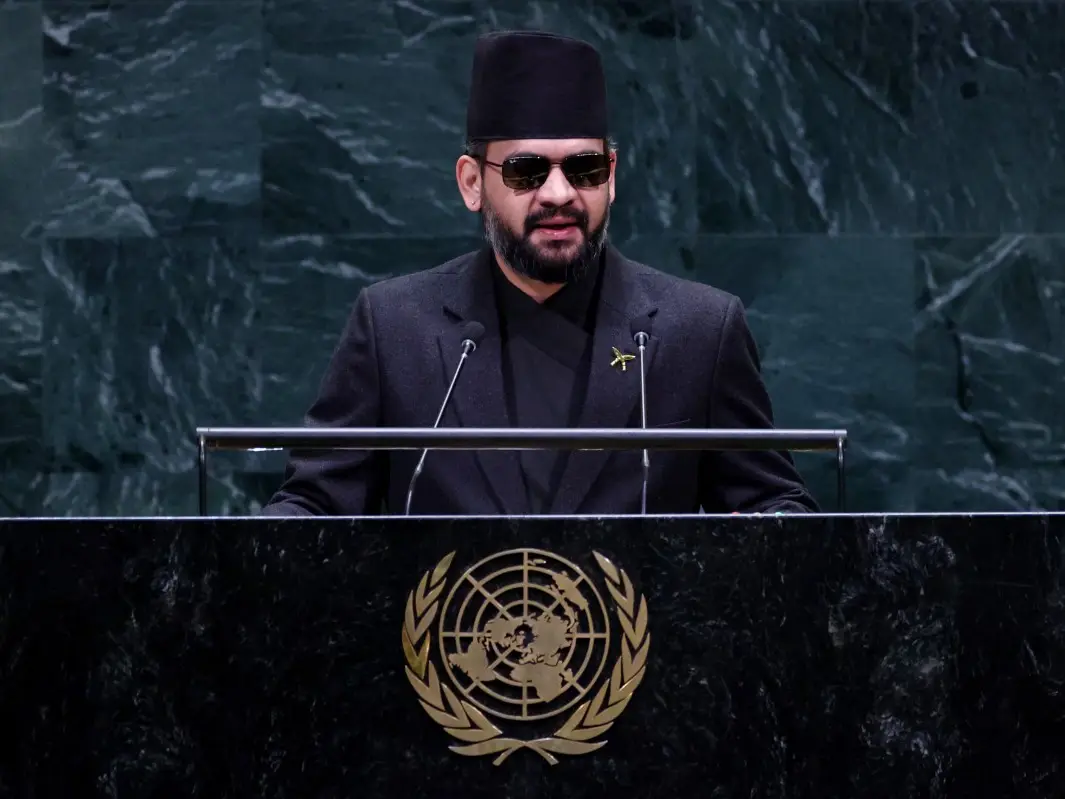
Nepal Prime Minister Balendra Shah has described the catastrophic floods that struck the country last month as a warning to the world, saying climate change is placing growing pressure on the fragile Himalayan ecosystem.
Addressing the 81st session of the United Nations General Assembly on Thursday (Sep 24), Shah said the disaster should not be viewed simply as a domestic tragedy, but as evidence of the wider risks posed by a warming planet.
The catastrophic Nepal flooding last month was “not just a local tragedy; it was a warning to the world,” Shah told the UN.

He said rising global temperatures were “destabilising the fragile Himalayan ecology”, with melting permafrost and glaciers adding to the risks faced by communities across the region.
According to World Weather Attribution (WWA) scientists, the event was a "compound crisis," involving local geological instability alongside sustained warming that has led to glacier retreat and permafrost thaw.
Trending Stories
)
2,000-foot tube, laser tests and more: China builds towns to expand nuclear arsenal, satellite images show
)
Xi Jinping's 'special plane' vs Trump's Air Force One: What's the difference?
)
US judge questions Trump’s decision to ban CNN, MS NOW and Politico from White House
)
Scientists detect first radio signals directly from faraway planet
)
Meet Adrian Abraham: 9-year-old Indian-origin guitar prodigy aiming for a Guinness World Record
)
WION Iconic Tourism Summit: How local tourism MSMEs must upskill for AI integration
)
Forget the smartphone: This tiny gadget could be Meta’s answer to the post-smartphone era
)
'What kind of confession is this?': Pakistan PM Shehbaz Sharif’s 'terrorists would be roaming New York' remark goes viral, raises alarm online. Watch
)
IIT Bombay CCTV footage emerges: Sahil Wakode seen looking at phone in examination hall
)
Shah Rukh Khan is India's richest actor, Amitabh Bachchan is second: Hurun List 2026
)
Report: UK using ground-based system to jam hostile satellites
)
Russia likely to target Spain, France and Italy in drone attacks, warns CIA: Report
)
For the first time, the UN Security Council sat US and Chinese AI makers at the same table
)
Welcome actor Mushtaq Khan dies at 56 after battling cancer
)
Trump-Xi state dinner 2026: Who is invited? Full guest list of tech CEOs, business leaders and officials
)
Hours before Xi-Trump meeting, US announces visa curbs targeting birth tourism: What is it?
)
What’s on the menu? Inside Trump’s lavish White House state dinner for Xi
)
What’s in a name? Trump’s 'Lake America' move gets a tit-for-tat response from Canada
)
Property registration becomes faster, convenient as model sub-registrar offices open in Maharashtra
)
WATCH | China President Xi Jinping lands in US as Trump greets him ahead of high-stakes summit
)
Mumbai Indians appoint Luke Williams as head coach for Women’s Premier League
)
China to test supersonic jet that moves at Mach 2, double the speed of sound
)
Winter coat, gloves in September? Trump’s Xi welcome sparks social media buzz
)
Australian PM Anthony Albanese calls OpenAI AI incident 'unacceptable' after restricted data access
&im=FitAndFill=(700,400))
Netanyahu at UN: Mass walkout, attack on Mamdani and Iran threats | In Pics
)
Israeli envoy to US Yechiel Leiter’s son critically injured in West Bank ramming attack
)
Who is Peng Liyuan? Xi Jinping's singer wife and China's most visible First Lady
)
Trump’s Board of Peace unveils $2.45bn Gaza plan,66 projects: But where’s the money?
)
'There will be elections': Venezuela's interim leader Delcy Rodriguez makes big announcement at UN
)
EC appointment law: Why is the 2023 act controversial, and what happens next? WION explains
)
WION Iconic Tourism Summit: Is India's travel boom outrunning its airports, airlines and hotels?
&im=FitAndFill=(700,400))
Trump welcomes Xi Jinping in rare airport gesture: Photos from Chinese President's arrival in US
)
WION Iconic Tourism Summit 2026: Union Minister Shekhawat on 'experiential travel', peace diplomacy
)
'AI got into my speech': Prince Harry jokes after teleprompter failure at event in New York
)
250-pound WWII bomb found in Falmouth harbour in England
)
'Partners rather than rivals': Xi Jinping's first message after landing in US for Trump summit
)
'We would all be dead': Netanyahu defends decision to strike Iran's nuclear facilities in his UN speech
)
‘Both will lose in confrontation’: Xi says US and China should ‘coexist in peace’
)
Italy hit by floods in the north, drought in the south
‘Nepal cannot build resilience alone’
Shah called for greater international support to help countries such as Nepal adapt to the effects of climate change.
He said developing resilience required resources that Nepal could not provide on its own, particularly when the crisis was being intensified by broader failures in global governance.
“Nepal cannot build resilience alone against a crisis made worse by the failure of global governance,” he said.
The prime minister's remarks come after devastating flooding in Nepal last month, which caused widespread destruction and deaths and triggered major rescue and relief operations across the country.
His appeal at the UN placed the disaster within the larger debate over climate adaptation and the disproportionate burden faced by vulnerable countries as extreme weather events intensify.
Shah urged the international community to share the financial burden of adaptation, arguing that Nepal and other climate-vulnerable countries need greater support to prepare for the risks posed by a changing climate.
Nepal floods: The massive toll
More than 1,400 people died, 6,000 are still missing, and the economic devastation of the tragic Nepal floods runs into the billions of dollars. Preliminary estimates by the Nepal government have put the cost of the disaster at $5 billion.
Nepal, as per AFP, has asked the UN's Loss and Damage fund for $20 million. This is the maximum allowed, but in reality only amounts to a tiny fraction of what Kathmandu needs.
Established in 2022 after catastrophic floods hit Pakistan, the fund remains without its first disbursement and suffers from severe underfunding, while Nepal is seen by observers as an important test case.

