Indian, Hellenic Navies undertake key exercises; Commanding Officer says, focus on enhancing interoperability

&imwidth=600&imheight=450&format=webp&quality=medium "Indian, Hellenic Navies undertake key exercises; Commanding Officer says, focus on enhancing interoperability")
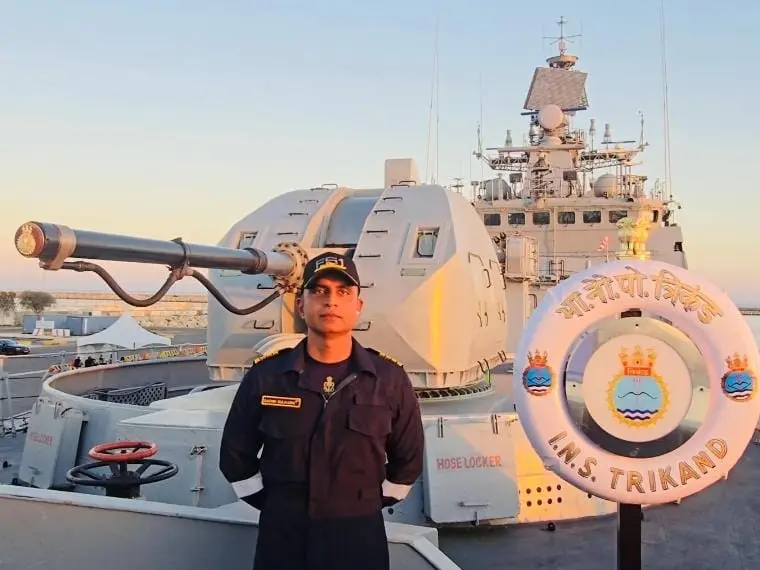
Commanding officer of Indian Navy Ship INS Trikand, Captain Sachin Kulkarni in Greece
Speaking from Salamis Bay, the commanding officer said, "exercising with the Hellenic Navy offered us an excellent opportunity to enhance interoperability and build mutual trust."
Commanding officer of Indian Navy Ship INS Trikand, Captain Sachin Kulkarni has said that last week, Indian Navy and Hellenic Navy (Greece Navy) participated in anti-submarine exercises, with focus on enhancing interoperability. INS Trikand participated in a maiden bilateral exercise with the Hellenic Navy from September 13–18, 2025, in the Mediterranean Sea.
Speaking fromSalamis Bay to WION's Sidhant Sibal, the commanding officer said, "exercising with the Hellenic Navy offered us an excellent opportunity to enhance interoperabilityand build mutual trust."
India, Greece Naval forces have been building on Naval cooperation. Last year, Indian Navy chief Admiral Dinesh K Tripathi visited the country and met his Greek counterpart, Vice Admiral Dimitrios E Kataras, and Deputy Minister of Defence Ioannis Kefalogiannis. In August 2025, INS Tamal visited Souda Bay and engaged in joint discussions and operational familiarisations.
The Indian Navy Ship, INS Trikand, had earlier visited Egypt to participate in exercise Bright Star 2025. Exercise Bright Star is a longstanding multinational military exercise co-hosted by the United States Central Command (CENTCOM) and the Egyptian Armed Forces. It is one of the largest and oldest joint military drills in the Middle East.
At the participation in theEx Bright star, how has the interactions and engagements been with the other navies?
Capt Sachin Kulkarni: Interaction and engagement with other Navies was extremelyfruitful, constructive, and professionally satisfying. During the harbour phase, planning conferences, drills, formal as well as informal discussions on the sidelines, gave us useful insights into how other Navies plan and operate. At sea, we had opportunitiesto undertake operations with these navies, which helped us in numerous ways in terms of enhancing interoperability, buildingrelationships, honning professional skills, adopting bestpractices and derivinglessonslearnt. One thing that stood out was the respect and confidenceshown by these navies for the Indian Navy, which shows the credibility Indian Navy has built over the years, as a highlyprofessional, potent and dependable force. Proud to say, INS Trikand'sperformance during the sea phase was acknowledgedand praised during the post sail conference.
Trending Stories
&imwidth=280&imheight=210&format=webp&quality=medium)
&imwidth=280&imheight=210&format=webp&quality=medium)
&imwidth=280&imheight=210&format=webp&quality=medium)
&imwidth=280&imheight=210&format=webp&quality=medium)
&imwidth=280&imheight=210&format=webp&quality=medium)
&imwidth=280&imheight=210&format=webp&quality=medium)
&imwidth=280&imheight=210&format=webp&quality=medium)
&im=FitAndFill=(700,400)&imwidth=280&imheight=210&format=webp&quality=medium)
&imwidth=280&imheight=210&format=webp&quality=medium)
&imwidth=280&imheight=210&format=webp&quality=medium)
&imwidth=280&imheight=210&format=webp&quality=medium)
&imwidth=280&imheight=210&format=webp&quality=medium)
&imwidth=280&imheight=210&format=webp&quality=medium)
&imwidth=280&imheight=210&format=webp&quality=medium)
&imwidth=280&imheight=210&format=webp&quality=medium)
&imwidth=280&imheight=210&format=webp&quality=medium)
&imwidth=280&imheight=210&format=webp&quality=medium)
&imwidth=280&imheight=210&format=webp&quality=medium)
&imwidth=280&imheight=210&format=webp&quality=medium)
&im=FitAndFill=(700,400)&imwidth=280&imheight=210&format=webp&quality=medium)
&imwidth=280&imheight=210&format=webp&quality=medium)
&imwidth=280&imheight=210&format=webp&quality=medium)
&imwidth=280&imheight=210&format=webp&quality=medium)
&im=FitAndFill=(700,400)&imwidth=280&imheight=210&format=webp&quality=medium)
&imwidth=280&imheight=210&format=webp&quality=medium)
&imwidth=280&imheight=210&format=webp&quality=medium)
&imwidth=280&imheight=210&format=webp&quality=medium)
&imwidth=280&imheight=210&format=webp&quality=medium)
&imwidth=280&imheight=210&format=webp&quality=medium)
&imwidth=280&imheight=210&format=webp&quality=medium)
&imwidth=280&imheight=210&format=webp&quality=medium)
&imwidth=280&imheight=210&format=webp&quality=medium)
&imwidth=280&imheight=210&format=webp&quality=medium)
How has the experience of participating in the tri service Multilateral exercise & what all activities were carried out during Bright Star
Capt Sachin Kulkarni: Participating in exercise Bright Star 2025, was an extremely rewarding and professionally enriching experience.The exercise was conducted on a large scale, bring together, naval, air and land forces from several countries on a single stage. It was also demanding, because it required us to quickly adapt to high tempo across a wide spectrum of activities, while ensuring that we put our best foot forward, showcasing Indian Navy's professionalism and combat capabilities. For my crew, it was a valuablelearning curve as an opportunity to test ourselves in different environments. I can proudly say, team Trikand demonstratedthat the Indian Navy can contribute effectively to multinationals , along with our partner navies with confidence and a very high level of professionality.
What all activities were conducted as part of Exercise Bright Star 2025?
Capt Sachin Kulkarni: Exercise Bright Star was conducted in all 3 dimensions, land, sea and air. India was represented by personnel and assets from the Indian army, navy and the air force. The maritime element of the exercisewas very well curated by the Egyptian Navy along with the US and was conducted over 9 days, covering both harbour and sea phases. In the harbour phase focus was on planning, fire fight, damage control, medical training, drills and professional interaction. In the sea phase, the ships participated in anti-submarine and air defence exercises. These activitiesrequired precision and close coordination with our counterparts. The crew gained exposure not only to operations but also to the professional and planning skills of our partners.
Is this the first time that the Navy has exercised with the Hellenic Navy?
Capt Sachin Kulkarni: Well this is not the first time we have engaged with the Hellenic Navy, but was certainly the maidenbilateral maritime exercise, and one of the most significant in terms of scale and importance. In the past, our ships have conducted PASSEX exercises and goodwill visits, but this deploymentoffered a more structured opportunity to work closely with highly professional Hellenic Navy. Our interactionreaffirms the value of building on the past good will, with a more focused approach.
Sidhant Sibal:how has the experience been of sailing all the way for such an exercise. How do you see such engagements with the Greek navy? What would be the scope of operations or exercises conducted in harbour and sea
Capt Sachin Kulkarni: Engagements with the Hellenic Navy are extremely important because they bring together 2 maritime nations that share strong traditions, historic ties and operate in regions critical to global trade. The Hellenic navy is an extremely professional force. Operating with them, offered us the opportunity to enhance interoperability through exchange of ideas, procedures and best practices. On a broader aspect, these engagements contribute to stability of sealanes that are vital to our own economic and energy security. This will go a long way in reassuring the world, India's status as a dependable partner, even beyond the Indian ocean region. Such engagementstrengthens mutual trust that underpin future cooperation.
What was the scope of the operationat sea and at the harbour?
Capt Sachin Kulkarni: Scope was designed to cover a full range of professional exchange and operational drills. In harbour, emphasiswas on planning, professional interactions and cross deck visits. On sea, INS Trikand exercises with ships, submarines of the Hellenic Navy and aircraft of Hellenic Air Force, participating in anti submarine and air defence exercises. Exercising with the Hellenic Navy offered us an excellent opportunity to enhance interoperabilityand build mutual trust.
How has your experience been as the Commanding officer, where INS Trikand sailed all the way from India to the Mediterranean?
Capt Sachin Kulkarni: Sailing from India to Mediterranean was a challenging yet exciting experience. Every passage has its own set of challenges. We left Mumbai, the extremely choppy Arabian sea, tested our grit and resolve. Transit through the Red Sea tested our capabilities towards safe operations in an unfavourable environment. Whole experienceof crossing the historic choke points of Bab El Mandeb and the Suez Canal was extremelysatisfying. Further long transit in the Mediterranean offered us a good opportunityto train and prepare for the tasks that lay ahead of us.
How has your experience been as the Commanding officer, where INS Trikand has been operating in the Indian Ocean Region including rescue/medical assistance and exercising with foreign Navies?
Capt Sachin Kulkarni: Commanding INS Trikand through such a diverse mission in the Indian ocean region, has been an extremely challengingyet professionally fulfilling experience. In the IOR, or the Indian ocean region, the ship has been called upon for rescue and medical assistance in the recent past, and watching the crew deliver with professionalism and compassion has been a matter of pride. These missions show that the Navy's role extends beyondcombat readiness, humanitarian assistance and good will which is equally important. Our engagement with the foreign navy, has enabled us to strengthen the Indian Navy's image as a highly professional, capable and dependable force, being the first responder and the preferred security partner in the region. Every such deployment is a constant reminder that our role, as the front line warship of the Indian navy, is as much about building bridges of friendship as it is about showing our professionalismand combat capabilities.
