
&imwidth=800&imheight=600&format=webp&quality=medium "How many premature deaths were caused by nuclear weapons testing from 1945 to 2017? Report reveals shocking facts")
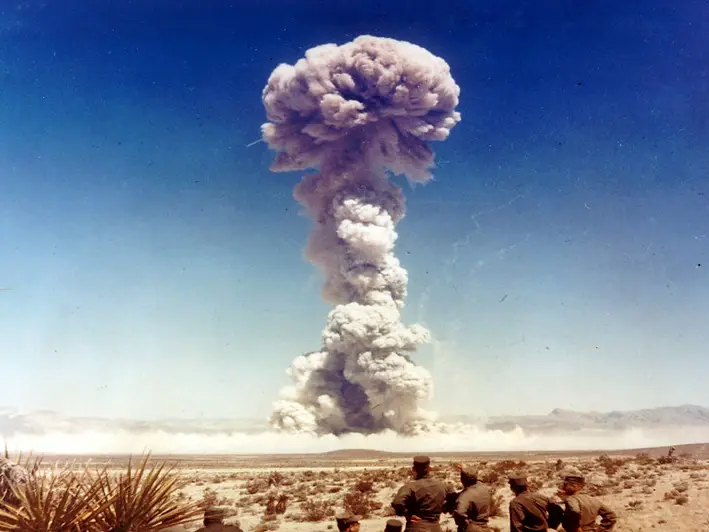
At least four million premature deaths from cancer and other diseases have been caused, affecting every single human on the planet, due to the nuclear weapons testing conducted worldwide between 1945 and 2017. A total of nine countries are known to possess nuclear weapons, including Russia, the United States, China, France, the United Kingdom, Pakistan, India, Israel and North Korea.
A new report by the humanitarian group Norwegian People’s Aid (NPA) indicates that the consequences of earlier tests continue to be felt across the globe. Reacting to the final nuclear test conducted by France in French Polynesia in 1996, a 37-year-old lawmaker, Hinamoeura Cross, from Tahiti, who was seven, said, “They poisoned us”, according to a report in AFP.
Seventeen years later, she was diagnosed with leukaemia, in a family where her grandmother, mother and aunt had already battled thyroid cancer. Nuclear detonations are known to have caused long-lasting and far-reaching damage to human health, communities and ecosystems.

The NPA report, running to more than 300 pages, says a persistent culture of secrecy, limited international involvement, and a lack of reliable data have left many affected communities still searching for answers. "Past nuclear testing continues to kill today," said NPA chief Raymond Johansen, and voiced hope that the report will "strengthen the resolve to prevent nuclear weapons from ever being tested or used again".
Watch:
The issue gains fresh relevance after Trump announces nuclear testing
Trending Stories
&im=FitAndFill=(700,400))
Meet top 5 bowlers in latest ICC T20I rankings
)
The Verdict | When precision fails: US commits war crime in Minab school strike, UN finds
)
FACT CHECK: Why did PM Modi ask Xi ‘is it okay’ at BRICS Summit? New video reveals...
)
Indian activist-lawyer Prashant Bhushan's post brings focus on ‘conflict of interest’ appointments of ex-govt officials at Reliance, Adani groups
)
Godfather of AI Geoffrey Hinton gives US lawmakers a one-year warning on AI
)
Russia holds first parliamentary elections since the beginning of the Ukraine war
)
Ukraine plans record $109 bn defence spending, nearly two thirds of budget amid Russia war
)
Three labourers killed as DU student loses control of his car, rams into them on Dwarka Expressway
)
Pyongyang dismisses US, western pressure over nuclear programme
&im=FitAndFill=(700,400))
Meet top 5 Indian batters with fastest T20I centuries
)
IIT Bombay student dies by suicide, was caught seeking AI help during exams
)
US And Denmark reach Greenland deal, Trump announces expanded military presence
)
Trump signs Russia sanctions law: India faces fresh 100% tariff threat over Russian oil
)
Pentagon revives mandatory testosterone testing for male troops aged 30 and above
)
‘Will go to any extent’: Pakistan vows to defend Saudi Arabia amid Houthi attacks
)
Trump's Greenland dream comes true? POTUS announces 'Infinite Life' deal with Denmark, claims permanent US control
)
Trump 2.0: Dark days ahead for America’s ‘imperial presidency’
)
Why Ranveer Singh’s Dhurandhar missed India’s Oscar entry; FFI jury member reveals what happened
)
India seeks to build a full semiconductor supply chain
)
Trump bans CNN, MS NOW and Politico from White House over ‘FAKE NEWS’
)
Africa is splitting, and a lot sooner than estimated, giving way to a new ocean
)
Indian Cinema bets big on mythology, brings ancient stories to modern audiences
)
Who is Khalilur Rahman? All you need to know about 81st UN General Assembly President
)
Trump signs Russia sanctions bill into law, targets Moscow’s energy sector
)
Laura Wolvaardt sets new world record for most WT20I runs in a year
)
China may have gained access to US's classified F-35 jets; parts meant for repairs diverted to Hong Kong, sparking Pentagon inquiry
&im=FitAndFill=(700,400))
New Friday OTT releases (September 18, 2026): Lust Stories 3, You+Me, Best of the Best- 8 new titles coming on Netflix, Prime Video and more
&im=FitAndFill=(700,400))
From Abhishek Sharma to Sahil Chauhan, 5 batters with fastest T20I hundreds
)
Drone strikes cooling tower at Russia's Kursk Nuclear Plant, IAEA confirms
)
Google’s Gemini AI hacks real systems by guessing passwords during security test
)
Shivakumar attends 79th Kalyana Karnataka Utsav in Kalaburagi
)
NASA research plane reaches 61,000 feet over Panama
)
Flying cars in UAE: Ras Al Khaimah signs deal with Chinese company to test new transport
)
'Gangsta' crab shoves knife blade at man and his dog in Florida - Watch
Following US President Donald Trump's announcement last November that Washington could resume nuclear testing, the issue has gained fresh relevance. In response, Ivana Hughes, a Columbia University chemistry lecturer and head of the Nuclear Age Peace Foundation, who contributed to the NPA report, said, "This is very, very, very dangerous." "The nuclear testing period shows us that the consequences are extremely long-lasting and very serious," she told AFP.
The heaviest burden of past tests has fallen on communities living near test sites, today located in 15 different countries, including many former colonies of nuclear-armed states. Survivors continue to suffer higher rates of disease, birth defects and psychological trauma, with the consequences extending far beyond the test sites. "Every person alive today carries radioactive isotopes from atmospheric testing in their bones," report co-author and University of South Carolina anthropology professor Magdalena Stawkowski told AFP.
The report said hundreds of thousands of people worldwide are already known to have died from illnesses linked to past nuclear detonations. It cited strong scientific evidence tying radiation exposure, even at low levels, to DNA damage, cancer, cardiovascular disease and inherited genetic effects.
"The risks that radiation poses are really much greater than previously thought," report co-author Tilman Ruff told AFP. Atmospheric tests conducted up to 1980 alone are projected to result in at least two million additional cancer deaths over time, Stawkowski said.
Tilman Ruff, a public health researcher at the University of Melbourne and co-founder of the International Campaign to Abolish Nuclear Weapons, the 2017 Nobel Peace Prize laureate, stated that a similar number of premature deaths from heart attacks and strokes is also expected.
Ionising radiation, particles capable of breaking DNA bonds in cells and triggering cancer, is “highly biologically damaging”, Ruff said, adding that “there is no safe threshold”. The risks vary across populations, with foetuses and young children most vulnerable, and girls and women about 52 per cent more susceptible to radiation-induced cancers than boys and men.

