

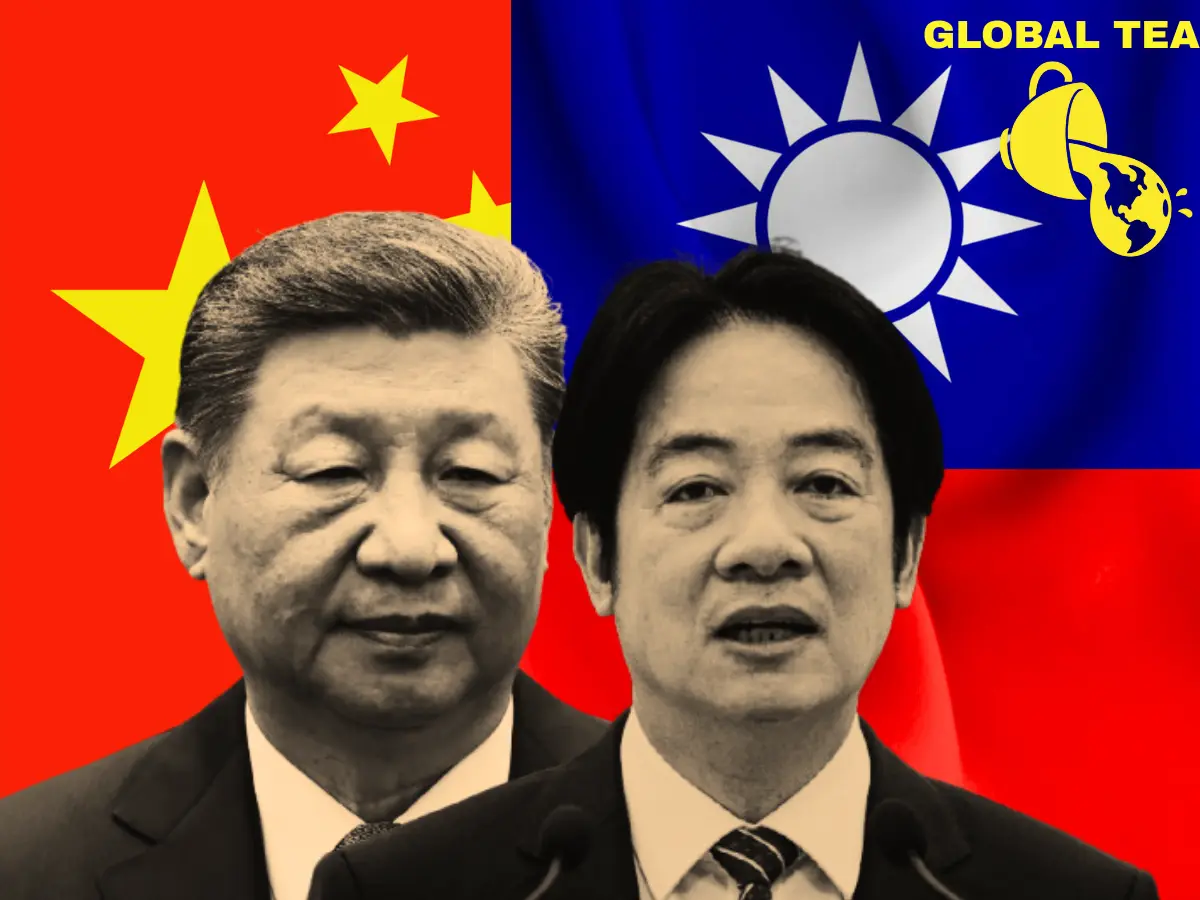
&imwidth=800&imheight=600&format=webp&quality=medium "GLOBAL TEA | China and Taiwan: World's most complicated situationship")
Editor's note: Global Tea is a series of light-hearted and informative articles on international affairs, explaining complex issues in a simple format while staying factual and accurate, aimed at our young readers.
If countries in the world had relationship status, China and Taiwan would be stuck on "It's complicated". It has been that way for over 70 years. The China-Taiwan issue is not merely a diplomatic tension. It's actually the ultimate geopolitical situationship filled with history, pride, obsession, mixed signals and the constant threat of a messy breakup.
So get ready, cos we're about to spill the tea.
The breakup that started it all
Before all the drama, China and Taiwan were married and part of one giant family - the Republic of China (ROC). This family stayed till 1949. The family tensions did not start suddenly. There were fights, accusations, and strained relationships that started in 1945 - just after World War II ended. In 1949, the Chinese Civil War ended. There were two major sides: the Communists led by Mao Zedong, and the Nationalists led by Chiang Kai-shek.
At the end of the war in December 1949, the Communists won, took over the mainland, and formed the People's Republic of China (PRC). The Nationalists, who lost, ran away to the island of Taiwan with the old government of China and formed the Republic of China (ROC).
Trending Stories
&im=FitAndFill=(700,400)&imwidth=180&imheight=135&format=webp&quality=medium)
Navratri 2026: 9 days, 9 forms of Goddess Durga and 9 colours- Check the complete list
&imwidth=180&imheight=135&format=webp&quality=medium)
Korean peninsula tensions escalate as North Korea launches multiple ballistic missiles, PACOM says 'no threat to US personnel'
&imwidth=180&imheight=135&format=webp&quality=medium)
Trump weighs firing Kimberly Guilfoyle as US ambassador to Greece amid misconduct allegations: Report
&imwidth=180&imheight=135&format=webp&quality=medium)
Anti-SIR protest in Mumbai: Protestors wear black masks & ribbons in Mumbai
&imwidth=180&imheight=135&format=webp&quality=medium)
UK PM Andy Birnham renews claims of Russian meddling in Brexit vote
&imwidth=180&imheight=135&format=webp&quality=medium)
BCCI rejects venue shift reports, India vs Sri Lanka 1st ODI to remain in Delhi
&imwidth=180&imheight=135&format=webp&quality=medium)
'Absolutely disgusting': Australia slams US plan to livestream Nidal Hasan's execution; Mike Johnson raises concerns, warns of terrorist propaganda
&imwidth=180&imheight=135&format=webp&quality=medium)
1,500 drones illuminate Mumbai sky as Cordelia Cruises unveils second ship, Cordelia Sky
&imwidth=180&imheight=135&format=webp&quality=medium)
Houthis warns US of 'painful response' if Washington joins Saudi war in Yemen as airlines suspend flights to Saudi Arabia
&imwidth=180&imheight=135&format=webp&quality=medium)
India Rejects Pakistan-China Boundary Commission, Tells Islamabad to Drop 'Theatrics' | GRAVITAS
&imwidth=180&imheight=135&format=webp&quality=medium)
Congress demands action against chief election commissioner
&imwidth=180&imheight=135&format=webp&quality=medium)
Apple HomeView smart home hub may launch soon with A18 chip, display and Siri controls: What to expect
&imwidth=180&imheight=135&format=webp&quality=medium)
'Turn approver, resign, we'll forgive you': Rahul Gandhi claims receiving messages from CEC Gyanesh Kumar
&imwidth=180&imheight=135&format=webp&quality=medium)
'I will not be silenced': Ilhan Omar alleges political intimidation after federal officers search her Washington home
&imwidth=180&imheight=135&format=webp&quality=medium)
Use AI as your ‘second brain’: Meta AI chief Alexandr Wang’s message to young people
&imwidth=180&imheight=135&format=webp&quality=medium)
Robotic surgery, advanced treatment: What is coming to this small Gujarat town?
&imwidth=180&imheight=135&format=webp&quality=medium)
Pakistan's government blames PTI for rise of terrorism in Khyber Pakhtunkhwa
&imwidth=180&imheight=135&format=webp&quality=medium)
‘This is just the start’: Maaya Rajeshwaran on historic ITF title, confidence boost and future goals
&im=FitAndFill=(700,400)&imwidth=180&imheight=135&format=webp&quality=medium)
How does a robot decide what to do next?
&imwidth=180&imheight=135&format=webp&quality=medium)
Trump says he 'may' meet North Korean leader Kim Jong Un during upcoming Asia trip
&imwidth=180&imheight=135&format=webp&quality=medium)
'Ouch!!! That must hurt': Kangana Ranaut hails Kamal Haasan's sharp reply to Elon Musk over Starlink row
&imwidth=180&imheight=135&format=webp&quality=medium)
Sidhu Moose Wala’s younger brother wins hearts by recreating late singer’s signature move at Toronto Hologram Show
&imwidth=180&imheight=135&format=webp&quality=medium)
UK school ditches technology, shifts from screen to pen and paper for learning
&imwidth=180&imheight=135&format=webp&quality=medium)
Opposition’s 10 demands in Supreme Court petition range from stay on SIR to audit of voter rolls
&imwidth=180&imheight=135&format=webp&quality=medium)
'I am thoroughly unamused': Judge slams Trump administration after 400 trees cut at Washington golf course
&imwidth=180&imheight=135&format=webp&quality=medium)
Portugal Federation confirms Cristiano Ronaldo’s return to national team despite suspension
&im=FitAndFill=(700,400)&imwidth=180&imheight=135&format=webp&quality=medium)
New OTT releases this week (October 12-18, 2026): Sacrifice, Koffee with Karan S9, Roadies Rebirth- 6 titles coming on Netflix, JioHotstar and more
&imwidth=180&imheight=135&format=webp&quality=medium)
Rishabh Pant ruled out of India A squad for New Zealand tour, Kumar Kushagra named replacement
&imwidth=180&imheight=135&format=webp&quality=medium)
India's Ajit Doval, Iran's Mohsen Rezaei hold talks amid escalating West Asia tensions, discuss 'issues of mutual interest'
&imwidth=180&imheight=135&format=webp&quality=medium)
'Almost certainly': UK Prime Minister Andy Burnham says Iran's IRGC behind RAF Fairford threat
&imwidth=180&imheight=135&format=webp&quality=medium)
Elon Musk pumps $276 million into Republican campaigns ahead of US midterm elections
There started the drama. Mainland China said, "I'm the real China". But Taiwan said, "Are you kidding? I am".
For the longest time, most of the rest of the world, like the mutual friends of a splitting couple, chose not to pick a side. These nations started recognising the “One China Policy”, with Beijing and not Taipei as the centre of China. But many of these countries still kept unofficial ties with Taiwan. It's like keeping your ex's number saved as "Pizza delivery", so no one knows.
China felt victorious, but was still not fully satisfied.
Over the years, Taiwan has had a major glow-up.
Taiwan's glow up
While China was going through famine, revolution, cultural breakdown, and Communism chaos, Taiwan was in its "focusing on myself" phase. Taiwan became everything China could only dream of: a democracy, a tech powerhouse, a global queen of semiconductor manufacturing, and a place with LGBTQ+ rights.
Now, mainland China saw this glow up and became an obsessed ex.
Why can't China just let go?
This is not only about emotions. China's obsession is strategic, historical, and deeply political.
These are the reasons China just can't move on:
1. National pride
For Beijing, Taiwan is more than just a geographical territory. It's the identity. The entire existence of the Communist Party of China is based on one promise from the people of mainland China - to restore China's "lost glory". For this mission, the party wants Taiwan back, the last remaining piece of what China believes should be part of the mainland, even if by force.
For President Xi Jinping, getting Taiwan back is not optional - it's an absolute necessity.
If he makes it possible, he would become the leader who completed China’s "unfinished mission".
2. Geographical importance
Just one look at the map, and you will understand why China is so anxious. Taiwan is right at China's southeast coast - the entrance to the strategically important South China Sea. It blocks China from accessing the deeper waters of the Pacific.
And even more importantly, Taiwan is inside the US-led First Island Chain. This chain comprises Japan → Taiwan → Philippines → Borneo.
3. Semiconductors
In this aspect, Taiwan is basically the Silicon Beyoncé of the world. The island nation, via its top companies like TSMC, accounts for 60 per cent of the global semiconductor production, or over 90 per cent of the world's advanced chips.
And keep in mind, these are not random chips. These chips run: iPhones, Teslas, AI systems, fighter jets, cloud servers and satellites, among other things. The modern world just can't function without Taiwan's chip industry.
Hence, for China, having control over Taiwan is like controlling the beating heart of global tech.
Now it's not like China had not tried its hand in the industry. Beijing has invested billions in domestic chip production. Still, it is 5-10 years behind Taiwan.
Why Taiwan isn't interested
Taiwan is living its best life. Taiwan has everything China doesn't:
1. Complete democracy:
Taiwan has free elections, multiple political parties, protests, LGBTQ rights, press freedom - the whole package. China? Absolutely opposite.
2. Progressive
Taiwan was the first ever country in Asia to legalise same-sex marriage.
3. Tech-rich
From TSMC to its EV sector to its innovation ecosystem, Taiwan punches way above its weight on the global stage. It’s the cool kid in the tech school.
4. Allergic to authoritarianism
After living for decades in a democracy, the youth in Taiwan identify as “Taiwanese,” not Chinese.” As per polls, less than 3 per cent of young Taiwanese want a reunion with China.
So, for Taiwan, China is not the "lost motherland". It's the ex who just can't stop texting.
US - the nosy friend
Think of Asia as a giant neighbourhood — and Taiwan is the house located right at the entrance of the street. If China takes that house, the whole balance of the neighbourhood shifts.
Here's why the US is interested in the whole drama:
America and its allies - Japan, South Korea, the Philippines and Australia - are part of the First Island Chain. It's a natural barrier that covers Japan, Taiwan, the Philippines and Borneo.
This chain limits China’s navy and air force movement, protects US allies, and provides US strategic depth in the Pacific. In this chain, Taiwan sits RIGHT in the middle. Therefore, if the US were not alert, China might take over Taiwan, break the whole chain, and get a straight path into the Pacific.
If China gets Taiwan, the Chinese military will reach the Second Island Chain as well. This will help China project power deeper toward Guam, a major US military base. It can threaten supply routes linking the US to Asia, pressure Japan and the Philippines, and dominate the South China Sea.
If China gets control of Taiwan, the US would no longer have access to Taiwanese chips, and it might lose access to the world’s most advanced semiconductor technology.
For the US, it’s like handing your arch-rival the master key.
Moreover, the US knows that its allies are watching. Japan, South Korea, Australia, and the Philippines - all depend on US protection.
If America fails to protect Taiwan, these allies will no longer trust the US. This simply means: more countries may drift toward China, American influence would shrink, and China could become the uncontested power in Asia.
What's Japan's role?
Imagine Japan as the quiet friend with popcorn, but also a samurai sword.
Japan’s southern islands, especially Okinawa and the Ryukyu chain, sit right next to Taiwan. This means that if China takes over Taiwan, Japan simply will become the frontline territory.
Interesting side note: The US and Japan have a security alliance. Under the deal, Japan hosts 50,000+ US troops, multiple bases, and key naval assets. This also means that the US would use Japanese bases in a China-Taiwan conflict, and Japan would likely support US forces with logistics, intelligence, missile defence, and protection of bases.
China knows this. Taiwan knows this. The whole world knows this.
So, when you zoom out, the whole China–Taiwan saga basically feels like the geopolitical version of a “will-they-won’t-they” couple that desperately needs therapy. Every week, we wake up to a new stunt, fighter jets, fiery speeches, and flexing with airspace and maritime territory violations.
And honestly, it’s giving season finale vibes, with no promise of renewal or cancellation.

