

&imwidth=800&imheight=600&format=webp&quality=medium "Global internet at risk? Iran targets subsea fiber-optic cables running under Strait of Hormuz")
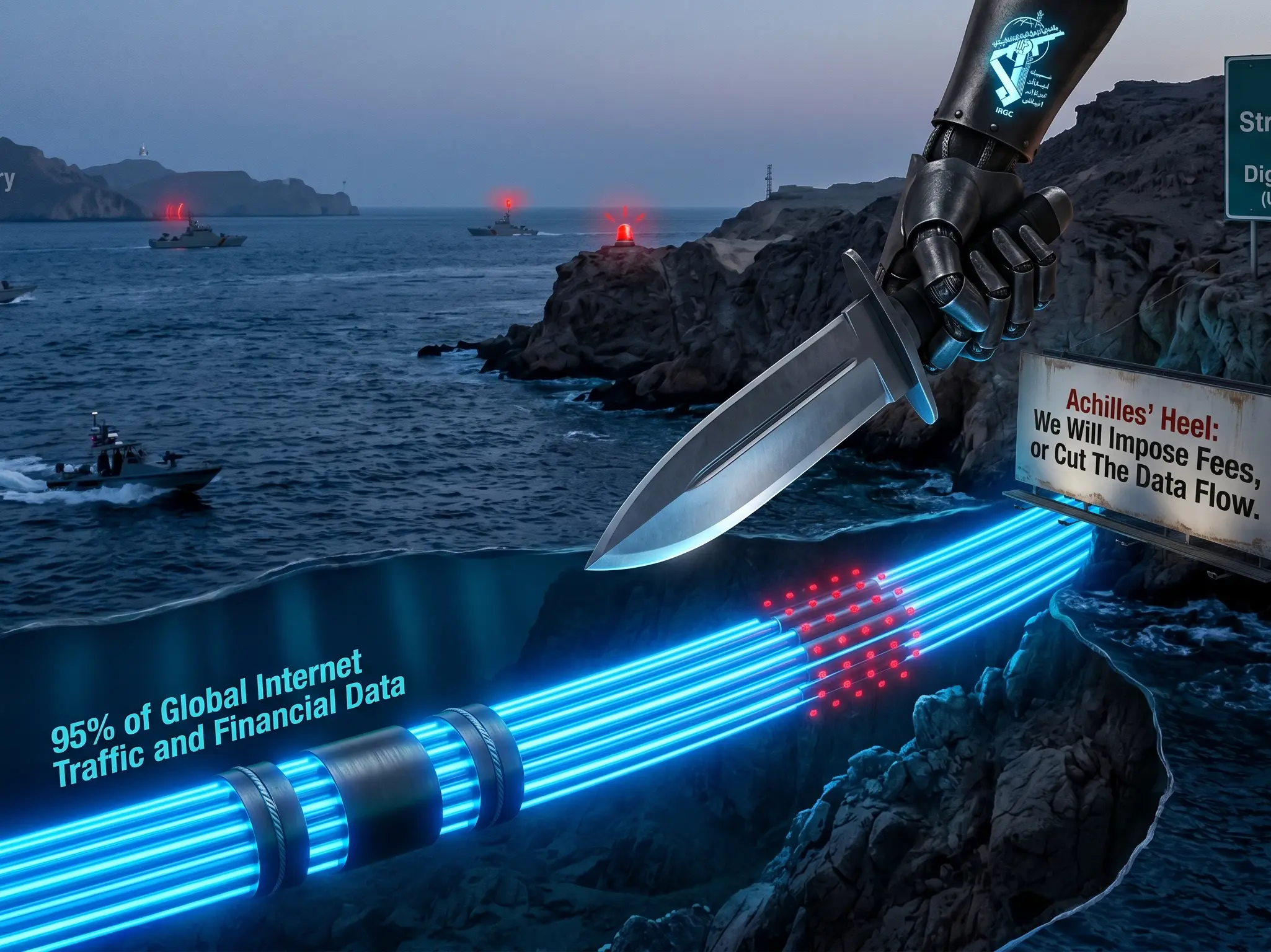
While the world is worried about oil and gas due to ongoing West Asia tension, Iran has set its eyes on another Achilles' heel, a real hidden weakness, the subsea fibre-optic cables running beneath the Strait of Hormuz. These cables carry more than 95 per cent of global internet traffic and financial data. These are not only internet cables, but also the financial transactions, military communications, AI traffic and everyday data flows that connect Europe, Asia and the Persian Gulf, which Iran wants to cut.
This concern followed after Tehran warned to impose fees on firms including Google, Microsoft, Meta and Amazon for use of the submarine cables that pass beneath the strait, according to reports from state-linked Iranian media. Last week, Iranian military spokesperson Ebrahim Zolfaghari said on the social media platform X, "We will impose fees on internet cables."
Iran's Revolutionary Guards media outlets indicated that the development would require major technology firms to comply with Iranian law. The country has demanded fees from the submarine cable operators. Maintenance and repair rights would also be handed exclusively to Iranian companies.
Why Subsea cables matter?
Subsea cables form the foundation of global digital connectivity, carrying the majority of the world's internet and data traffic. Any serious damage to them would cause more disruptions than just slower internet speeds, potentially affecting banking systems, military communications, artificial intelligence, financial trading and cross-border transactions.
Trending Stories
&imwidth=180&imheight=135&format=webp&quality=medium)
Asian Para Games: Nishad Kumar clinches T47 long jump gold; Ravi Budigina bags swimming silver
&imwidth=180&imheight=135&format=webp&quality=medium)
NFl 2026/27 - Saints vs Steelers to go ahead in Paris next week despite protest
&imwidth=180&imheight=135&format=webp&quality=medium)
US to review Russia sanctions waiver within 60 days as Rubio cites India’s ‘substantial’ Russian energy imports
&imwidth=180&imheight=135&format=webp&quality=medium)
Researchers name newly discovered Andean plant after Argentina legend Lionel Messi
&imwidth=180&imheight=135&format=webp&quality=medium)
PCB omits Atherton, Hussain from tri-series commentary panel over Imran Khan interview row
&imwidth=180&imheight=135&format=webp&quality=medium)
India moves to buy 10,000 more AI chips for a national compute pool open to startups
&imwidth=180&imheight=135&format=webp&quality=medium)
Girl 'dead' for 8 hours wakes up at her own funeral, dad insists she wasn't breathing
&imwidth=180&imheight=135&format=webp&quality=medium)
Anirudh Ravichander-Kavya Maran wedding: Telangana CM reveals Chennai reception date
&imwidth=180&imheight=135&format=webp&quality=medium)
Putin wants joint meeting with Trump-Xi summit on Ukraine war, proposes talks alongside APEC: Report
&im=FitAndFill=(700,400)&imwidth=180&imheight=135&format=webp&quality=medium)
New OTT releases this week (October 19-25, 2026): Gajab Raat to Chaar Yaar-8 titles to watch during Dussehra week on Netflix, Prime Video and more
&imwidth=180&imheight=135&format=webp&quality=medium)
'Grassroots leagues help bridge the gap': India's ODI WC winner Suresh Raina lauds ISCL ahead of Season 2
&imwidth=180&imheight=135&format=webp&quality=medium)
'We feel like Mr India': Gujarat’s undercover SHE team guard garba nights at Navratri
&imwidth=180&imheight=135&format=webp&quality=medium)
Saudi Arabia asks skyscraper employees to work from home amid Houthi threats
&imwidth=180&imheight=135&format=webp&quality=medium)
4 killed, 19 critically injured in grass fire at Canada's largest military base
&imwidth=180&imheight=135&format=webp&quality=medium)
Lawrence Bishnoi gang claims responsibility for firing at Tiger Shroff over ties to Salman Khan
&imwidth=180&imheight=135&format=webp&quality=medium)
Why France looks the most fragile in the G7 amid protests and budget deadlock
&imwidth=180&imheight=135&format=webp&quality=medium)
Priest dies after crucifix falls on his head during livestreamed Mass in Ecuador | VIDEO
&imwidth=180&imheight=135&format=webp&quality=medium)
No Ravindra Jadeja, Yashasvi Jaiswal in India’s 2027 ODI World Cup plans: Report
&imwidth=180&imheight=135&format=webp&quality=medium)
Elon Musk features on Lucknow's 'anti-India' Ravan poster alongside Rahul Gandhi, Akhilesh
&im=FitAndFill=(700,400)&imwidth=180&imheight=135&format=webp&quality=medium)
Tesla Roadster engineering: The hidden hardware behind its flying demonstration
&imwidth=180&imheight=135&format=webp&quality=medium)
Brendan Taylor overtakes Andy Flower to become Zimbabwe’s leading ODI run-scorer
&imwidth=180&imheight=135&format=webp&quality=medium)
'It's a joy to see the makers bring it on such a grand scale': SS Rajamouli on Ramayana
&imwidth=180&imheight=135&format=webp&quality=medium)
China responds to Trump's Press Secretary Katie Zacharia after toilet remark: 'Visit China more often'
&imwidth=180&imheight=135&format=webp&quality=medium)
MI5 is opening an AI threat centre, and OpenAI just told MPs the worst isn't over
&im=FitAndFill=(700,400)&imwidth=180&imheight=135&format=webp&quality=medium)
Ghaziabad is world's fastest-growing city; Surat, Patna, Rajkot also feature on list
&imwidth=180&imheight=135&format=webp&quality=medium)
Anthropic’s public benefit plan: What its 5% share commitment means for AI’s future
&imwidth=180&imheight=135&format=webp&quality=medium)
Cattle-feed bran in biscuits, detergent in milk: FSSAI acts against 3 companies
&imwidth=180&imheight=135&format=webp&quality=medium)
Flying car race: Alef Aeronautics welcomes Tesla Roadster '11 years' later, but are the two models the same?
&imwidth=180&imheight=135&format=webp&quality=medium)
Kylie Jenner makes Victoria’s Secret debut in $50 million diamond-encrusted design as Timothée Chalamet cheers
&imwidth=180&imheight=135&format=webp&quality=medium)
Shastri backs Shami comeback; lauds Bhuvi and warns Bumrah on format workload ahead of World Cup
&imwidth=180&imheight=135&format=webp&quality=medium)
After Kennedy Center and reflecting pool disputes, Trump turns to Washington golf course plan amid legal battle
&imwidth=180&imheight=135&format=webp&quality=medium)
Nobel laureate Machado, who dedicated prize to Trump, confirmed as Venezuela opposition leader
&imwidth=180&imheight=135&format=webp&quality=medium)
Karan Johar reimagines Student Of The Year with thriller series After Dark, Shanaya Kapoor to debut on OTT
&imwidth=180&imheight=135&format=webp&quality=medium)
Netanyahu rival Benny Gantz quits Israel election race, vows to push for unity government
Several major intercontinental subsea cables pass through the Strait of Hormuz. Given long-standing security concerns around Iran, international operators have historically routed most cables through a narrow corridor on the Omani side of the waterway. However, two cables, Falcon and Gulf Bridge International, pass through this water route, according to Alan Mauldin, research director at TeleGeography, a telecoms research firm.
If the route or cables are disturbed, then the consequences would be felt at a large level globally. This includes India and Iran's neighbours, where severe internet outages will be seen. The strait is also a vital digital corridor connecting major Asian data hubs such as Singapore with cable landing stations across Europe. Any disruption could trigger internet outages in parts of East Africa and significantly slow financial trading as well as cross-border transactions between Europe and Asia.
Does International Law Support Iran’s Position?
Iranian media has argued that if Iran were to impose a fee, it would align with international law, citing the 1982 United Nations Convention on the Law of the Sea (UNCLOS). Article 79 of the convention grants coastal states the authority to establish conditions for cables or pipelines entering their territory or territorial waters.
Although Iran has signed UNCLOS, it has not formally ratified it. Tehran has also pointed to Egypt as a precedent, noting that it charges transit and licensing fees for undersea cables passing through the Suez Canal. However, legal experts note that the comparison is limited, as the Suez Canal is an artificial waterway built within Egyptian territory, while the Strait of Hormuz is a natural maritime passage.

