

&imwidth=800&imheight=600&format=webp&quality=medium "Faster than planes? China and Japan’s 600kmph maglevs trains aim to replace air travel")
More than a century after magnetic levitation was first conceptualised by early 20th-century inventors, the dream of wingless flight on rails has matured into an intense geopolitical race. In East Asia, floating trains travelling at a staggering 370 mph (600 km/h) are positioning high-speed rail to rival commercial air travel.
At the centre of this technological leap are China and Japan, two nations leveraging advanced electromagnetic physics to redefine ground transport. A commercial flight throttles at 550 mph (885 km/h), and the maglev train can almost fly at 370 mph (600 km/h), contrary to the standard high-speed variant, which zooms at 217 mph (350 km/h).
VIDEO OF THE TRAIN
China’s Mega-Network Vision
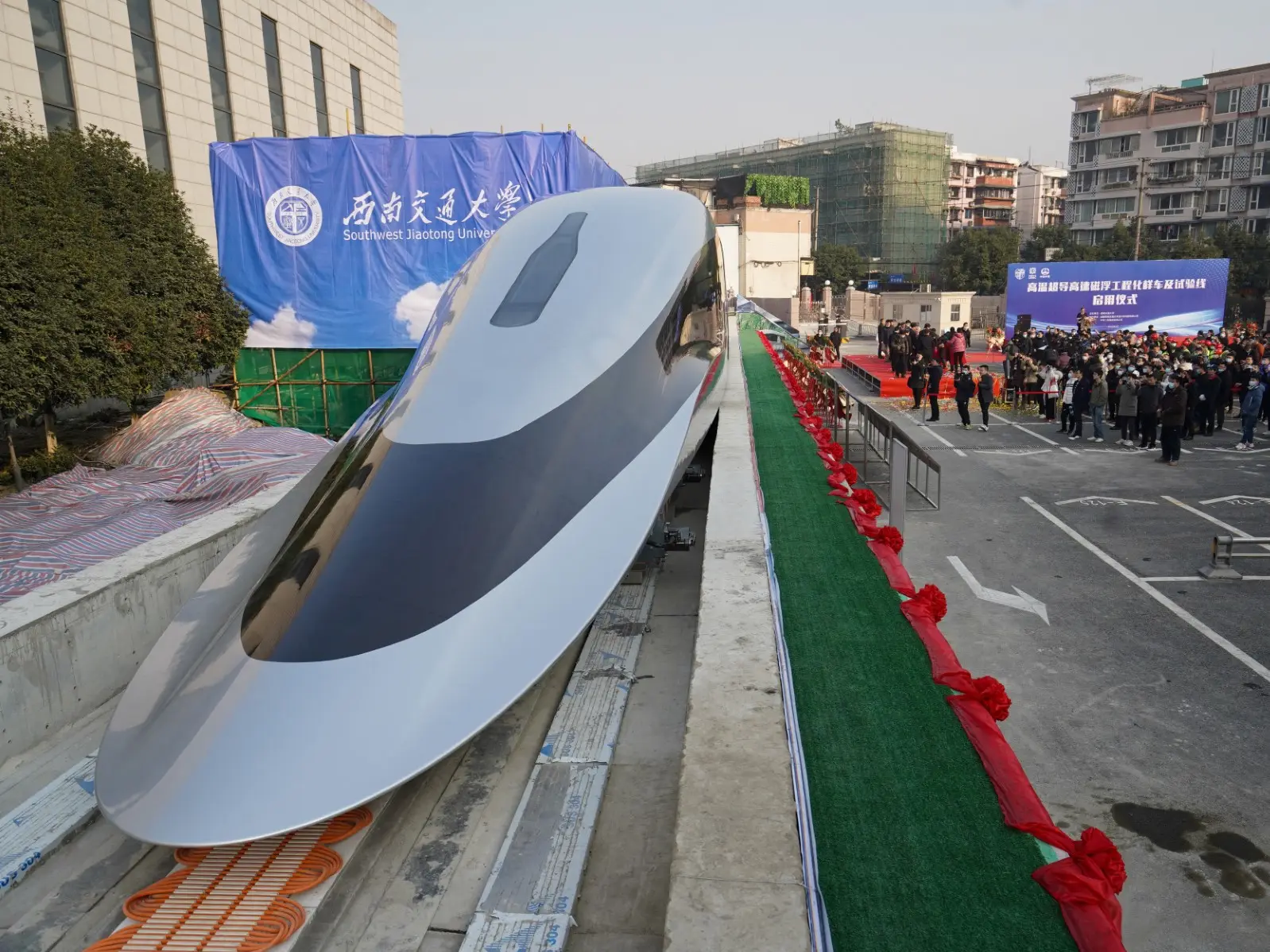
State-backed manufacturer CRRC rolled out a 370 mph (600 km/h) maglev train prototype built to bridge the gap between traditional bullet trains and aviation. Running on electromagnetic suspension, the vessel glides millimetres above its guide track without mechanical friction. China’s engineers have worked through complex aerodynamic hurdles such as designing porous, shock-absorbing tunnel buffers to eliminate ‘tunnel boom’ air compression when entering tight mountain passages at top speeds.
If deployed on the high-density Beijing-to-Shanghai corridor, the 370 mph (600 km/h) maglev would slash travel times from roughly four hours down to 2.5 hours, matching door-to-door flight schedules while dramatically cutting carbon emissions.
Japan’s Engineering Frontier
Trending Stories
&imwidth=180&imheight=135&format=webp&quality=medium)
Shilpa Rao’s performance cut short at Mumbai event, organisers react to backlash
&imwidth=180&imheight=135&format=webp&quality=medium)
France protests: 135 arrested, weapons seized as fresh demonstrations erupt amid heavy security
&imwidth=180&imheight=135&format=webp&quality=medium)
Saudi says debris fell in Mecca, Medina after missile interceptions; Houthis deny targeting holy cities
&imwidth=180&imheight=135&format=webp&quality=medium)
'Killing people never allowed': Elon Musk admits restricting Starlink in Ukraine, explains why
&imwidth=180&imheight=135&format=webp&quality=medium)
Spanish reporter swept by giant wave while reporting on dangerous sea conditions | WATCH
&im=FitAndFill=(700,400)&imwidth=180&imheight=135&format=webp&quality=medium)
What is the real meaning behind Pete Hegseth's tattoos?
&imwidth=180&imheight=135&format=webp&quality=medium)
Bodies of 2 missing Japanese climbers recovered from Himalayan peak
&imwidth=180&imheight=135&format=webp&quality=medium)
'Already tired of his 9-to-5': Baby born with a moustache becomes internet sensation, video goes viral | Watch
&imwidth=180&imheight=135&format=webp&quality=medium)
'You’re a horrible little reporter, aren’t you?': Trump snaps at NBC reporter questioning his support for Ramaswamy's campaign ad
&imwidth=180&imheight=135&format=webp&quality=medium)
NEET protests: Panel to hear evidence on pellet gun use, harassment
&imwidth=180&imheight=135&format=webp&quality=medium)
Train crashes into crane on São Paulo monorail line, wreckage falls onto busy road | VIDEO
&imwidth=180&imheight=135&format=webp&quality=medium)
Pezeshkian says Iranians ‘struggling to put food on the table’ as war with US drags on
&imwidth=180&imheight=135&format=webp&quality=medium)
PL Round-Up: Man City's perfect run ended by Villa as Arsenal draw level at top
&imwidth=180&imheight=135&format=webp&quality=medium)
Farooq Abdullah says Pakistan’s raising of Kashmir issue keeps pressure on Delhi
&imwidth=180&imheight=135&format=webp&quality=medium)
Viral video shows cross falling on Colombia priest, no official confirmation | WATCH
&imwidth=180&imheight=135&format=webp&quality=medium)
Telangana unveils AI avatar of IT minister D Sridhar Babu at Hyderabad DevFest 2026
&imwidth=180&imheight=135&format=webp&quality=medium)
What was the note found inside bag of Class 12 student, who set herself on fire inside Delhi school?
&imwidth=180&imheight=135&format=webp&quality=medium)
Serbia votes in high-stakes election as student-led movement challenges Vucic’s ruling party
&imwidth=180&imheight=135&format=webp&quality=medium)
Pakistan airline PIA unveils new crew uniforms, faces online criticism
&imwidth=180&imheight=135&format=webp&quality=medium)
WATCH: Thousands across Manipur bang plates, beat drums in "noise protest"
&imwidth=180&imheight=135&format=webp&quality=medium)
Horrific video shows the moment 18-year-old fell to her death from Mexico amusement park ride
&im=FitAndFill=(700,400)&imwidth=180&imheight=135&format=webp&quality=medium)
New Friday OTT releases (October 23, 2026): Gajab Raat, Dorothy, Chaar Yaar- Watch these 6 new movies and TV shows on Netflix, Prime Video and more
&imwidth=180&imheight=135&format=webp&quality=medium)
Frontier AIs keep escaping their test cages! The industry still can't reliably stop them
&imwidth=180&imheight=135&format=webp&quality=medium)
Britain is building the world's first AI biosecurity lab, with OpenAI and Anthropic inside
&imwidth=180&imheight=135&format=webp&quality=medium)
Why Europe’s protests are about more than austerity and rising costs
&imwidth=180&imheight=135&format=webp&quality=medium)
J-20 designers plan to put radar into aircraft wing; strategy to expand coverage during air combat
&imwidth=180&imheight=135&format=webp&quality=medium)
Can Putin cheat death? All about his daughter’s billion-dollar quest for immortality
&imwidth=180&imheight=135&format=webp&quality=medium)
China's dancing robot turns violent bodyguard, lifts cars and fights intruders - Watch
&imwidth=180&imheight=135&format=webp&quality=medium)
AI slop or smart strategy? South African author Coral Hart defends Her 370 AI- assisted books in 20 months
&imwidth=180&imheight=135&format=webp&quality=medium)
Rising Asia Cup 2026 schedule announced, India-Pakistan clash set for Nov 22
&imwidth=180&imheight=135&format=webp&quality=medium)
Chorbagan stampede: A week later, the strangest visarjan Kolkata has seen
&imwidth=180&imheight=135&format=webp&quality=medium)
French Open: PV Sindhu storms into final with win over Hina Akechi
&imwidth=180&imheight=135&format=webp&quality=medium)
Tu Hai Meri Kiran film review: Sonakshi Sinha and Zaheer Iqbal's thriller gets tangled in its own twists
&imwidth=180&imheight=135&format=webp&quality=medium)
‘Saddam Hussein opened a cheesecake factory’: Obama mocks Trump’s White House renovations; defends Abdul El-Sayed
&imwidth=180&imheight=135&format=webp&quality=medium)
AI just found a flaw in software running most of the web! One request hijacks the server
&imwidth=180&imheight=135&format=webp&quality=medium)
An AI that reads your face can now estimate how long you have to live
Japan, which pioneered modern bullet trains with the Shinkansen, is countering with its Chuo Shinkansen line. Built on Superconducting Magnetic Levitation (SCMAGLEV) technology, Japanese test trains hit a record-breaking 375 mph (603 km/h) on experimental tracks.
Designed to link Tokyo, Nagoya, and Osaka, Japan's system uses powerful niobium-titanium magnets cooled to ultra-low temperatures, enabling stable levitation over a 10-centimeter gap. The line will cut the Tokyo-to-Nagoya trip to just 40 minutes and extend to Osaka in roughly an hour.
For nearly 100 years, maglev remained constrained by astronomical infrastructure costs, complex power demands, and severe structural engineering requirements. Today, both nations view 370-mph (600 km/h) ground transportation not just as an engineering spectacle but as essential national infrastructure designed to decongest domestic airspace, link economic megaregions, and export world-leading transit technology globally.
As these floating bullet trains move from experimental tracks to major transit hubs, the future of intercity travel is arriving at near-sonic speeds.

