

&imwidth=800&imheight=600&format=webp&quality=medium "EXPLAINED: What Japan's Taiwan stance against China means for India ahead of Modi-Takaichi talks?")
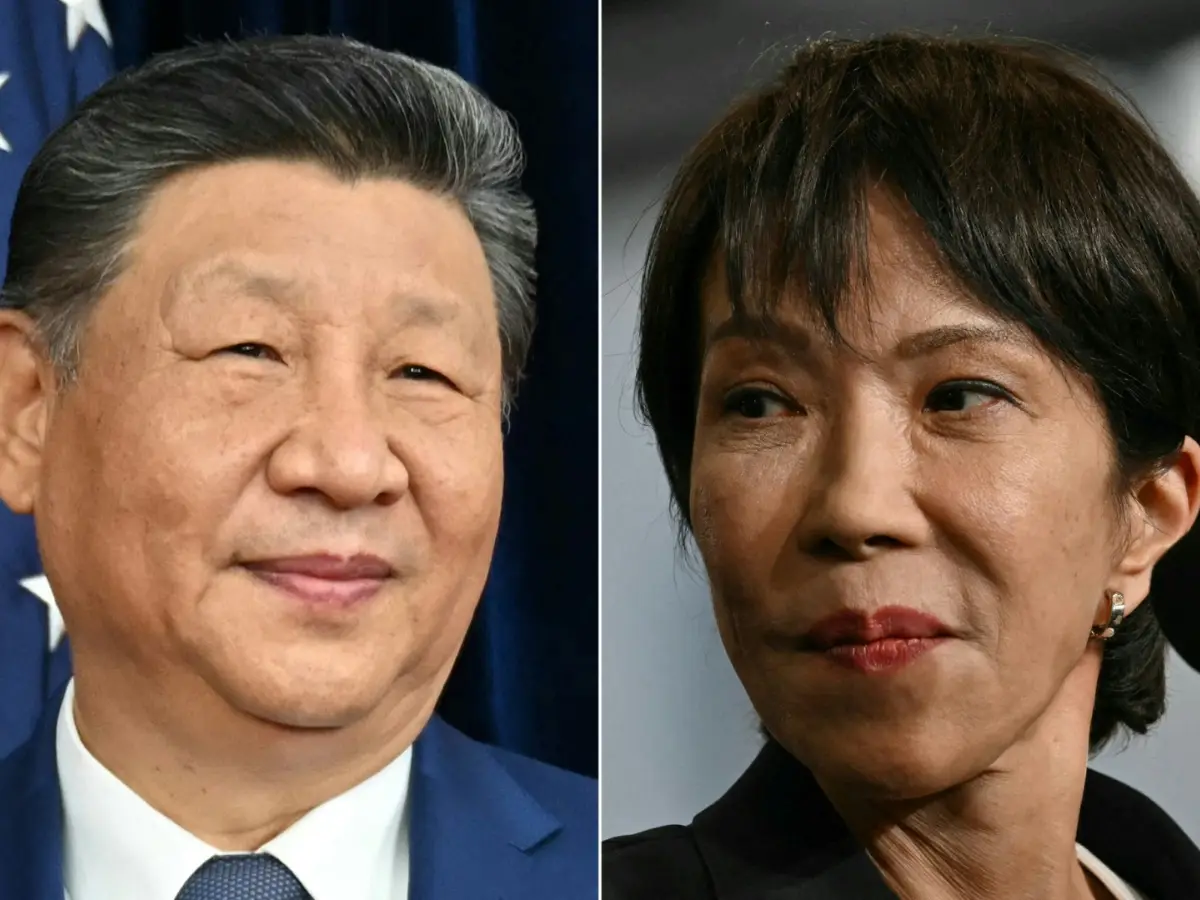
Prime Minister Takaichi, Japan's first female PM, has maintained a hawkish stance toward Beijing. The bilateral friction intensified significantly after Takaichi declared in parliament that Tokyo could hypothetically intervene militarily alongside the US in the event of a "Taiwan emergency." The development unfolded on 7 November 2025 after Takaichi gave her remark stating that an attack on Taiwan could represent “a situation threatening Japan’s survival”, a legal term that would enable Tokyo to intervene militarily in a conflict involving Taiwan.
Following her comments, a fierce reaction from Beijing followed that included bans on Japanese seafood, prompts for Chinese tourists and directing students not to visit Japan and blocks on the screening of Japanese movies in China. It resulted in military tensions, prompting a Chinese live-fire exercise in the Yellow Sea, patrolling by Beijing’s coast guard near the disputed Senkaku/Diaoyu islands and Tokyo’s deployment of missiles on the Japanese island of Yonaguni, near Taiwan.
Why does Taiwan matter to India?
However, in response to the China-Japan spat, India has not made any reaction and also has not made any statement during the brief bilateral meeting between Prime Minister Narendra Modi and Takaichi on the sidelines of the G20 summit, which was held in Johannesburg. The Institute of South Asian Studies highlighted in its research paper that the China-Japan crisis plays a vital role for India as it puts New Delhi in a sensitive position because it reflects the country’s uncertainty on key questions confronting its foreign policy in the Indo-Pacific. There are three key questions raised by the China-Japan spat to which New Delhi has no answer.
First, India faces a delicate balancing act when it comes to Taiwan and the growing rivalry between the United States and China. As tensions in the Taiwan Strait continue to rise, many countries are being pressured to take a clearer stance on Taiwan’s international status. While India has strengthened economic, technological and cultural ties with Taiwan in recent years, it has remained cautious about crossing Beijing’s red lines. New Delhi has also maintained strategic ambiguity regarding Taiwan’s status, avoiding any formal shift in policy.
Trending Stories
&im=FitAndFill=(700,400)&imwidth=180&imheight=135&format=webp&quality=medium)
Navratri 2026: 9 days, 9 forms of Goddess Durga and 9 colours- Check the complete list
&imwidth=180&imheight=135&format=webp&quality=medium)
Is America trying to ‘destabilise’ India or change its regime? How influence operations became a recurring theme in political rhetoric
&imwidth=180&imheight=135&format=webp&quality=medium)
Researchers believe AI could cure cancer patients around the world
&imwidth=180&imheight=135&format=webp&quality=medium)
US considering use of ‘mother of all bombs’ in its war with Iran: Report
&imwidth=180&imheight=135&format=webp&quality=medium)
Russian woman and Bihar boy's love story goes viral after she reaches India to marry him
&imwidth=180&imheight=135&format=webp&quality=medium)
Arijit Singh 9-city India stadium tour to start from January: Check venue and ticket prices
&imwidth=180&imheight=135&format=webp&quality=medium)
F1 set to return to Africa for first time since 1993
&imwidth=180&imheight=135&format=webp&quality=medium)
'Don't ever mess with nature!': Trump’s tiger attack post triggers social media backlash as victim's family issues heartbreaking tribute
&imwidth=180&imheight=135&format=webp&quality=medium)
Ankita Bhandari’s parents detained after overnight India Gate protest; released later: Why are they protesting
&imwidth=180&imheight=135&format=webp&quality=medium)
US judge blocks Trump administration sanctions on human rights groups supporting Gaza war crimes investigation
&imwidth=180&imheight=135&format=webp&quality=medium)
Washington calls for 'de-escalation' as Ethiopia-Eritrea tensions fuel war fears
&imwidth=180&imheight=135&format=webp&quality=medium)
US midterms: Trump rallies behind Husted as Brown mounts challenge in crucial Ohio race
&imwidth=180&imheight=135&format=webp&quality=medium)
US police foil alleged mass shooting plot targeting Illinois Hindu temple during Navratri; 19-year-old’s manifesto called Indians ‘subhumans’
&imwidth=180&imheight=135&format=webp&quality=medium)
Group of men cheered and asked 'when’s it my turn?' as woman was assaulted inside bathroom at University of Chicago frat party
&imwidth=180&imheight=135&format=webp&quality=medium)
‘Rise up, young patriots!’: American singer Mary Millben says US donors funding CJP, backs Modi govt
&imwidth=180&imheight=135&format=webp&quality=medium)
Nobel Peace Prize winner Navi Pillay calls on US to 'get back to' being defender of human rights
&imwidth=180&imheight=135&format=webp&quality=medium)
Who is Abu Dhabi royal Mahrah Al Nahyan, found unconscious on London street with toddler after cocaine use
&imwidth=180&imheight=135&format=webp&quality=medium)
Iranian woman, 23, handed death sentence for ‘blasphemy’ in social media post; appeals for help
&imwidth=180&imheight=135&format=webp&quality=medium)
'Turn approver, resign, we'll forgive you': Rahul Gandhi claims receiving messages from CEC Gyanesh Kumar
&imwidth=180&imheight=135&format=webp&quality=medium)
'Leakers should be shot': Trump rages over leak of US military plans to attack Iran, slams media
&imwidth=180&imheight=135&format=webp&quality=medium)
Bangladesh man killed after mob storms hospital, drags him away over blasphemy allegations
&imwidth=180&imheight=135&format=webp&quality=medium)
‘My president, I mean my husband’: Trump's new press secretary Katie Zacharia's first briefing goes off the rails in 14 minutes
&imwidth=180&imheight=135&format=webp&quality=medium)
Mars is not for man: Human heart is too weak to survive the trip, study shows
&imwidth=180&imheight=135&format=webp&quality=medium)
Girl 'dead' for 8 hours wakes up at her own funeral, dad insists she wasn't breathing
&imwidth=180&imheight=135&format=webp&quality=medium)
India-Afghanistan relations: Growing India-Kabul ties to rattle Islamabad?
&im=FitAndFill=(700,400)&imwidth=180&imheight=135&format=webp&quality=medium)
New OTT releases this week (October 12-18, 2026): Sacrifice, Koffee with Karan S9, Roadies Rebirth- 6 titles coming on Netflix, JioHotstar and more
&imwidth=180&imheight=135&format=webp&quality=medium)
Actor Imran Khan asked to leave India by the Mumbai Police days after participating in CJP-led protest
&imwidth=180&imheight=135&format=webp&quality=medium)
Did the US withhold missile warnings? Ukraine questions Washington's 'bad weather' explanation after Russian strikes kill six, cut power to 600,000
&imwidth=180&imheight=135&format=webp&quality=medium)
'Troubling pattern of threats': Hindu groups issue advisory after man arrested for alleged plot to target Illinois temple
&imwidth=180&imheight=135&format=webp&quality=medium)
Hidden video recording device found on Australian Navy ship amid claims of secret filming
&imwidth=180&imheight=135&format=webp&quality=medium)
'White supremacist' terror plot against Illinois Hindu temple foiled by jammed gun: Who is Alexandros Paporakis?
&imwidth=180&imheight=135&format=webp&quality=medium)
Zelensky feels betrayed by Trump, urges Musk to restore Starlink in Ukraine; Musk responds
&imwidth=180&imheight=135&format=webp&quality=medium)
'Girls are uncomfortable': Salman Khan calls out paparazzi for bad angles, speaks on PR on Koffee With Karan
&imwidth=180&imheight=135&format=webp&quality=medium)
After flydubai co-pilot attack, Air France bans Pakistani, Muslim-majority crew on Israel flights
&imwidth=180&imheight=135&format=webp&quality=medium)
Indonesia Wildfires: Thousands deployed to fight massive wildfire
&imwidth=180&imheight=135&format=webp&quality=medium)
US midterms 2026: Trump under election watch? Democrats deploy 100 observers across nine states
In the event of a military conflict over Taiwan, India is unlikely to directly intervene despite the significant economic and security implications. However, it could still be drawn into the crisis. The United States may seek logistical support or access to strategic locations such as the Andaman and Nicobar Islands, placing India in a difficult position. At the same time, China could attempt to pressure India through diplomatic threats or military actions along their disputed border, complicating New Delhi’s response, the report says.
Second, India faces a complex challenge in balancing its growing partnership with Japan and its relationship with China. Japan has become one of India’s key economic, technological and strategic partners, making the relationship increasingly important. However, India is unlikely to fully align with Japan on contentious issues such as Taiwan or the Senkaku/Diaoyu islands, which could trigger conflict with China. Supporting Japan on matters tied to Beijing’s core interests risks undoing years of efforts to stabilise India-China relations and could reignite border tensions. Ultimately, New Delhi remains undecided on whether China is a long-term adversary requiring closer strategic alignment with Japan.
Third, India’s role in the US strategy to counter China is becoming less certain. While India-US ties have partly been built on balancing Beijing, the Trump administration has adopted a more transactional and less confrontational approach toward China. Washington’s cautious stance on Taiwan and efforts to encourage de-escalation in China-Japan tensions suggest a shift in priorities. This evolving approach raises questions about how central India will remain to US efforts in the Indo-Pacific, the report further added.
Meanwhile, Japan's Prime Minister, Sanae Takaichi, is on a three-day visit for the 16th India-Japan Annual Summit from July 1-3. The External Affairs Ministry stated that the Summit will provide an opportunity for both nations to review and strengthen the full spectrum of bilateral cooperation and exchange views on regional and global issues of mutual interest.

