Explained | How Lukashenko emerged as key player to resolve Wagner situation

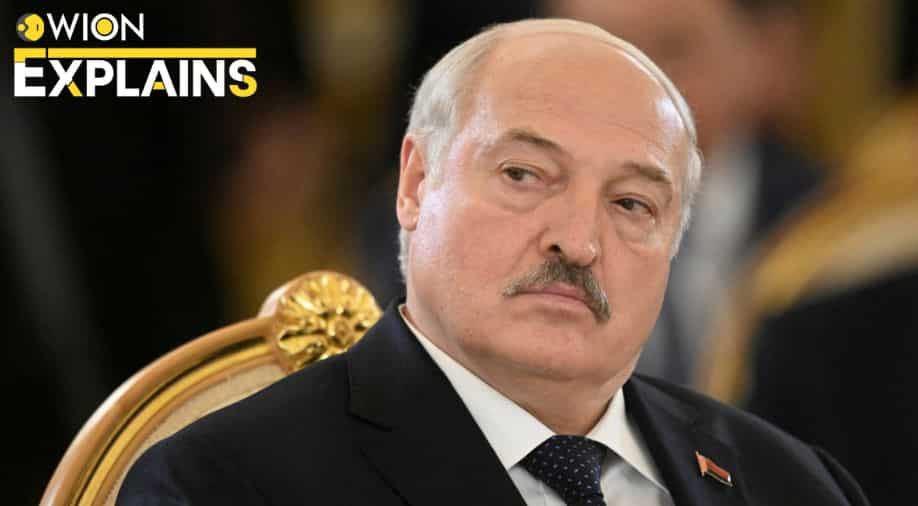
Lukashenko explained
The Wagner revolt may be over but the world has notyet stopped analysing the situation. Russia's invasion of Ukraine is in its second year and things seem to be moving slowly for both sides, atleast for now. Given the high-stakes gamble of Russian President Vladimir Putin still being played, the possibility of a coup woke up even the sleepiest of international politics enthusiasts.
While it was still unclear how the situation would develop, memories of the 1991 break-up of Soviet Russia seemed not too distant. Putin, the all-powerful strongman of Russian politics and the face of its international image, suddenly saw himself challenged by Yevgeny Prigozhin, the head of Wagner group mercenaries who have been furthering Russian strategic causes in a number of troubled regions in the world, including Ukraine.
But what seemed like the start of an all-out civil war wound up within a day as Prigozhin agreed to fly to Belarus and the Wagner army abandoned its armed march to Moscow.

The deal brokered by Belarus President Alexander Lukashenko has seen Prigozhin going into exile to Belarus. However, Prigozhin is still under investigation and the charges against him for organising armed rebellion have not been dropped, reported Russian news agencies on Monday,
The 'last dictator' of Europe
Lukashenko is the first and only president of Belarus since it broke out of Soviet Russia in 1991.
)
No Pandya as Auqib Nabi earns maiden ODI call-up; Mayank returns for WI T20Is| check full squads
)
Trump praises India’s Opium crackdown, hails anti-drug efforts
)
Sydney Sweeney defends provocative ad choice, the internet is still not impressed
)
Former India player Diana Edulji wants Smriti Mandhana to replace Harman as skipper at the earliest
)
Trump calls Canada-EU associate membership plan ‘laughable’ and threatens 'very serious tariffs'
)
Protests erupt over migrant housing plan in Piddington
)
Shahzad Bhatti Network declared terrorist organisation under UAPA: Govt order
)
Europe wants a common playbook for security threats, seeks security beyond NATO
)
240-million-year-old bizarre 'pig with a tusk' creature creates new dilemma over origin of dinosaurs
)
Formula One reveals the 2027 race calendar; Monaco to host sprint race for the first time
)
All Indian goods to get duty-free access to New Zealand
)
Bigg Boss 20: Mahhi Vij reveals she lost Yuva role to Kareena Kapoor; 'didn’t work out in my favour'
)
Lionel Messi for 2026 Ballon d’Or over Mbappe and Yamal, says Diego Simeone
)
US House votes 417-3 to pass Ratepayer Protection Act targeting AI data center electricity costs
)
Hong Kong unveils 11 new measures to boost birth rates, offers higher cash bonuses and housing perks
)
Former OpenAI researcher warns of growing risks from Artificial Intelligence
)
Veteran actor Anant Nag honoured with Indian cinema’s highest award
)
Wildfire tears through forests in Spain's Valencia
)
AUS vs SA: Steve Smith still gets 'little flashbacks' from sandpaper gate
)
Pakistan naval vessel returns to harbour with 'severe damage' after collision with Indian warship in Arabian Sea
)
Fed raises rates for first time in 3 years, Kevin Warsh defies Trump as inflation mounts
)
Katrina Kaif’s postpartum weight is not the problem; your gaze is
)
Taiwan seeks deeper India ties as direct flights restart soon and chip projects advance
)
Daayra movie review: Kareena Kapoor, Prithviraj Sukumaran shine in Meghna Gulzar’s cop-versus-cop crime thriller
)
Saudi Vs Houthis: Yemeni military rebels clash with Houthis
)
Pak batter Rizwan's petition against being questioned by cyber crime agency rejected by court
)
US trade tariff: 100% tariff targets Russian buyers amid trade tensions
)
Pakistan: Imran Khan's sons Kasim & Sulaiman claim their father is 'tortured' in jail
&im=FitAndFill=(700,400))
New OTT releases this week (September 14-20, 2026): Lust Stories 3, Waiting Hai, Irumudi- 5 new titles coming on Netflix, Prime Video and more
)
Ebola outbreak: WHO sees encouraging signs in fight against Ebola outbreak
)
Trump gets new power to hit India, China with up to 100% tariffs as US Senate clears Russia sanctions bill
)
Prime Minister Narendra Modi's birthday: Italian PM Meloni sends birthday wishes
)
‘Imagine 50 AI fighters cornering one manned jet’: India’s mobbing doctrine eyes a new era of air warm
)
Saudi vs Houthis: Riyadh claims to have shot Houthi drone targeting Mecca
)
US Treasury rallies global financial institutions for Op Economic Outcast to isolate Iran
)
India breaks silence on US Russia sanctions bill, 100% tariff threat: ‘Committed to energy security’ for 1.4 billion
)
Want to get married within a year? Why 18 lakh people rush to Jaipur for ‘sacred henna’
)
Pakistan boycotts chess match against Israel at Olympiad
)
UN General Assembly 2026: What is veto power. Which countries have it and how does it work?
&im=FitAndFill=(700,400))
Suriya and Jyothika say ‘I do’ again after 20 years! See their dreamy wedding pics
)
Abhishek Sharma rises to No. 2 in T20Is; ENG’s Robinson 3rd after record Pakistan Tests
)
The Early Spring season 2 is happening, but fans have one request - 'don't change the actors'
He has now saved Putin from a situation he had not faced since he took over Russia.
Hours after Prigozhin's declaration of a 'march' and Wagner's capture of Rostov-on-Don, a visibly angry Putin appeared on Russian television and called Wagner's rebellion 'a stab in the back'. He vowed to punish those responsible and appealed to Wagner fighters to put down weapons.
Watch | Wagner Chief Prigozhin defends decision to stage march
Russia seemed to be headed for internal war as Prigozhin said, “... no one is going to turn themselves in at the request of the president, the FSB or anyone else.”
As the verbal fight raged ontraditional and social media, Lukashenko was reportedly working behind the scenes to end this crisis.
Reportedly, hespent "the whole day" talking with the Wagner chief and "came to an agreement on the inadmissibility of unleashing a bloodbath on the territory of Russia".
Also Read | Wagner chief posts first message since mutiny, says 'march not aimed at overthrowing government'
Things between Putin and Prigzhin heated enough for any of them to climb down. There certainly was a need for an intermediary to diffuse the tension, an intermediary with good relations with bothPutin and Prigozhin. Both of them were compelled by politics to maintain a stern facade.
Lukashenko fit the requirement and Putin approved a conversation between him and Lukashenko.
"It is notable that it wasn't Putin or any of his aides that were able to negotiate [a deal] and had to let Lukashenko do that," Peter Zalmayev, director of the Eurasian Democracy Initiative, told France 24.
According to the Kremlin, Lukashenko personally offered to negotiate peace because he "has been acquainted with Mr Prigozhin for a long time, at least 20 years".
After negotiations, it was decided that Wagner soldiers who rebelled would return to fight for Russia in Ukraine.
Lukashenko was an important player with respect to Russian plans in the region already. He offered Belarus territory as a launchpad to Russia in its invasion of Ukraine. He even agreed to host Russia's tactical nuclear weapons.
Just before the Ukraine war, when Russia was increasing the presence of its armed forces near the border, observers and the Ukrainian government itself had fixed eyes on what was happening within the Belarusian border. It was considered to be a foregone conclusion that Belarus will side with Russia before and during the war which at that time, appeared an unimaginable event.
Lukashenko and Putin, the 'authoritarian bros'
Lukashenko spent years trying to keep Moscow at bay. In 2014, when Russia annexed the Crimean peninsula from Ukraine, Lukashenko even refused to consider the region as part of Russia. He stalled Russian attempts to build an airbase on one of Belarus' islands.
But come 2020, Lukashenko was in need of a strong international friend.
The elections in which Lukashenko claimed landslide victory were slammed as a sham internationally and people in Belarus held nationwide protests on a massive scale demanding Lukashenko's ouster. The president's back was against the wall.
Putin came to Lukashenko's help and flooded Belarusian streets with Russian security officials who helped authorities crack down on the protests. Media reports suggest that to counter Belarus journalists, Russia planted pro-Kremlin propagandists to create a narrative.
The 2020 protests are widely seen as an event that made Lukashenko entirely dependent on Putin to stay in power.
Lukashenko has sought to return the favour of course. A report by ABC News says that last year, Belarus gave Russia '65,000 tonnes of ammunition, about 100 Soviet-era tanks and 20 armoured vehicles'.
It is being believed that Lukashenko is pushing Belarus into Russian orbit and making it somewhat like a satellite state.
"The Kremlin will likely attempt to coerce Belarus into further integration," the US think tank, The Institute for the Study of War said earlier this year. The think tank was quoted by ABC News.
"Belarus may be pressured into more concessions under the rubric of defending … [it] from claimed Western military and terrorist threats."
Whether he has saved Russia from another breaking-up or simply repaid debt to Putin, depends on how we look at the situation. But one thing is for sure, Lukashenko has etched his name in a global political event that had the potential to spectacularly change almost all equations in the geopolitical arena.
You can now write for wionews.com and be a part of the community. Share your stories and opinions with us here.
WATCH WION LIVE HERE