Canada to become EU’s first ‘associate member’? Von der Leyen proposes move amid US tensions

&imwidth=600&imheight=450&format=webp&quality=medium "Canada to become EU’s first ‘associate member’? Von der Leyen proposes move amid US tensions")
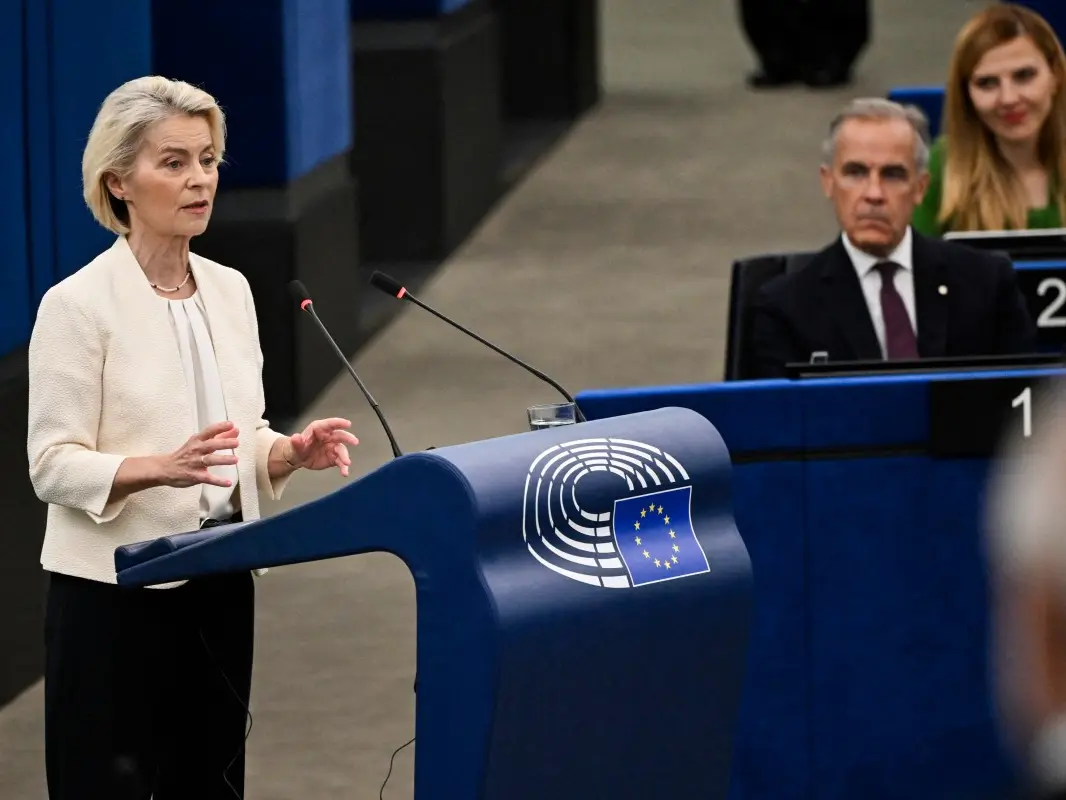
European Commission President Ursula von der Leyen delivers a speech near Canada's Prime Minister Mark Carney (2R) during her annual State of the Union address at a plenary session of the European Parliament in Strasbourg, eastern France on September 16, 2026. Photograph: (AFP)
EU chief Ursula von der Leyen has proposed Canada become the bloc’s first ‘associate member’, seeking closer ties with Ottawa amid worsening Canada-US trade tensions and shared security concerns.
The European Union is considering a new level of ties with Canada, with European Commission President Ursula von der Leyen proposing that Ottawa become the bloc’s first “associate member”. During her annual State of the Union address in Strasbourg on Wednesday (Sep 16), Von der Leyen made the offer to Canadian Prime Minister Mark Carney, saying she wanted to work towards “opening the door” for Canada.
Carney, who received a standing ovation from European lawmakers, has been pushing for a “unique alliance” with the EU as relations between Canada and the United States come under increasing strain.
Beyond trade, towards an alliance
The proposed arrangement would build on the existing Comprehensive Economic and Trade Agreement (CETA), which removes tariffs on 99 per cent of goods exports between Canada and the EU. Von der Leyen said Brussels wanted to take the relationship further.
“We will move from CETA to an Alliance for the Future to create a common prosperity and economic security space,” she said.
The expanded cooperation could cover advanced manufacturing, technology, defence production, the Arctic, energy, critical minerals, batteries, artificial intelligence, quantum computing, cybersecurity and economic security.
Trending Stories
)
)
)
)
)
)
)
)
)
)
)
)
)
)
)
)
)
)
)
)
)
)
)
&im=FitAndFill=(700,400))
)
)
)
)
)
)
)
)
)
)
)
Von der Leyen also stressed that the initiative was based on shared political values.
“Above all, dear Mark, Europe and Canada believe in democracy,” she said.
Canada-EU ties deepen amid US tensions
The proposal comes as Canada faces an intensifying trade dispute with the US. Trade talks between Ottawa and Washington collapsed last month, followed by new tariff measures. US President Donald Trump has also repeatedly spoken about Canada becoming the “51st state”, adding to tensions between the two neighbours.
Von der Leyen avoided naming Trump directly while stressing that the proposed partnership was not aimed at another country.
“This is a partnership not against anyone else, but for our common strength,” she said.
Carney is due to address the European Parliament on Thursday (Sep 17).
Security also on the agenda
Von der Leyen separately proposed a European Security Council involving partners including Canada, Norway, Ukraine and the United Kingdom.
“This is even more urgent now, given the nature and scale of the risks at play,” she said.

