Analysis: Trump, Russia and Deutsche Bank?Links that raise many, many questions

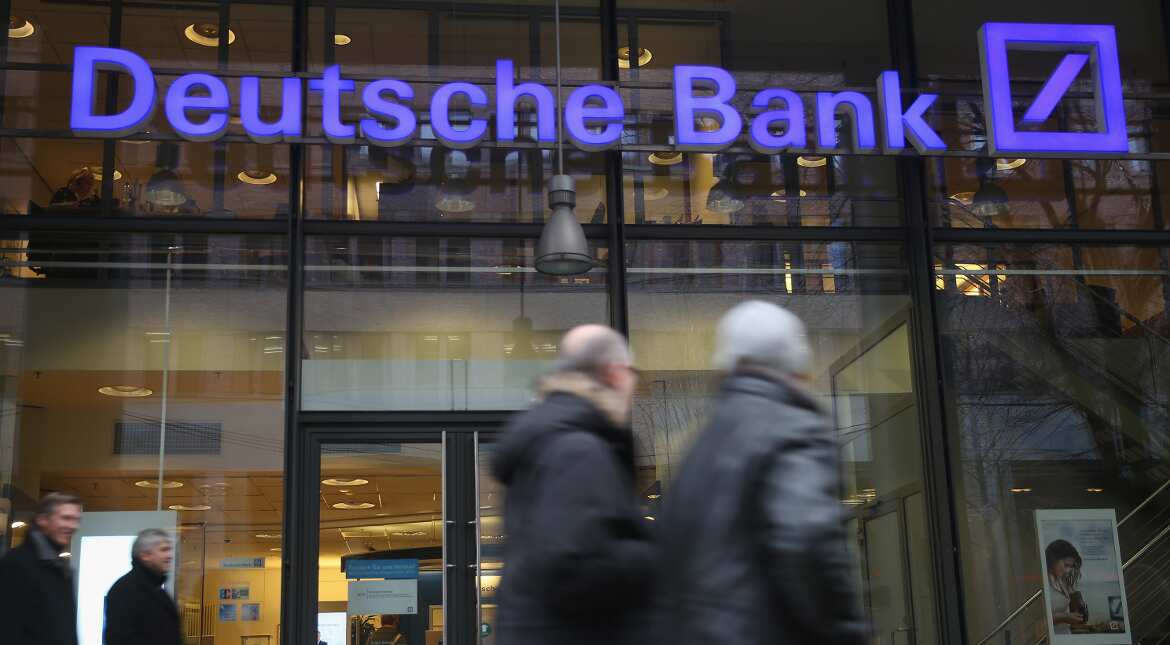
Deutsche Bank
Trump has received funding from Russia, which is now amping up war in Ukraine, and Deutsche Bank, guilty lately of major financial crimes
For a man whobrags about his wealthDonald Trump has gone to great lengths to keep his financialstatus an absolute secret. Every presidential candidate for the last 40 years has published their tax returns. Trump has refused, over and over, and he and his team have repeatedlyhis son Erik said, essentially, releasing his tax returns was inadvisable because it wouldsubject themto public scrutiny).
Donald Trump askeda foreign government to hack into an American politicians private emailson live TVbeforemillions of people during the presidential debate, but publish one page of histax returnhe threatens to sue.When nearly forced to prove his wealth, Trump has repeatedly declined.
While Trump did publish afinancial disclosure form, required by law, he made an immense lie: The document reveals that companies he owns are $300million in debt, but actually aNew York Times investigationdetermined that in reality this figure is more than twice as large, at $650 million. He is beholdento a wide range of financial backers, including ones he has criticised publicly.

Who funds Donald Trump, and what does this mean?
A brief look at his Deutsche Bank history
To understand Trump, follow the money. This is inherently difficult, because Trump goes to enormouslengths to keep his money secretdespite projectingthe image of aself-made billionaireenrichedby savvydeal-making.Really, his father was a New York real estate tycoon, handy when starting out, and for more than adecade Donald received money forputting his name on stuff other people produce.
&imwidth=180&imheight=135&format=webp&quality=medium)
100,000 strikes in 3 years: How October 7 redefined Israel's war
&im=FitAndFill=(700,400)&imwidth=180&imheight=135&format=webp&quality=medium)
Happy Birthday Rekha: Watch these 7 evergreen Bollywood hits on Netflix, Prime Video and more
&imwidth=180&imheight=135&format=webp&quality=medium)
‘Your people don’t even let us near it’: IAF chief’s blunt response on US F-35; India yet to decide on Russia’s Su-57
&imwidth=180&imheight=135&format=webp&quality=medium)
Real or fake? PIB fact-checks protest videos; Delhi Police clarifies on Gurdwara Bangla Sahib clip
&imwidth=180&imheight=135&format=webp&quality=medium)
UK navy hit by espionage scandal: Sailor accused of spying for Russia | Gravitas
&imwidth=180&imheight=135&format=webp&quality=medium)
Delhi on high alert for CJP protest: Delhi police to use body cams to 'prove whether we did anything’; Pink Force, RAF, 35,000 personnel deployed
&imwidth=180&imheight=135&format=webp&quality=medium)
‘Never-ending flow of cheap labour’: JD Vance hits back at Indian-origin Congresswoman over US green card curbs for major tech companies
&imwidth=180&imheight=135&format=webp&quality=medium)
Panama president declares ‘major disaster’ after powerful 7.7-magnitude earthquake; over 80 aftershocks recorded
&imwidth=180&imheight=135&format=webp&quality=medium)
HYBE’s Weverse Con India sets ticket sale date for March 2027 festival
&imwidth=180&imheight=135&format=webp&quality=medium)
'Jantar Mantar not the story of India': BJP's Sambit Patra claims 'anarchists' tried to hold Delhi captive
&imwidth=180&imheight=135&format=webp&quality=medium)
BJP MP Ravi Shankar Prasad slams CJP protests, calls it 'shadow boxing for AAP'
&imwidth=180&imheight=135&format=webp&quality=medium)
Riyadh airport hit in missile attack, dozens injured; 5 in intensive care
&imwidth=180&imheight=135&format=webp&quality=medium)
'Spent Rs 2,000 cr to elect Trump': Elon Musk bought US President's loyalty by writing the biggest political cheque in human history
&imwidth=180&imheight=135&format=webp&quality=medium)
Powerful 7.7 magnitude earthquake strikes Panama, tsunami warning issued
&imwidth=180&imheight=135&format=webp&quality=medium)
US mid-term elections: What are PACs - Unique American System that lets corporates shape voting
&imwidth=180&imheight=135&format=webp&quality=medium)
Elon musk & India clash over Starlink's market entry terms
&imwidth=180&imheight=135&format=webp&quality=medium)
Who is Ajinkya Shinde, announced to lead CJP protest after Dipke, Das and Ranka's detention?
&imwidth=180&imheight=135&format=webp&quality=medium)
'Ouch!!! That must hurt': Kangana Ranaut hails Kamal Haasan's sharp reply to Elon Musk over Starlink row
&imwidth=180&imheight=135&format=webp&quality=medium)
‘Right to protest must be protected, but...’: Delhi Police reveals why it denied CJP permission for October 10 Jantar Mantar protest
&imwidth=180&imheight=135&format=webp&quality=medium)
Hamas used double agents, deceived Israel to carry out October 7 massacre
&imwidth=180&imheight=135&format=webp&quality=medium)
Portugal Federation confirms Cristiano Ronaldo’s return to national team despite suspension
&imwidth=180&imheight=135&format=webp&quality=medium)
All 22 Indian seafarers safe in attack on Panama-flagged tanker off UAE coast
&imwidth=180&imheight=135&format=webp&quality=medium)
‘Time for Ukraine to get a new president’: Trump lashes out at Zelensky over Russia strikes
&im=FitAndFill=(700,400)&imwidth=180&imheight=135&format=webp&quality=medium)
Food shortages, suicide attempts and more: USS Abraham Lincoln returns to US after 321 day deployment — What happened aboard the US carrier?
&imwidth=180&imheight=135&format=webp&quality=medium)
Thai queen becomes first reigning monarch to fly jet solothailand #queen #wion
&imwidth=180&imheight=135&format=webp&quality=medium)
Four years, 3 licenses, zero launch: Why is Elon Musk’s Starlink still struggling to crack Indian market? EXPLAINED
&imwidth=180&imheight=135&format=webp&quality=medium)
Rahul Gandhi calls Modi, Shah ‘cowards’ amid CJP protest crackdown in Delhi
&imwidth=180&imheight=135&format=webp&quality=medium)
‘Every game against Liverpool is special’: Erling Haaland ahead of Anfield clash
&imwidth=180&imheight=135&format=webp&quality=medium)
Why was CJP founder Abhijeet Dipke detained? What Delhi Police said
&imwidth=180&imheight=135&format=webp&quality=medium)
Putin conveys Iran’s proposal to Trump, offers to take Tehran’s enriched uranium
&imwidth=180&imheight=135&format=webp&quality=medium)
'It’s been 12 hours': CJP writes to Delhi Police, demands release of Dipke, Saurav Das and Ranka
But what we do know abouthis financetells us important something, and puts into sharp relief the importance of what we do not know.
American banks stopped lending money to Donald Trump in the late 1980s and early '90s, around the time he declared $900 million in losses as Trump casino-related businesses keptgoing bankrupt. American banks considered him a major liability.
He was funded by Russian oligarchs, billionaires nearly overnight after seising for their own private wealththe state assets of the newly-collapsed former Soviet Union.The German Deutsche Bank also stepped in.
Last March,The Wall Street Journal reported that, just since 1998, Deutsche Bank has “led or participated in loans of at least $2.5 billion to companies affiliated with Trump,” not including one billion in loan commitments to Trump-related businesses.
Trumpgot into a large fight with Deutsche Bank when the US housing bubble burst in 2009.Trump tried to avoid paying back a$334million loan, saying the subprime mortgage crash constituted a “force majeure”, an unforeseeable catastrophe, like an act of god. He even attacked the bank,saying their lending practices played a role in the collapse--he sued themfor $3 billion in damages. The bank sued him back, saying he issueda personal guarantee that he'd pay $40 million in case his company couldn't pay them back. They were forced to negotiate.They settled, but the bank was soured on Donald Trump. "He was a persona non grata after that," said a banker who worked on the deal, the Wall Street Journal reports.
This matters, because right nowDonald Trump still owes the private arm ofDeutsche Bank roughly $300 million.And Deutsche Bank has had major problems lately.
From a November 9 Wall Street Journal post: "Right now Deutsche Bank is facing a host of tricky issues in the US, including the threatened $14 billion penalty over mortgage-bond investigations that would seriously damage the bank's capital base. There is also a probe related to equity trades for wealthy clients in Russia, a country Mr Trump appears friendly towards. The bank [Deutsche Bank]declined to comment."
On December 23, a few weeks before Trumpentered the White House,Deutsche Bank settled,managingto cutthe threatened $14 billion penalty roughly in half to$7.2 billion.
Just yesterday, Deutsche Bank was fined another $690 million for its role in a “mirror trade"scam that laundered$10 billion, illegally moving thismoney outside of Russia.
Early, still releveant cause forfear
Regarding the settlement, perhaps the outgoing Obama administration wanted to get what they could while they could,fearing that a Trump administration would be more amenable to forgive Deutsche Bank, for something else in return.
Given that we know Trump was funded for years byPutin-approved oligarchs, that his bank of choice is also connected in a major way to Russian money laundering stands out.
It's speculation, but the lack of concrete facts here isTrump's fault: The onus is on himto clear this up, which he could overnight.But given both hisscandalous refusal to publish financerecords his predecessorsconsidered par for the course,andhis absolute refusal to divest from his private business empire while serving in public office, nobody should expect suddentransparency.
The former CEO of oil giant ExxonMobilRex Tillerson, just confirmed asUS Secretary of State, worried observers because he opposed sanctions against Russia after Russia annexed Crimea, sanctions that were stopping his company from making at least one billion dollars.
Recent reasonsto worry: Trump and Igor Sechin CEO ofRosneft, Russia's state oil company
The notorious unverified dossier (adjudged serious enough that US intelligence briefed both then-President Obama and Trumpon it)allegingRussia had recorded enough material on Trump to "compromise", or blackmail, him also contained perhaps an even more important allegation:Igor Sechin, CEO of Rosneft, Russia's state oil company, offered Trump-ally Carter Page a 19 per cent stake in the $130-billioncompany in exchange for lifting US sanctions against Russia.
Page was an early Trump adviser, who "took a leave of absence" after his trip to Russia came to light. The Trump campaign denied it ever worked with him, Business Insider reports.
Regarding Russian sanctions, Trump said: If you get along and if Russia is really helping us, why would anybody have sanctions if somebody's doing some really great things?"
Just last week, in "one of its largest privatisations since the 1990s",Russia sold a 19.5per centstake in Rosneft, andbecause of thehighlyopaque structure of the dealnobody knows who bought it. Some commentators havenoticed that the19.5 per centsale looks like the 19 per cent alluded to in the unverified dossier, plus a brokerage fee.
Afew days ago, the Kremlin escalated its attack on Ukraine with apparent confidencethat the US president would not object.
Independence?
When Trump-appointed regulators dealwith Deutsche Bank, will theyadvancethe interests of the United States or the Trump Organization? Ditto for Trump and Russia.
Donald Trumpcampaigned on being an indepedently wealthy candidate unbeholden tointerests. But he is keeping very large and important secrets. Just as he once was considered byDeutsche Bank, if he were to disclose what is really going on, many currentsupporters would likely change their mindand also consider Trumpa"persona non grata".
(WION)