

&imwidth=800&imheight=600&format=webp&quality=medium "A single B-52 bomber can carry 70,000 pounds of bombs! Here's what that actually looks like")
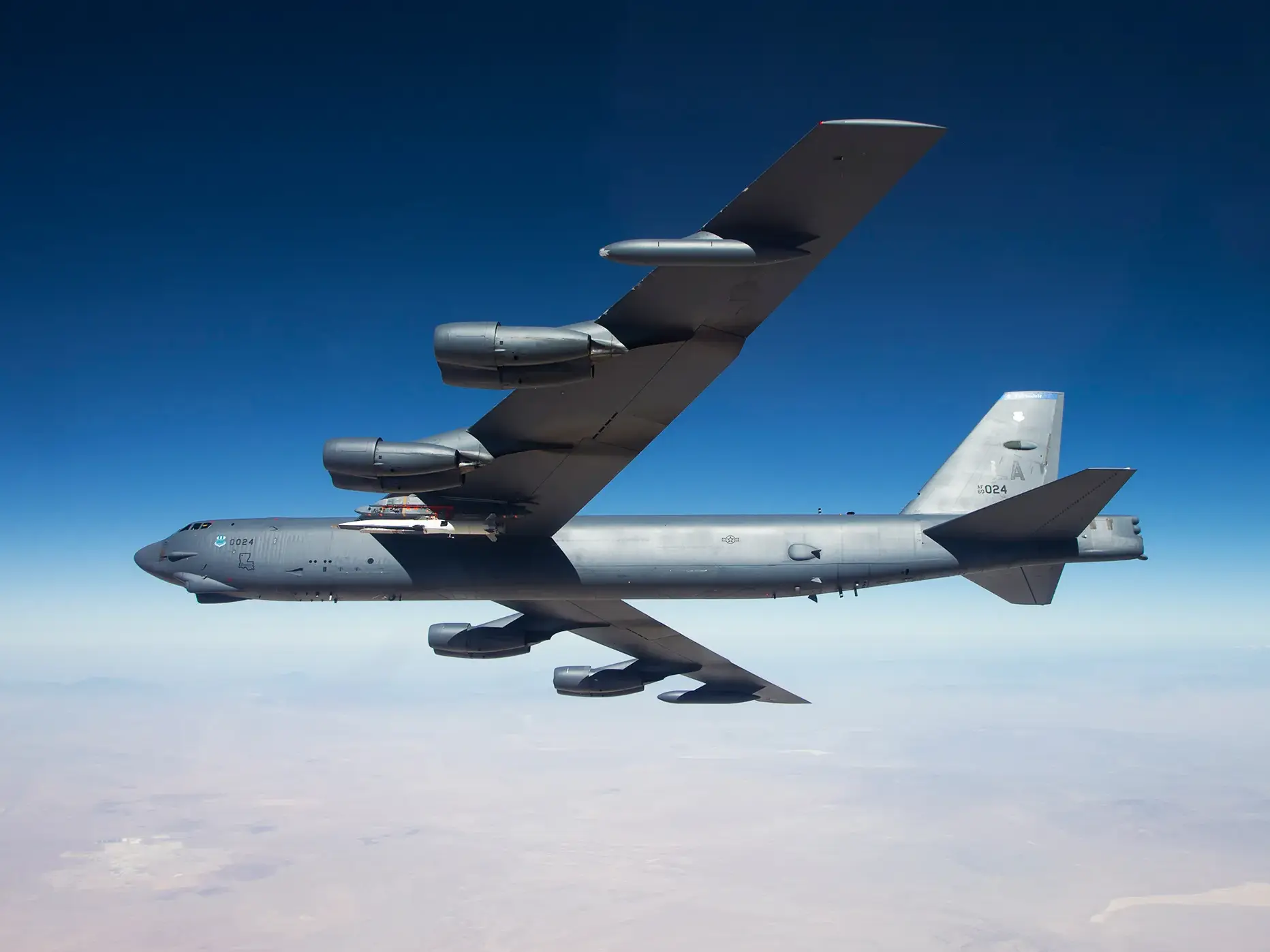
When military specifications say the B-52 can carry a 70,000-pound weapons payload, the number is easy to read and difficult to visualise. Seventy thousand pounds is 32,000 kilograms. It is roughly the weight of eight fully loaded SUVs. It is more than what many commercial cargo aircraft carry. And the B-52 can carry that weight in explosive ordnance across more than 14,000 kilometres without refuelling. Understanding what that payload actually consists of and the sheer variety of weapons a single B-52 can deliver — is what makes the aircraft unlike anything else in any air force on Earth.
The Internal Bomb Bay
The B-52's bomb bay runs through the lower centre of the fuselage and can hold a rotary launcher or conventional bomb racks. It was originally designed to carry free-fall nuclear weapons during the Cold War. Today, the internal bay can hold a rotary launcher loaded with AGM-86 Air-Launched Cruise Missiles — the same weapon used in Operation Secret Squirrel to open the Gulf War. It can also carry GPS-guided Joint Direct Attack Munitions, known as JDAMs, which are conventional bombs fitted with satellite-guidance tail kits that allow them to strike targets with precision from high altitude.
The Underwing Pylons
In addition to the internal bomb bay, the B-52 has multiple hardpoints under its massive 185-foot wings. These external pylons can carry additional cruise missiles, conventional bombs, precision-guided munitions, and in more recent years, experimental weapons including hypersonic test vehicles. The combination of internal and external carriage gives the B-52 a total weapons capacity that no other operational bomber in any country's inventory can match.
Nuclear Capability
Trending Stories
&imwidth=180&imheight=135&format=webp&quality=medium)
US-Iran war: Bibi, Trump gamble on new Iran war to save themselves in polls
&imwidth=180&imheight=135&format=webp&quality=medium)
US midterms 2026: What polls and prediction markets indicate about Congress
&imwidth=180&imheight=135&format=webp&quality=medium)
EU probes Booking.com under Digital Services Act
&imwidth=180&imheight=135&format=webp&quality=medium)
Feds obtain DNA evidence that could prove Ilhan Omar married her brother: Report
&imwidth=180&imheight=135&format=webp&quality=medium)
Meta slapped with $25 billion fine in New Mexico over Facebook data practices, company plans appeal
&imwidth=180&imheight=135&format=webp&quality=medium)
Pakistan signs another defence pact even as Makkah Alliance shows no teeth. This time, it's with Qatar, Indonesia, Turkey
&imwidth=180&imheight=135&format=webp&quality=medium)
Viral video shows cross falling on Colombia priest, no official confirmation | WATCH
&imwidth=180&imheight=135&format=webp&quality=medium)
Priyanka Chopra celebrates Dussehra 2026 with Nick Jonas and daughter Malti Marie | See pics
&imwidth=180&imheight=135&format=webp&quality=medium)
China's dancing robot turns violent bodyguard, lifts cars and fights intruders - Watch
&im=FitAndFill=(700,400)&imwidth=180&imheight=135&format=webp&quality=medium)
New OTT releases this week (October 19-25, 2026): Gajab Raat to Chaar Yaar-8 titles to watch during Dussehra week on Netflix, Prime Video and more
&imwidth=180&imheight=135&format=webp&quality=medium)
16-foot doomsday fish in Chile triggers fears that the next earthquake is coming
&imwidth=180&imheight=135&format=webp&quality=medium)
Will Rohit and Kohli play ODI World Cup 2027? BCCI president Manhas says board 'not in a position to comment'
&imwidth=180&imheight=135&format=webp&quality=medium)
Australia police arrest former national 100m champ Jake Doran for alleged child abuse
&imwidth=180&imheight=135&format=webp&quality=medium)
Ranbir Kapoor apologises for Dussehra speech slip, clarifies remark at Ramayana event
&imwidth=180&imheight=135&format=webp&quality=medium)
From Agni-V to Project Kusha: How are India’s indigenous missile systems and defence shield reshaping modern warfare
&imwidth=180&imheight=135&format=webp&quality=medium)
US Midterms 2026 and money: From Bloomberg to Musk, corporate donors, super PACs and lobbies, it's all about the cash
&imwidth=180&imheight=135&format=webp&quality=medium)
WATCH | Mysterious haze grips Ohio city as toxic chemical leak forces mass evacuation – What is happening?
&imwidth=180&imheight=135&format=webp&quality=medium)
US midterms 2026: Trump's approval rating hits record low as Democrats gain ground
&imwidth=180&imheight=135&format=webp&quality=medium)
Kolkata airport: CISF detects ₹1.13 crore in US dollars hidden in bags of 2 Bangkok-bound passengers
&imwidth=180&imheight=135&format=webp&quality=medium)
'Gyanu must go': CJP's Saurav Das, Ashutosh Ranka after release, despite Jantar Mantar protest undertaking
&imwidth=180&imheight=135&format=webp&quality=medium)
Finance influencer dies by suicide in Chennai; father accuses tech CEO, who denies charge
&imwidth=180&imheight=135&format=webp&quality=medium)
'Bombed the Vidhana Soudha': Bihar man arrested over AI-generated Bengaluru blast video; netizens slam 'zero freedom of speech' | Watch
&imwidth=180&imheight=135&format=webp&quality=medium)
Why websites around the world are suddenly going offline? What you need to know about PHP
&imwidth=180&imheight=135&format=webp&quality=medium)
Rafale Marine fighter begins flight trials in Goa ahead of Indian Navy induction
&imwidth=180&imheight=135&format=webp&quality=medium)
'You are a dummy, you are a stupid person': Trump loses temper with CNN, ABC reporters after questions about Russia sanctions
&imwidth=180&imheight=135&format=webp&quality=medium)
1 killed, several injured in attack on Saudi Arabia's King Fahd airport
&imwidth=180&imheight=135&format=webp&quality=medium)
Hunger makes alcohol more appealing, study finds
&imwidth=180&imheight=135&format=webp&quality=medium)
Kim Jong Un death rumors explode | China accused of secretly sending troops to Pyongyang
&imwidth=180&imheight=135&format=webp&quality=medium)
WATCH: Woman IPS officer fires several rounds of AK-47, ignites debate online
&imwidth=180&imheight=135&format=webp&quality=medium)
Are the US and Israel preparing for another major attack on Iran? Here's what report claims
&imwidth=180&imheight=135&format=webp&quality=medium)
'Father of all bombs' vs 'mother of all bombs': Iran threatens US with new weapon as Trump hints at MOAB strike
&imwidth=180&imheight=135&format=webp&quality=medium)
‘I caution the president...’: Trump’s ex-press secretary warns after Zacharia’s exit
The B-52H remains one of the three legs of the United States' nuclear triad, the combination of land-based intercontinental ballistic missiles, submarine-launched ballistic missiles, and bomber-delivered nuclear weapons that forms the backbone of American nuclear deterrence. The B-52 is certified to carry B61 nuclear gravity bombs as well as nuclear-tipped cruise missiles. When a B-52 is deployed on a nuclear alert mission, the aircraft and its payload represent a level of destructive capability that is measured in megatons.
Sea Mines, Conventional Bombs, And Hypersonics
The B-52's versatility goes beyond nuclear and precision-guided weapons. It has been used to deploy naval sea mines, flying over ocean areas and dropping mines that sink to the seabed to deny enemy ships passage. It has carried massive conventional bomb loads in every American conflict from Vietnam onward. And it has served as the primary testbed for experimental hypersonic weapons, including the AGM-183 Air-Launched Rapid Response Weapon programme, which uses the B-52 as a launch platform for missiles that travel at speeds exceeding Mach 5.
One Aircraft, Every Mission
No other bomber in service anywhere in the world can switch between nuclear deterrence, conventional carpet bombing, precision-guided strikes, cruise missile launches, sea mine deployment, and hypersonic weapons testing, all from the same airframe. That is what 70,000 pounds of payload capacity actually means in practice: not just a large number, but the ability to be a different weapon system on every sortie, depending on what is loaded into the bomb bay and bolted under the wings.
